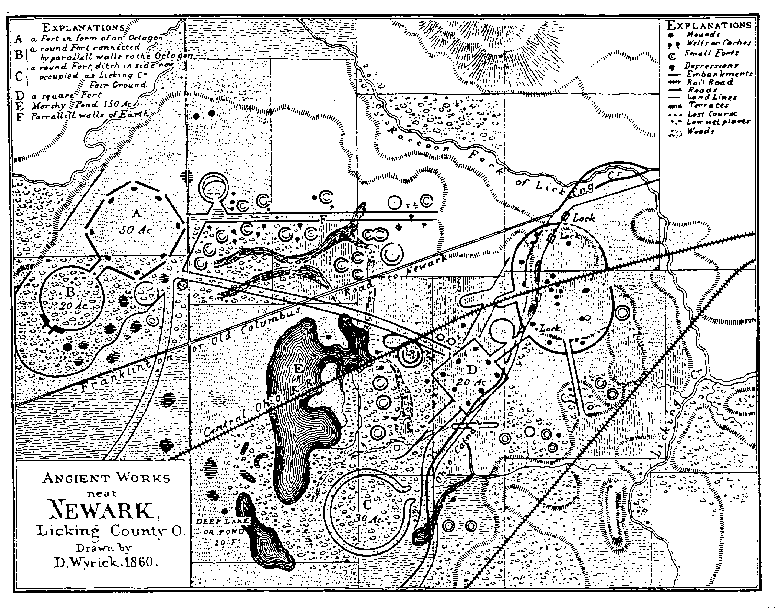
Monday, February 21, 2011

Knapsack 2-24

Notes From My Knapsack 2-24-11

Jeff Gill

Twelve Years Old in Granville – 1871

___

Bluebell knew that some thought her name was a bit odd, but it was
the only one she'd ever had, so it sounded right to her.

Her father was a doctor up past Mary Ann Furnace along Rocky Fork
Creek, down to Hanover and back, riding along the trails through open
valleys and into rocky gorges towards the Knox County line. Mother
died so long ago she could hardly remember her face, and recently
Father had sent her to board at the "Lower Sem," which is what people
hereabouts called the Granville Female College. That distinguished it
from the "Upper Sem," or the Young Ladies Institute, where Dr.
Shepardson led a fine institution, but Dr. Kerr was much beloved by
all of his students as a teacher and leader.

Bluebell would not quite be old enough for the Lower Sem ordinarily,
but she was old beyond her years, after becoming mother hen to so
many younger girls in the wilds of Rocky Fork – part of why her
father wanted to give her back a bit of her childhood in the best way
he knew how. She stayed in the boarding house across the street, next
to the old post-road inn on Broadway, looking out her window at night
to the four story building on the north side of the street, where so
many marvels of the wider world were brought before her.

On weekends, she went to the other side of town to stay with cousins
who had a lovely house and a spare room, but she rather enjoyed the
boarding house during the week. The older girls of thirteen and
fourteen and more looked out for her, taught her how to sew up small
rents in her skirts and other fine little skills she had never
mastered; in return, she told them about how best to tickle a fish
out of a hollow in the creekbank into your hands, and that an osage
orange would keep spiders out of the wardrobe they shared.

Today, a special treat for all the young ladies was the visit of Miss
Hartwell. Bluebell thought how marvelous it was that she was exactly
twice her own age, twenty-four years old, mature yet still so young.
Not yet married, but having graduated from this very school, she had
gone on to teach, in Granville as she had in Jersey Township, and now
in Danville, Illinois, but back to visit family in Hebron, Luray, and
here in Granville.

She was an honored guest of the Lower Sem not as a successful
teacher, though she was, but as a published author. Not just in the
Newark Advocate or North American, but in national publications like
Frank Leslie's Illustrated, "Golden Hours," "Hearth and Home," and
Lippincott's had shown an interest in her work. She had even been
paid for work, Miss Hartwell told them with a smile, before it was
completed!

As a schoolgirl, Bluebell could hardly imagine that.

During the reception after Miss Hartwell's address to the young
ladies, Bluebell had pressed forward to shake the author's hand,
hoping some of that success might, in a way, rub off onto her. She
found herself invited to a chair, where her story was gently drawn
out by the guest, asking for an account of how one so young came to
be there. It was clear that Miss Hartwell understood much of
Bluebell's story without even asking, but she asked about the oddest
details…and even drew out a small notebook, in which, with a pencil,
she noted a number of things as they spoke.

[Mary Hartwell Catherwood married in 1877, and published a book that
became a nationwide best-seller in 1882, titled "Rocky Fork," tracing
the mundane adventures of a young girl named Bluebell, from her
valley home to a town west of Newark named Sharon that is
unmistakably Granville.]

Wednesday, February 16, 2011

Faith Works 2-19

Faith Works 2-19-11

Jeff Gill


The Law of Unintended Consequences

___


In dealing with human persons, when you try to make them do a certain thing, even a good or better choice (maybe even especially then), they have a tendency to shoot off in an unexpected direction.


Under the umbrella of policy and politics, that phenomenon is known as "the law of unintended consequences." Trying to get people to do what you want them to do doesn't always work out the way you think.


One reason for this is that the decision makers and rule creators often are already doing the thing they want to see others do, and so assume that a small disincentive is all it takes to nudge people their way . . . since obviously, everyone would want to live the way they do, and those who don't are simply misinformed or wrongly influenced by some external factor.


What results isn't what's expected because human creatures are much more complicated than that. In faith circles generally and Christianity in particular, we call it sin, but we don't always try to empathize, to think from within the decisions and behaviors, often for fear that this will appear to be "giving in" to sin or excusing it. Call it "sympathy for the devil," as Mr. Jagger did, and church people tend to shy away.


But here's what happens when you don't try to share your good news, in a specific area, without trying to imagine what people are actually thinking from the inside. Not long ago, Ohio passed with great righteousness, a "DUI license plate" law which gives some folks yellow vehicle tags with red lettering  (nice touch, the scarlet letters). The idea was: if you see other people having to wear this mark of shame on the roads, others will then be less likely to drive drunk.


I've read conflicting studies on the outcome so far of that law, but the unintended consequence has been that, in certain circles, the plates have become a badge of honor. Some in law enforcement quietly worry that getting the yellow plates has become a goal for some.


Ditto the perfectly reasonable consequence for an assortment of offenses of withdrawing driver's licenses. It makes sense, and I really don't want to argue against it, but traffic cops tell me in some areas, when you pull over vehicles, as many as two out of three have some kind of issue with their license (none, canceled, suspended) or registration . . . or an outstanding warrant.


That's not two of three of all drivers on the road, but when around two-thirds of those you pull over are in that situation, you have to wonder in general. So how's that "suspended license" thing working out?


Which brings me to a pair of stories this week, unrelated in essence, but closely tied in how I read the law of unintended consequences applying. One was a suggestion that we "drug test" recipients of public assistance. Gosh, on one level, that sounds so reasonable. I can hear lots of good, upstanding citizens thinking, at home with their coffee on a Saturday morning, "Why not?"


The other is the move by a county school district to effectively ban sweets and sugary treats in the classroom. Food allergy issues were raised, but they're actually a very small element in the outline and impact of this plan. The point is to help kids make better choices about food, allow parents to control their kids' caloric and nutritional intake, and promote healthy eating.


One is proposed, the other about to be implemented, and both, I believe, assume that a nudge will cause most people to shift behaviors in a better direction. Both, I believe, are seriously misguided and are likely to cause . . . unintended consequences. I think both plans show a clear lack of consideration of why people make the choices they do, and how to motivate people to want to make better choices.


In faith community discussions, mission-minded activity should always start with trying to understand the population you're trying to reach, on their terms. Only then can you truly enter their world and offer clearly the message you feel called to carry.


Why do people struggling economically choose to spend precious resources on drugs (or alcohol, or cigarettes, both legal but costly choices)? Why do parents send sugary snacks to school for their children and their classmates? Hint on the latter: it's not for the sugar, it's usually the simplest and easiest and most popular choice. On the former: let's think about it, shall we? Before we nod approvingly at a policy option that could create more problems than it solves.


Jeff Gill is a writer, storyteller, and supply preacher around central Ohio; yes, he sent cupcakes to school for his son's birthday in years past - lock him up now. Tell him your nutritional sins at knapsack77@gmail.com or follow Knapsack @Twitter.

Thursday, February 10, 2011

Faith Works 2-12

Faith Works 2-12-11

Jeff Gill


We Live In a Haunted Landscape

___


We live in a haunted landscape, that much is certainly true.


Near where my family lives, I often hear the weeping of pioneer mother Lilly Jones, who will not live to see her three children, including a newborn, grow to adulthood as life fades from her body.


Just yards from where I work on weekdays, her second (of three) gravesites calls to my mind her four brothers and a cousin, standing not far from the rough-hewn square platted out for a courthouse in a county not yet formed.


And I feel the warmth of her smile quite regularly, as I pass her third and last burial location, gazing down on the passing cars near (where her father and mother are buried as well), marveling at the ease with which I slip into a grocery store filled with wonders from around the world.


It may just be me, but I can sense her presence.


There is that Courthouse Square, with watching faces of stone telling grimly serious jokes about our county's past, lips barely moving but the wit apparent to all who have ears to hear.


I can spot shadowy figures, known from old black and white photos, shading into the doorways of today with ethnic restaurants and modern businesses in full color, but their long dead hopes and dreams putting the chiaroscuro into the street scenes.


And yes, I've walked with others who marked a path from a century ago, a journey of terror and sorrow, and then got to gently trace the heartlines back to a birthplace, and a last resting place for one who died on a downtown Newark corner. Should his shade still be here, or there? He walked alongside of me in both places.


We live in a landscape haunted by names we know, and also by the works of a people whose name for themselves we cannot recover, whose individuality largely comes down over thousands of years to one object, found in the last century – today, the Wray figurine has a human face below the hood of bearskin which looks at me often, and whispers . . . something. He knows what the earthworks are for, and he's willing to tell.


I'm still trying to make it out, just what he's saying.


And of course there are steeples and buildings, churches still used for worship and some repurposed, in which pastors preached and deacons served and a living Word called across the ages. Some names we know – Father Lamy, Rev. McCarty, Dr. Fiers – many more we know not, but their imprint is far beyond cornerstones and congregational histories.


In the pews, faithful worshipers are hearing, in the words of the Christian New Testament, "a great cloud of witnesses," our parents and grandparents and great-grandparents, for some of us spiritually only, but no less our ancestors. There are hymns that, wherever I hear them sung, whomever I'm worshiping with, I can hear my grandmother's high clear soprano singing out over the top of the melody.


No, really – I hear her, quite distinctly, gone these thirty years and more.


Then we come to the table, the altar, the Lord's Supper, the communion, the Eucharist. "This do in remembrance of me," said someone who died, and yet lives. We see him not, then suddenly, "in the breaking of the bread," he is visible, present, alive.


We live in a haunted landscape, absolutely.


Ghosts?


I'll leave that subject to the marketing department. There's money to be made and thrills to be evoked on call, as scheduled, for individuals and tours by arrangement (bring your own equipment for recording or photography).


But that's not the kind of haunted I'm talking about, or the spirit that can truly bind a community together. There's a spirit of connection, of common purpose & history, of communication, that has nothing to do with digital temperature readouts or resistance meters -- but it's real and vital and necessary, and perhaps most importantly, it's the results that can be measured, not the experience itself.


It is, however, very real. Maybe even more real than . . . what we call reality.


Jeff Gill is a writer, storyteller, and supply preacher around central Ohio; tell him your local ghost story (careful, he's a skeptic, but you wouldn't know it) at knapsack77@gmail.com or follow Knapsack @Twitter.

Sunday, February 06, 2011

Knapsack 2-10-11

Twelve Years Old in Granville -- Granville Sentinel 2-10-11

Jeff Gill

[This is eighth in a series of twelve stories based on historic fact,
or known small details, about life in this area from the point of
view of a twelve year old.]

Some 2000 Years Ago

She had watched as closely as she could, but it was still a puzzle.

Her mother had set up the loom under the tree where the well-worn
branch showed, in two polished patches of bark, that they were not
the first of their people to set up their weaving here.

They had spent the last few weeks with the fibers, dried after their
removal from the proper plants which were themselves pulled out of
the marshy ground. In large circles, sitting cross-legged on the
hard packed clay surrounding the fire hearths, they had hand rolled
the fibers of thistle and milkweed stems into longer cordage.

The smaller, younger girls had rolled pieces together between their
palms like a daub of riverbank clay turned into a worm, but now
compressing and straining until the tubes became strands – then they
passed those bits on to the older women, who with nary a smile would
roll them between their work hardened hands and along their thighs,
and in no time see those strands become strings.

When the strings were spun into long fiber (by some amazing work done
by women with longer fingernails, dangling spindle weights, and
skills the younger girls despaired of ever matching), it was then
passed around the circle to the beginning again, where the littlest
young women rolled it up onto clay cylinders until a fat ball of
cordage was the result.

Some of that cordage had been woven into a multi-strand rope that
made up the sides of the loom that now hung down from the tree
branch, and other stretches of it had been taken to the fire camp,
where larger pots sat ready with water and nut shells or berries. The
girls of her age had been sent down yesterday to the creekbed, where
they gathered up fist-sized rocks that were hard and dense, not the
stone which easily scraped down into sand, and those stones were now
in the big fire.

Older women with longer arms (and some of whom already had scorched
eyebrows) took pairs of green sticks with small forks on the end, and
lifted the rocks to where they could gently place them in the pots.
After a short time of cooking the dyes with the water, the rolls of
fiber would be placed into them, coming out sometimes with colors you
couldn't always predict. She had just learned yesterday that it was
bright yellow-green hickory nut coats that made the best black dye.

Now the challenge was to master the rhythm of the snake stick,
flashing it back and forth between the vertical strands, tapping down
with the lightning stick to firm up the horizontals from above.

Her mother was making a beautiful pattern, one that echoed the story
of their clan, colors contrasting and marching back and forth among
the more stolid background, like the tale of the people across the
face of the earth, like the weaving of the sun and moon across the
sky and through the year.

She was just working with a solid color, trying to make a sturdy
piece of rough cloth that could cover a baby (maybe even hers in a
few years, absurd though that might seem), or just a panel for a
shirt or pair of trousers.

It looked so easy as her mother worked, and she kept saying "It was
hard for me at first, dear" as she worked her weaving up from her lap
into the air above her head.

The weave was loose, and the ends of sections of fiber hung at odd
intervals, but slowly, row by row, the small loom filled out in the
shadow of the larger one. She would get better.

[There is little fiber found in the ground from the period of Native
American life in Ohio called "Hopewell," but from impressions left in
clay surfaces, and a precious few scraps preserved by contact with
copper, we know their weaving technology was quite skilled, to the
extent of making fine fabrics.]

Thursday, January 27, 2011

Faith Works 2-5

Faith Works 2-5-11

Jeff Gill


A Cult You Might Be a Member Of

___


It's been a while since I wrote about cults.


I feel about cults and their influence much as C.S. Lewis did about Satan and all his works: you can actually spend too much time talking about them and help their cause more than your own.


How much is too much? Almost any amount can be, mused Lewis, after which he wrote a whole book showing how our world looks from the point of view of a senior demon, who was advising (or let's say "preparing") a junior nephew in the dark arts of temptation.


Consistency is the hobgoblin of little minds, said Emerson, so in the shadows of those two older and wiser eminences, I will venture into the murky waters of cult influence.


There is a cult that can't be said to be growing in pervasiveness, since it's been around for a very long time – some might say as long as time itself. Most of us know that this is a sad, shabby, false belief system, and look down on those we perceive as having gotten tangled up in it . . . and there are precious few of us who aren't actually members of the cult whether we know it or not.


(And most of those who are emphatically not "in" let themselves be defined almost entirely by their not being in it, which means the cult oddly controls even their lives.)


What is this malevolent, destructive, subversive cabal? Oh, you ask like you don't know.


It is: the Cult of the Next Thing.


There. I said it out loud.


The Cult of the Next Thing has infiltrated every church, mosque, synagogue, cathedral, praise barn, or rental hall where a congregation gathers. The Cult of the Next Thing is weaving its ever clutching tendrils through every denominational structure there is, whatever the faith.


The Cult of the Next Thing whispers sibilantly into your ear "things will be better as soon as the Next Thing comes along." When you start to suspect you need to be moving along yourself, because everything where you currently worship, where you practice your faith, is getting kind of old and stale and over-familiar, the voice of the Cult of the Next Thing says seductively to you "when you find the Next Thing, everything will be different."


The object of worship in this world-dominating cult, the Next Thing, is always almost here, nearly ready, just about perfect. It just requires that you let go of what you've known, and usually those people you've gotten close to (or been irritated by), and move on to get just a little closer to the promise of . . . the Next Thing, which will fix everything.


The Next Thing is easier, cooler, smarter but also simpler, more effective (or will be once the kinks get worked out), shinier, has fewer calories, and whitens your teeth while slimming your figure. The Next Thing gets you more in tune with God without actually having to listen closely or strain or wait for a deeper understanding, because the Next Thing IS a deeper understanding just by being what it is.


And by moving to the Next Thing, you show your taste and discernment by so doing, as opposed to all those still stuck on the last thing, whatever that was. I forget.


On the other hand, there's this fellow who said that the Kingdom of God was not the next thing, but is within you. If you move on to the next thing, you really aren't any further away from the Kingdom, but just by making that shift you didn't automatically get any closer to it.


When you start getting habituated, not to say addicted, to the experience of the shift, the move, the transition to the next thing, that can – itself – actually block your approach to what's been within you all along.


Perhaps the true worship you need to find is best located not by going back, nor by moving on yet again (in tools or techniques, which church or discipline, whatever), but by stopping where you are, with all the flaws and problems there so painfully apparent all around you. Stop, and reflect, and look at your own role in creating an atmosphere of thankful praise in your heart.


You might be surprised by what happens next.


Jeff Gill is a writer, storyteller, and supply preacher around central Ohio; he's fallen into a few cultic traps himself. Tell him about your experience of the Next Thing at knapsack77@gmail.com, or follow Knapsack @Twitter.

Wednesday, January 26, 2011

Faith Works 1-29

Faith Works 1-29-11

Jeff Gill


Ministerial Education Is Changing (Again)

___


For most Christian denominations, a seminary degree is the baseline credential for ordained ministry.


A seminary is effectively a graduate program, a master's degree beyond a bachelor's, or college degree. In living memory (but just barely), a seminary or "divinity" degree was a B.D., a "bachelor of divinity" such as Oxford and Cambridge in England still grant, but both across the pond and here it was a graduate degree in the sense that you had to have earned your Bachelor of Arts (B.A.) or Bachelor of Science (B.S.) to enroll.


So to reduce confusion the degree has become known in the last fifty years as an M.Div., for the Latinate "magister divinitatis" or Master of Divinity.  Divinity is, when it's not a very nice egg white based dessert, an archaic term for pastoral theology – the practical study of applied theology in preaching, pastoral care, sacramental theology, and ethics. If that sounds like more than your average master's program, you're right.


A master of divinity has long been 90-100 credit hours to earn, plus an oral defense and/or a thesis paper. Most academic master's programs are 32 to 50 credit hours, in part because they're a high-level overview of a particular field, usually leading to the more intensive doctorate, or Ph.D. program. But the standard "ordination track" degree of M.Div. is a kind of unique creature all its own, not quite a doctorate, but well beyond a basic college diploma.


Like any graduate education, though, it ain't cheap. Or isn't.


I could go over all the woes and complications of having significant student loan debt built up, and then going into a professional field that have average pay rates lower than any other (less than teachers & social workers, let alone administrators & lawyers & doctors, even worse when you compare by amount of education & experience), but the truth is you know all that.


The question getting asked with varying degrees of insight and compassion across the country is: but why?


Why, that is, do we need each gathered congregation to have a graduate-level trained person with a professional certification & institutional oversight, when you just need someone to get up and say a few words on Sunday and go visit a few sick people occasionally, plus read a funeral service out of a book once in a while?


[I'll pause so all the ordained clergy reading this can pause to catch their breath from either weeping uncontrollably or laughing maniacally.]


The problem is, it's not that simple, and never has been. True, the historic roots of "a well ordered and educated clergy" are in the days when you were a day's ride on horseback from the next pastor of your tradition, you had (maybe) a Greek New Testament along with your KJV Bible, and a commentary or two, and a book of printed sermons from an honored preacher of your denomination. Along with the doctor (if there was one) you were the best educated person in town, almost without fail, and when there was no schoolteacher you usually filled in until the next one could be found.


Stipulated: those days are gone. But what cars and interstates and the internet haven't changed is that if someone asks you a pointed theological question in an ER at 3 am, or while standing by a graveside at high noon, you can't often say "What a good question that is; let me go home and look some answers up and I'll e-mail you later."


And you may be able to pass off pre-digested messages out of the gunny sacks of LaHaye and Lucado and Warren and Schuller, maybe even re-purposed as your own, but after a while the least literate of your flock is going to notice that the teaching and tendencies of your preaching is swinging around the compass, like an unanchored ship at high tide in shifting winds.


There's a place & a purpose for seminary trained clergy, even if practically speaking that may not be every pulpit in every church building every Sunday. Meanwhile, church bodies have to accountable to the congregations, who may observe that if credentialed clergy are no better bets for good behavior and solid teaching than a guy off the street, why pay the premium?


Seminary training & ministerial certification are being radically reworked literally as we speak (so to speak). If you hear a conversation going on near you, jump in. We need everyone thinking and working on this challenge.


Jeff Gill is a writer, storyteller, and supply preacher around central Ohio; he's a "magister divinitatis" himself but always thought he should have gotten a B.S. degree. Tell him about your training in ministry at knapsack77@gmail.com or follow Knapsack @Twitter.

Friday, January 21, 2011

Knapsack 1-27

Twelve Years Old In Granville -- Granville Sentinel 1-27-11

[This is one of a series of stories I'm offering over the next few
months, telling stories based on historic details from the viewpoint
of a twelve year old in that time and place. I hope they promote
some reading out loud, a little sharing of family stories, and maybe
even a bit more digging into history by children & their parents.]


About 2000 Years Ago

This was the first year he had been allowed to come to the men's camp
where the special, sacred blades were made.

When his father had solemnly affirmed that twelve laps of the sun
across the eastern horizon had passed since his birth, the other men
of their village had gathered around to place their hands on his head
and shoulders, and sung their song over him.

When they came to the special spot, men of the other families
connected to this valley were already present, bending the sapling
poles and weaving the mats to set up the workshop.

It was the young boy's first time here, rather than further up into
the hills where the women and small children stayed during the
regular trip back to the ceremonial grounds. Almost exactly halfway
between the watercourse to their south, and the sudden lift of the
hills to the north, they had been coming to this place before his
father's and his father's father's days.

In a few more years, he might join the parties that traveled west,
beyond the wide river there, across three more great streams, and
almost to the Great River to which all of these waters ran. There
they would find the source of the smooth, grey, milky flint from
which they carefully shaped the bladelets for this place of preparation.

Likewise, if the years were good to him, he might find himself
walking just a short distance to the east, through the squeeze where
the creek bent around the bluff that reached the closest into their
valley, and so into the open land where the great shapes were laid out.

Father had explained how the wisdom of the sun's motions, and the
mysteries of the moon's both shorter and longer cycles, was
considered and consulted through these enclosures, and the healers
and singers who had their own set locations in the arrangement. The
boy understood little of it, for now, but knew as he sat through the
nights listening to the singers of his own clan, more would be made
clear, just as your eyes adjusted to see easily on a full moon night
even after a bright sunny day.

Today's clear weather helped him as he picked carefully at the dirt,
gathering up all the debris from the making of the bladelets from the
distant flint source, and laying it on a deerhide which would then be
taken to the trash pit nearby. These fragments could cut your feet,
but would never be simply cast aside as some of their local flint
would be back at the hunting and cooking camp.

So much to learn, but so many to teach him; not only his father, but
uncles and uncles unknown who came to greet them as family, here in
the preparation camp.

What would the next week be like, here in this place with so many
memories for all of his family, men and women, adults and children
alike? He did not know, but he was sure it would be wonderful.

With the discarded flint flakes all in a tidy heap, old single edged
bits, a few broken spear points and a worn down spokeshave, he
carried it all over to what he knew now was the proper spot, and did
his part with a prayer in his heart.

From the earth it came, and to the earth, returned as a blessing.

[Near Cherry Valley Road, south of Newark-Granville Road, a series of
archaeological sites revealed concentrations of Wyandotte chert, a
flint from southern Indiana used in the Hopewell period of Native
American earthwork building. Little is known for certain about the
material's significance to the users, or its use.]

Thursday, January 20, 2011

Faith Works 1-22-11
Jeff Gill

Dialogue, By Any Other Name, Would Sound As Sweet
___


Back in seminary, studying for my preparation for ministry, one of my mentors and professors then is now “general secretary” of the National Council of Churches of Christ in the USA (www.ncccusa.org), aka the National Council of Churches, or plain old NCC.

Then and now Michael was interested in ecumenism, the field of building bridges and connections between various Christian denominations – a subject related to, but different from interfaith discussions, which would be between Christians, Jews, Muslims, Buddhists, etc.

In constructing ecumenical dialogues, Michael taught and preached over and over something that has always stuck with me (and hope it’s what he wanted to stick with us): when you are truly trying to maintain dialogue, you engage with the best of the tradition you are addressing. If you are focusing on weak spots, as you perceive them; if your discussions tend to always gravitate quickly to the areas where you find their doctrine or structures or practices to be deficient, you’re not having a dialogue, you’re trying to win a debate. And the response, on both sides, will be to retreat into the mutual fortresses of apologetics.

This is not the same as saying you never talk about the tough stuff, or that you can’t disagree with a dialogue partner; what happens, though, when you look for the strengths of the other side’s position, and open by discussing what you value and why of their own way, it does two things.

First, it creates no little pressure for the responding party (even if they were ready to rip into your flaws) to do the same, and secondly the most worthwhile part of the discussion comes from your own (on each side) reflection on the often unique way the dialogue partner has honored who you are. Very often, in these sorts of discussion, the reaction is “we never thought about our own approach in that way: wow!” (Or a more distinguished phrasing of “wow!”)

I had the chance recently to preach for a congregation whose denominational practice is infant baptism, and I spoke about what is valuable, from my viewpoint, about the primacy of God’s role and proper subordination of the role of our “choice” in baptism as a means of grace, both in remembering your own baptismal status, and how that informs your witnessing of baptisms in worship again and again through your life – and I made it clear I come from and still affirm what’s called a “believer’s baptism” practice of my own Christian tradition, where a decision for Christ, confession of faith, and full immersion are the norm.

It was fascinating to hear from folks, after the sermon, who said they had not considered the significance of their own baptism as God’s gracious act more than something our choice, or our parents’ choice, did for us in our lives. They had heard those words, but knowing that they were hearing this appreciation from someone who, as a pastor, could ruefully note that “believer’s baptism” can turn into works-righteousness if we’re not careful: that made aspects of their baptismal practices jump out into sharper and clearer contrast.

Mind you, I still don’t choose to do infant baptisms (traditions like mine do baby dedications, and then what many churches call confirmation becomes a baptismal preparation or “pastor’s class”); in the same manner, I prefer weekly communion, while respecting how some churches make a very special worship experience out of less frequent reception of the bread and wine; likewise, I’m not ready to see myself under the authority of the Bishop of Rome, Archbishop of Canterbury, or any other local person with a funny hat, yet I am all too aware of how chaotic and counterproductive a purely congregational approach to ministry & evangelism can be. And so one.

There’s something about Dr. Kinnamon’s call to engage with the best of a tradition that you are standing against that is very effective, and not just for a rhetorical version of “cheap grace” and easy, inoffensive agreement. I could throw out cheap shots about baptizing anyone and everyone including the village cat, misbehaving cardinals from the Inquisition to the internet, or run down denominational structures both hither AND yon.

Which just begs those parties to snarl and start dissecting my own numerous sins and trespasses.

Will we find a new culture of civility? Standing before the Great White Throne, alongside the glassy sea, near the river shaded by trees whose leaves are for the healing of the nations – we’ll find it there, I’m sure. Short of the Kingdom of God, I’m not so certain. If we do find some islands of civil discourse, I think they’ll start with an approach very like a healthy ecumenical discussion, where we begin not with where our distinguished colleague is an idiot or a Nazi or a (insert party label here), but with an opening consideration of the areas where we think our good friend and dialogue partner, who is sadly if mildly mistaken on a number of subjects, has made some excellent points.

Come, let us reason together.

Jeff Gill is a writer, storyteller, and supply preacher around central Ohio; he’s won a few debates that he might have done well to lose. Make your points to him at knapsack77@gmail.com, or follow Knapsack @Twitter.

Tuesday, January 11, 2011

Faith Works 1-15

Faith Works 1-15-11

Jeff Gill


Just Listen to That

__


With some business on the Newark campus of The Ohio State University, I was walking through the Reese Center and then the Warner Center, and had a few minutes in each to just stand, and wait, and watch.


There were probably a few students and staff who walked by me without phones, but they didn't stand out. The dominant experience was the vaguely Doppler-effect sound of one half of a conversation increasing in volume and clarity as the bent-armed walked came past me, then faded into the next passage or doorway . . . quickly replaced by the next.


This is not to say that every electronic conversationalist was moving along, and indifferent to nearby listeners. Even with temperatures flirting with single digits, some hovered outside around a corner for a motivation I can only put down to a desire for privacy, unless they just had a thing for frostbite. But they were keeping themselves warm with energetic talk.


My work done there, I got into my car and heading back towards downtown Newark along Granville Street, into the Five Points and down to Courthouse Square. Now that I'm thinking about it, I can't help but notice, at each intersection, and even oncoming traffic – it's something like two out of three drivers, if not a bit more in sum, holding a phone up to their ear while driving (I think) with their other hand.


It's amazing when you consider it from the viewpoint of the last few centuries, where like the World's Greatest Salesperson in the World, we used to have to carry our bulky dial phones over our shoulders on broad leather harnesses. But our signal strength was never what his seems to be.


Right, I'm kidding. We used to carry a dime in our Boy Scout first aid kit so we could make an emergency phone call from a booth (kids, don't even ask).  I saw my first Motorola cell phone in 1977 and thought it was the coolest, sleekest thing – looked like a slimmed down, streamlined sewing machine, and weighed about as much, just without the cabinet.


Today, everyone: the guy in the beat-up pick-up ahead of you at the stop light, the coatless student sitting on a picnic table, the woman behind you in the express check-out, everyone has a cell phone, a smart phone, a connection, and they're all on the line (ha!) with someone, constantly.


Which is why we are communicating so well these days.


What do you mean, am I joking? Of course not, we're communicating at a frantic clip, words pouring forth, piling up, rising into the ether and erupting from devices in our hands or clipped around our ears. And that's why we all understand each other better, get along so well, work together so smoothly in groups and as families, and everything is cupcakes and puppies and unicorns, right? (Mmmm, cupcakes.)


I had piled up a bunch of Biblical citations I wanted to use here: Mt. 6:7, Eccl. 5:2, et cetera, et cetera, but you can look those up for yourself. What I want to say is simply a good word for . . . silence.


Winter is a fine time for a silent retreat, or just a day chosen to intentionally NOT speak. Maybe even a couple if you can pull it off.


"Is there enough silence for the word to be heard?" asked T.S. Eliot. For those who wonder how silence can speak, who hear about silent retreats and consider it wasted time, I can only ask "how's all our talking working out for us?"


One shouldn't talk on a phone while driving, let alone texting; beyond that, I have no interest in joining a general effort decrying phones and the internet and blogs and tweets, and there are many of them out there if I wanted to sign up.  I'm really not sure they do much harm.


I just don't think they represent much communication, either, and I want to point that obvious point out to everyone. We're talking to each other more than ever, but we are losing our opportunities for, and perhaps our appreciation of, silence. I think we all need a little, perhaps some more than others, but everyone a bit, like iodine in our salt.


Find some silence for yourself before we head back into spring, and Lent, and sports, and the 2012 political prospects. Write a list, and don't call your spouse from the canned vegetables aisle. Walk out and listen to the snow fall, and hit the ground.


Did you know that you can hear that, if you listen?


Jeff Gill is a writer, storyteller, and supply preacher around central Ohio; he knows that preachers like silence more than most people would think! Quietly send e-mail this week to knapsack77@gmail.com, or follow Knapsack @Twitter.

Sunday, January 09, 2011

Winter 2011 "in class" tours --

http://www.econ.ohio-state.edu/jhm/arch/nrkwrks.gif

http://knapsack.blogspot.com/2010/01/links-for-newark-earthworks-tours.html

http://newark.osu.edu/Pages/Default.aspx

http://www.change.org/petitions/view/nominate_significant_ohio_earthworks_to_be_added_onto_the_unesco_world_heritage_list

Knapsack 1-13

Notes From My Knapsack 1-13-11

Jeff Gill

Twelve Years Old in Granville – 1863

[2011 marks the 150th anniversary of the beginning of the Civil War,
and Licking County will have a number of events honoring our many
local connections to those momentous days in our nation's history;
this story is based on one of those ties.]

1863 -- Ellen wondered where her father was today.

They got letters from him at odd intervals, and some of them referred
to previous letters that clearly they had never received.

Right now, she and her brothers and sisters were only certain that he
was in a state called Tennessee, which was very hard to spell.
Spelling was not Ellen's favorite subject at the old octagonal
schoolhouse, down Centerville Street just past Clouse's lane, but in
general she liked schooling, just not as much as she loved her father
and worried for him.

He was an officer, and she always envisioned him bravely leading his
men at the front of a charge, but even a twelve year old knew that
the front of a charge was no place for a father of six.

Mother Ruth always seemed the very picture of grace and calmness, but
she looked like a little girl herself when a letter arrived from
Father. The younger ones were still taught at home, but Ellen was
walking back from school. She felt very fortunate that her walk every
day was not even a full mile each way; there were children, and young
ones, who had to walk some four or almost five miles from the Welsh
settlement out in Sharon Valley, and they had the steepest part of
their journey one the way home.

From Tannery Hill overlooking Clear Run, it was level all the way to
the schoolhouse and back. To make the short jaunt into the village
meant you dipped into the valley, waded or skipped from rock to rock
across the crick, then scrabbled up the slope and around the shoulder
of Mount Parnassus to get to town.

In town were shops and stores where candy could be found and news of
the war in the South, but out here on Centerville Street, you could
get dried apple slices, fresh milk, toasted nuts, grilled fish, and
stories about the fearsome "alligator" on top of the hill to the
north. They went into the village for church on Sunday, but for the
most part, they had everything they needed right along their two
miles of heaven from Clear Run to the Newark turnoff, down alongside
the old feeder canal to the aqueduct.

It was good to go to school, but it was even better to head home
where you could freely ask Mother questions about what you had
learned: Had she ever been to Baltimore? Did a clipper ship really
travel faster than a horse and carriage? Were there actually
factories that extended for blocks, filled with metal machinery that
took in raw material and produced useful gear at the other end?
Boston, Massachusetts sounded like a city full of marvels, and
Faneuil Hall to boot, where Samuel Adams and John Hancock once spoke.

Perhaps one day she would see it for herself.

Perhaps one day she would teach children in a school, like Miss
Aylesworth did, sitting at her desk opposite the door, with the
remaining six sides lined with desks, the older scholars in those
privileged seats, the younger perched on the seat extended outward
from the front. These two concentric rings of students were the
entire world of education for Ellen, but she knew there was more to
learn beyond Centerville Street.

Then a voice she almost mistook for her younger sister, but was her
mother calling out at the house on ahead: "Ellen! There's a letter
come from your father!"

[Ellen Hayes went on to teach, and after five years saving her pay
attended Oberlin College, then ultimately taught astronomy and
mathematics at Wellesley College in Massachusetts; she ran for state
office and published her own newspaper, and before her death in 1930
wrote of her childhood in "Wild Turkeys and Tallow Candles," still
available in Granville.]

Knapsack 1-13

Notes From My Knapsack 1-13-11

Jeff Gill

Twelve Years Old in Granville – 1863

[2011 marks the 150th anniversary of the beginning of the Civil War,
and Licking County will have a number of events honoring our many
local connections to those momentous days in our nation's history;
this story is based on one of those ties.]

1863 -- Ellen wondered where her father was today.

They got letters from him at odd intervals, and some of them referred
to previous letters that clearly they had never received.

Right now, she and her brothers and sisters were only certain that he
was in a state called Tennessee, which was very hard to spell.
Spelling was not Ellen's favorite subject at the old octagonal
schoolhouse, down Centerville Street just past Clouse's lane, but in
general she liked schooling, just not as much as she loved her father
and worried for him.

He was an officer, and she always envisioned him bravely leading his
men at the front of a charge, but even a twelve year old knew that
the front of a charge was no place for a father of six.

Mother Ruth always seemed the very picture of grace and calmness, but
she looked like a little girl herself when a letter arrived from
Father. The younger ones were still taught at home, but Ellen was
walking back from school. She felt very fortunate that her walk every
day was not even a full mile each way; there were children, and young
ones, who had to walk some four or almost five miles from the Welsh
settlement out in Sharon Valley, and they had the steepest part of
their journey one the way home.

From Tannery Hill overlooking Clear Run, it was level all the way to
the schoolhouse and back. To make the short jaunt into the village
meant you dipped into the valley, waded or skipped from rock to rock
across the crick, then scrabbled up the slope and around the shoulder
of Mount Parnassus to get to town.

In town were shops and stores where candy could be found and news of
the war in the South, but out here on Centerville Street, you could
get dried apple slices, fresh milk, toasted nuts, grilled fish, and
stories about the fearsome "alligator" on top of the hill to the
north. They went into the village for church on Sunday, but for the
most part, they had everything they needed right along their two
miles of heaven from Clear Run to the Newark turnoff, down alongside
the old feeder canal to the aqueduct.

It was good to go to school, but it was even better to head home
where you could freely ask Mother questions about what you had
learned: Had she ever been to Baltimore? Did a clipper ship really
travel faster than a horse and carriage? Were there actually
factories that extended for blocks, filled with metal machinery that
took in raw material and produced useful gear at the other end?
Boston, Massachusetts sounded like a city full of marvels, and
Faneuil Hall to boot, where Samuel Adams and John Hancock once spoke.

Perhaps one day she would see it for herself.

Perhaps one day she would teach children in a school, like Miss
Aylesworth did, sitting at her desk opposite the door, with the
remaining six sides lined with desks, the older scholars in those
privileged seats, the younger perched on the seat extended outward
from the front. These two concentric rings of students were the
entire world of education for Ellen, but she knew there was more to
learn beyond Centerville Street.

Then a voice she almost mistook for her younger sister, but was her
mother calling out at the house on ahead: "Ellen! There's a letter
come from your father!"

[Ellen Hayes went on to teach, and after five years saving her pay
attended Oberlin College, then ultimately taught astronomy and
mathematics at Wellesley College in Massachusetts; she ran for state
office and published her own newspaper, and before her death in 1930
wrote of her childhood in "Wild Turkeys and Tallow Candles," still
available in Granville.]

Wednesday, January 05, 2011

Faith Works 1-8

Faith Works 1-8-11

Jeff Gill


Organized Religion: Don't All Laugh At Once!

___


Other than missionary stories, I didn't know about a "church" beyond my own church until my junior year of high school.


We had our pastor move to Florida to take a church there, and the "region" helped out a great deal; that's what my denomination calls the part of church life that might be known in your communion as a diocese, a synod, presbytery or conference.


They helped lay leadership organize a search committee (unlike in Catholic or Methodist churches where the pastor is sent by the church hierarchy), and connected us with an interim minister while we looked, who served with us almost two years.


When I went to college and got active in campus ministry, I attended regional events that brought together youth and young adults from around our state, and ended up serving on an ecumenical board that connected a number of "middle judicatories" of different faith traditions together.


Then I went to seminary, and got to see denominational hierarchy at work, up close and personal. It was . . . interesting.


Becky Garrison and I are almost exactly the same age, but her experiences of denominational structures are much more ambivalent . . . OK, negative, than mine have been, and I wouldn't call mine too awful good.


Last year she wrote a book titled "Jesus Died For This?" with the word "this" in bright, testy red. It's a bit of a personal memoir, to some degree a travelogue around the (western Protestant) Christian world, and generally a critical look at the developing forms of church that are arising as most of the Protestant world is seeing traditional or formerly called "mainline" church bodies implode.


Some will find the word "implode" a bit harsh, but the catastrophic declines in membership, attendance, and giving to national/general denominational structures really can't be described any other way.


In the wake of that devolution are two phenomena: a rise of decentralized if not entirely non-denominational forms of local church that tend to the more charismatic or Pentecostal in their worship format & leadership, even among formerly mainline Protestant folk. The number of non-denominational churches has tripled, from 5 to 15% of US congregations just over the last decade.


Then there's something called "emergent" church, which is a broadly persistent if numerically small expression of local church community.


Emergent church is a special interest of Becky's, and she knows most of the well-known players in that world -- as well as showing us, in her book, what some of the unknown forms look like.


Boomers (as measured in an AARP study using born from 1946 to 1964) have shown a dramatic drop in having "a great deal of confidence in organized religion" accompanied by a corresponding increase in "hardly any confidence at all," the drop being to barely 10% with, and some 27% utterly without.


That's a growing third of our largest demographic group with no confidence in organized religion.


Organized religion – for most, that's not denominational structures, that's a mix of two things: the clerical leadership that most often comes from somewhere else, trained by the denomination and our most visible representative of that body (whether we clergyfolk see ourselves that way or not), and the structure of the functional (or dysfunctional) congregation. Whether it's called a board, a consistory, a session, a vestry, or a leadership team, that's the face of organized religion to the people both in and out of the church.


When we fight, we split, we carry out our disagreements in public (or unsuccessfully try to hide them), we are the image of organized religion to everyone looking on.


It's not that churches shouldn't ever fight – sometimes, as in a marriage, no fighting means no communication. The question is HOW you work through disagreements, and your end product shouldn't just be another dispute, but some kind of concrete expression of your ideals & intentions in action.


When churches ONLY fight, or at least that's all people know of about us, and they don't see much else going on, they think "heh, organized religion. Yeah. Right."


Which is why I really like Becky's latest book, "Starting From Zero With $0," which is about "Building mission-shaped ministries on a shoestring" as the subtitle says. It has ideas for pretty much any sort of congregation. "Jesus Died For This?" outlines why people are skeptical about what churches can do; "Starting From Zero" gives us all some good guidance for what we ought to be doing.


Jeff Gill is a writer, storyteller, and supply preacher around central Ohio; he's heard all the "organized religion" jokes there are, probably. But see if he's heard yours, at knapsack77@gmail.com or follow Knapsack @Twitter.

Saturday, December 25, 2010

Knapsack 12-30

Notes From My Knapsack 12-30-10

Jeff Gill

Putting the Genie Back In the Bottle

___

Where should I begin?

The usual place is at the beginning, I know, but even that starting
point has a number of candidates.

Symbolically, they all loop through a little Christmas tree ornament
that for twenty years has been the one ornament that never gets put
away, and is sitting right now in our kitchen window.

It's from a series of "matchbox" ornaments that reveal a miniature
scene when you slide them open. The scene is of a couple sitting in a
booth at a diner, holding hands.

My wife and I had driven through Granville a time or two before the
Christmas walking tour in 1989, but that was about it. We came over
from where we'd just moved into apartments on the west end of Newark
a couple months before, walked around the four corners' churches,
watched the snow fall on the luminaries, and ended the evening with
yum yums at Aladdin's Diner, holding hands about like that little
ornament I saw the following week.

By a long and winding road, as Mr. Lennon & Mr. McCartney would say,
we live here now. I walked along these last two years with our son,
setting out and lighting and then taking in the luminaries that give
the candlelight walking tour its name, in between eating home cut
fries with grilled cheese at Aladdin's, pickles on the side.

When we sat there first, we hoped, we dreamed, we prayed that we
might yet have a child; we spoke of many things. Some of them have
come about, a few have had to be set aside, and others turned out
differently but in the very best possible way.

Dreams, hopes, prayers, wishes – in today's world, a genie,
especially a genie cutout in plywood with peeling paint, has little
enough to do with such plans and intentions. Health inspections and
nutritional recommendations and food pyramids (or dodecahedrons or
whatever they are now) have not been kind to diners in general.

I know that there are those who have had their magical family moments
at inns and pubs and other hostelries in the area – and we have our
list for those spots, as well – but for this family, at least,
there's a special alchemy, a particular vibe that only goes with a
diner. And that we got from Don and the crew in this particular
diner, the one we're about to lose tomorrow, with the end of 2010.

Perhaps the genie will do a phoenix, and rise from the ashes, or the
grease trap. There's more than just this couple, now with a charming
child, who want the kind of atmosphere that only a diner can provide,
and I hope we number enough to make up a market niche.

However the last few years have wearily worn down on the old
Aladdin's, there's a brightness to the memories my wife and I have
focused there. We may have to abstractly polish them just as
memories, and store them in a matchbox on the kitchen windowsill, and
wait for the Fourth of July to get our fresh cut French fries. I know
that I could do with a break from country omelets, at least for a
little while.

Whatever establishment takes up the spot on the north side of
Broadway where, for a little while longer, the genie still hovers
benignly, I just want to say thank you for every server and cook, for
Don and his mom, for the days and nights and in-between seasonal
moments when Aladdin's was the only place to go.

Last winter my son and a couple friends spent a frigid afternoon
sledding off the front of Bryn Du. When it was time to thaw them out
and take them home, the road there had to go the long way, through
Aladdin's for hot chocolate and grilled cheese and fries.

I will never forget those fries, and those booths, and the
conversations that ranged from the ridiculous to the sublime within
them, and had an import far beyond ringing up the tab and leaving our
tip.

We probably never quite left enough of a tip, but I hope this helps.
Good night, Aladdin's.

Jeff Gill is a writer, storyteller, and supply preacher around
central Ohio; he ate far too often and not often enough at Aladdin's
Diner. Send him restaurant recommendations at knapsack77@gmail.com.

Tuesday, December 21, 2010

Faith Works 1-01

Faith Works 1-01-11

Jeff Gill


Out of Egypt, Up From the Depths

___


One of the quirks of the Christmas story that's often overlooked is the immediate aftermath.


There's the well known if rarely retold "massacre of the innocents," instigated by the great villain Herod, quisling Jewish leader on behalf of the Roman Empire. He fears the loss of his position, and craftily getting a sense of the story from the "wise men from the East" as told in Matthew 2, he quickly moves to forestall any member of the legitimate royal house of Judah from gathering a following, ordering a general slaughter of all the boy children under two. That age range hints at the idea these "magi" came along in the wake of the birth in Bethlehem, perhaps months or even years later, not on the heels of the shepherds as our manger scenes tend to show.


That part of the story is known, but more intentionally edited out than overlooked; how do you include that in a children's pageant?


What is clearly described in the story, but rarely touched on other than as a closing aside, is that to escape the clutches of Herod's minions, Joseph and Mary take their little baby boy child and flee into Egypt.


Some argue that this is a fabrication of Matthew's own agenda, with an interest in cobbling together proofs of Jesus' messiahship by creating from whole cloth neatly fulfilled Old Testament prophecy, such as where Hosea says in chapter 11 "Out of Egypt have I called my son."


You could convene a series of academic conferences just on Hosea 11 and whether or not we're talking about a reference to the people Israel coming out of Egypt (see the Book of DeMille, chapter "Ten"), or if this is meant as a foretelling prophecy about the messiah to come.


What is really not much of a stretch, though, is that in the era when Jesus and Mary and Joseph lived, there was a great deal of traffic between Egypt and Israel. The Elephantine papyri, the Gospel of Mark itself, and many other specific textual and archaeological proofs show that Jewish people were a large and vital community in Egypt in general and Alexandria in particular.


People went back and forth across a challenging, but not impossible caravan route, especially those in skilled trades, and that would surely describe Joseph, a "tekton" or highly skilled worker in wood – carpenter doesn't quite translate the word in Greek, which tells us Joseph was no casual chopper of cedar.


But what's the point? Why do we even care? Well, there's that prophecy in Hosea that a trip to Egypt will check the box for, but more to the point, it tells us something about Jesus' background and experience of the world.


Jesus spends an important part of his childhood across the Nile, and later in his adult ministry he is at ease going north of the border into Syro-Phonecia, modern day Lebanon. For an average Galilean, it's like saying about an otherwise everyday Ohioan "she's been to Mexico and Canada!" A Frenchman might sniff at said Buckeye's knowledge of the world, but for any of us hereabouts, we'd know that this is a person who's at least left Licking County and seen a little more than just German Village or Napoleon, Ohio.


"Out of Egypt have I called my son," says the prophecy, reminding Israel that the one who is the sign of God-for-us, Emmanuel, may come from a place where we're used to assuming otherness, even enmity. It's like Woody Hayes leaving behind a letter telling us "My future chosen QB will come from the State-Up-North."


From the heights of Mount Zion, the metaphoric peak of Jerusalem itself, you go down, down to the Dead Sea, down to the Jordan, but also down to the Negev desert, down into the Sinai wilderness, even further down to the depths of the Nile Valley itself. From the banks of the great river through the pagan, polytheistic, perilous provinces of Egypt, there's nowhere to go but up, and to the pinnacle of worship and promise is where God is wanting to lead us.


Every step of the way, from the depths of down-ness all the way up to the top of Zion, to Calvary, God sends someone who knows the path, all the way from the bottom to the top. In that sense, it only makes sense for Jesus to get his start in Egypt, and work his way back up. It's a necessary part of his whole life story.


Jeff Gill is a writer, storyteller, and supply preacher around central Ohio; tell him about your trips up out of the depths at knapsack77@gmail.com or follow Knapsack @Twitter.

Faith Works 12-25

Faith Works 12-25-10

Jeff Gill


No One Is Ever Really Ready For a Baby

___


There are books and videos and websites, all telling expectant parents what to expect, how to prepare, and the stuff you need when a baby is on the way.


Plenty of advice and counsel and even some cultural assumptions (color of nursery, having mother come stay with her daughter and new grandchild, rituals at the door), but in the end, it comes down to this: they send you home with the kid, and you think to yourself "I have no idea what I'm doing."


This may be a guy thing, but I've talked to enough women about their first day home experiences to know it's pretty common for mothers themselves – although men may find it easier to forget about what's about to happen than does the expectant mother.


For me and my wife, we were both a little later-in-life parents, and with a fair amount of experience with other people's kids, plus I'm an oldest of four, so we felt pretty prepared. Even prepared for the feeling "Whoa, this is happening now" before it happened, thinking of it akin to the first day on a new job or sliding down your first solo rappel rope.


What we hadn't considered was, of course, what happened. There were a few complications, and my wife had to go back into the hospital . . . and I had to go home with the baby. Alone. Well, he was there, but you know.


It wasn't the stuff you had to do that was daunting: strapping into the car seat, feeding the bottle of breast milk to him, bathing, diapering, diapering, putting him down to sleep, diapering, and so on. That was familiar from my own siblings and other experience, and it wasn't the very first day, anyhow. (Did I mention diapering?)


The frightening part was when there was nothing that needed to be done. Thought one: I'm forgetting something that should happen next. Check, check, diaper check, no. Thought two: is the baby still breathing? If you've never had children, you have no idea how much time a parent spends at first checking that simple fact. The absolute unreality of a new life, where there were just kicks and ultrasound pictures before, and then the amazing rugged fragility of a baby – you just can't quite comprehend it all, and you respond by checking to see if it's still breathing. Often. (And the diaper.)


I got through those days just fine, but never without a vague sense of unease when the tasks were done, and the child was sleeping. Because the next thought, after breathing and diapering, was "What next?"


My vision of the next few decades ahead, and even beyond my own appointed span on the earth, had a different focus. A little bit longer view to the horizon, a tiny bit sharper in some places, and surely a wider field of vision. It takes some getting used to, and I'm not entirely there yet. It only took me four months to get used to bifocals, but having a baby is an orientation changer that keeps you squinting.


Christmas is a celebration about a baby being born; born then, and born now, "in your heart" as the pious phrase has it. If that doesn't work for you, think of it this way: for Christians, the birth of that Bethlehem baby changes our view of everything as far as the eye can see. We can't look at anything in our world the same way after that baby came into it.


In a sense, that's true, or should be, about any baby, though we tend to only really feel it when the baby is "our own." The infant Jesus is a baby for all of us, and he's offered into our arms, our care, our lives . . . our hearts, if you will.


Take him to yourself, and then look up, and look out. What do you see?


Jeff Gill is a writer, storyteller, and supply preacher around central Ohio; tell him about your childlike wonder at knapsack77@gmail.com or follow Knapsack @Twitter.

Thursday, December 16, 2010

Faith Works 12-18

Faith Works 12-18-10

Jeff Gill


Scrooge Was Right

___


Scrooge was right, you know.


When he said "Bah, humbug," he had a point.


Humbug was a stock phrase of the day, 1843 that is, one that got attached in this country to P.T. Barnum.


A humbug was a hoax, a fraud, a scam perpetrated on a gullible public to get their money and leave them only semi-satisfied, whether in having seen a freak show or simply following the sign "This Way to the Egress."


Humbug was a commercial scam pulled off with the almost willing cooperation of the sucker, tugging at their heartstrings and gnawing at a vague sense of nostalgia for something they'd never actually known.


When Scrooge said "Humbug," he meant that the Christmas season, as far as it impinged on the storefront offices of "Scrooge and Marley" was just another ripoff. Sure, the churches may have their well intended aims to celebrate the birth of their leading figure, but if you weren't interested in those liturgical ends, the means of Christmas were just another mean and low plot to pick the pocket of those who had a few coins to spare.


Scrooge even hated to see his overworked and underpaid clerk, that Cratchit fellow, get pulled into the cultural demands to spend money. It was wrong, and Scrooge felt the need to call "Humbug" on it.


Oh, there were some charitable initiatives tied up with it all, but they could be done more effectively and efficiently in a more consistent, and ordered sort of way.


And Scrooge was right when he had a chance, in his mind's eye if not through some late night drowsy indigestion – "an undigested bit of beef, a blot of mustard, a crumb of cheese, a fragment of underdone potato" – to reflect on his childhood.


The past was over and done, and those who have passed on into that "undiscovered country" are to be cherished, but not dwelt upon. What good does it do to wallow in the memories of bygone days, those mostly sad and painful?


To imagine the lot of those who walk this unquiet earth alongside of us: now there's an unproductive mental activity. Even if you could fly through the air, or peep unseen through windows, even stand invisibly inside someone else's family room, can any of us know what the actual inner life of another is, as it is felt?


Then there's those darkest hours just before the dawn, when even your own death is a well-lit possibility in your imagination. What will people think of you when you're gone . . . what will you think, at all? Exactly.


Scrooge was right. He was right in his sense of "humbug" about so much of the Christmas seasonal celebration, and in his resistance to letting the sentiment of the season slosh around and easily move him to current conformity.


Scrooge was also right in the end, to repent. Not so much to turn away from the stern stuff that was at the heart of his make-up, his hard-earned stoicism in the face of disappointment and tragedy. No, not that sort of repentance, the turning away *from* something.


Scrooge was right to turn towards something; he turned (the core meaning of "repent") towards hope and happiness and joy and a restored sense of self by finding your purpose in serving others. That warm and steady source of light is what Scrooge turned towards, and he was absolutely right to do so.


We all have some Scrooge in us, and we are mostly right to feel that way during this mixed and muddled time of year. We are also well advised to repent right along with old Ebenezer, for "it was always said of him, that he knew how to keep Christmas well, if any man alive possessed the knowledge. . . he became as good a friend, as good a master, and as good a man, as the good old city knew, or any other good old city, town, or borough, in the good old world.  Some people laughed to see the alteration in him, but he let them laugh, and little heeded them; for he was wise enough to know that nothing ever happened on this globe, for good, at which some people did not have their fill of laughter in the outset; and knowing that such as these would be blind anyway, he thought it quite as well that they should wrinkle up their eyes in grins, as have the malady in less attractive forms.  His own heart laughed: and that was quite enough for him."


Jeff Gill is a writer, storyteller, and supply preacher around central Ohio; he's had his Scrooge moments often enough. Tell him your stories of Christmas past, present, and future at knapsack77@gmail.com or follow Knapsack @Twitter.

Sunday, December 05, 2010

Faith Works 12-11

Faith Works 12-11-10

Jeff Gill


A View From the Steeple

___


Teetering out along the gable end, he took each shuffling step a little bit more carefully. Each movement was half as far and twice as hesistant as the last.


This can't continue indefinitely, he thought with a touch of amusement.


Finally both feet were perched in the spot where he had ended up every year for more decades than he cared to recall, lifting the string of lights over the nail he had pounded in place as a much younger man.


They had been those big bulbs. with the paint making the different colors slowly flaking off, then smaller ones, just as bright, with colored plastic shells, then narrow tiny bulbs, and now these LED lights. Saved energy, or so they said.


Didn't look quite right, he felt, but he also remembered that his grandmother hadn't liked electric bulbs at all.  "We had candles on our tree, lit 'em just for Christmas Eve, looked like God's own tree that way in the glow of the flames, just like the burning bush," she said.


There had been some discussion when the church first started putting lights up on the steeple. A few old-timers felt it was too worldy, just a little tacky to have colored lights on the house of the Lord. Now he was an old-timer, but he was still crawling out the hatch, behind the tower, through the attic roof, to get to the steeple.


A couple of pastors back, one had told him that one of the symbolisms of a steeple was that "parallel lines intersect in eternity, so a pointed steeple hints to us of the ultimate destiny of us all.' That had stuck with him. In many ways, a church steeple gets you closer to God.


Right now, the goal was to not suddenly find yourself going in the opposite direction. He reached, and at the very furthest extension of his arm, the line of Christmas lights hooked over the last nail along the gable.


The hardest task done, he looked up and down the street below. Each streetlight had an ornament affixed just below the lamp itself, a star or lantern or holly leaf in outline. In between the posts, houses stood both decorated and unornamented.


After this many years, he knew which house was whose, and he had some idea about why certain homes had no lights or decoration, and why others were almost excessively so. Marriages in trouble, happy homes, widows who turned aside all assistance, mothers whose sons and daughters were happy to help and then some. There was one house where he knew it was time to go by and knock, and offer again. There'd be a "no, I'm fine" at first, but if he sat down in the front room, and drank some tepid coffee, ate some cookies, he'd probably be able to get her to let him put out her lighted deer and a few strands of multicolored lights over the bushes.


Or get permission to send his grandson over to do it, he smiled to himself.


Up here, all looked tidy and squared away. Down at street level, along the sidewalks, the house numbers and backyards told a different story, but there weren't any tales that couldn't find their way to a happy ending with a little help. That's what a church was for, you know.


It was nice to look around the area from up here, but cold aside, it was time to come down, to go along door to door and talk face to face. As the snow started to fall, the view was lovely, but you couldn't stay.


Slowly, but steadily, he inched back along the peak to the hatch, and the warm glow of the single bulb in the attic below. Time to work back down the ladders, into the sanctuary, and lock up behind him, going out into the streets to talk to his neighbors.


That was the real view of Christmastime, he thought. At the door, in the house, under the tree. But it sure looks nice from up here.


Sooner or later, though, you have to come down.


Jeff Gill is a writer, storyteller, and supply preacher around central Ohio. Tell him about your unique viewpoint on Christmastime at knapsack77@gmail.com, or Knapsack @Twitter.com.

Knapsack 12-16 (or 12-9)

Notes From My Knapsack 12-16-10
Jeff Gill

Twelve Years Old in Granville  --  1850

[This is fourth in a series of stories called "Twelve Years Old in Granville," each set in a particular year from the perspective of a twelve year old, based on our local history with a bit of literary license to help the narrative along.]


The fortress was impregnable, of that they were all certain.


Perched on a spur of Prospect Hill, glowering over towards Mount Parnassus, the walls had steadily risen, lunch hour by lunch hour, during this last week of nightly snows and bright sunny (if frigid) days.


The boys of the upper form in the village school house said to each other that they were no colder out on the hillside, looking over Granville, than they were inside the gloomy brick chambers of the aged structure that peered south down the Lancaster Road.


Even the face of the sun, they said, the one carved into the keystone over the central arch of the lower market level, looked pinched with cold. They were happy to hoot past his stony, warmthless gaze, running outside after flying down the stairs from the third floor (the youngest scholars being on the second), and clambering along the hillside, working up behind the row of homes they now looked down the chimneys of.


Their mothers had called out "Dinner is ready!" over and over, echoing across the snowdrifts and backyards, finally giving up and eating their own luncheons in peace and quiet. Their boys would rather play than eat, and it wasn't as if they had anywhere else to get a bite before supper and bed.


Today, though, would be different. The week was ending, and while all the town could see their commanding location, that included the sworn foes of the public school lads: their counterparts enrolled at the Academy. Each considered the other faction beneath their notice, and either could not stop noticing the others' antics.


All week, the young men of the Academy on Elm Street looked up at Prospect Hill during their all too short (as they saw it) dinner break, and they had been planning.


No sooner had the dinner hour been declared than the Academy boys trotted quietly, but in a body, along Elm over to Pearl, then up the road until they were even with the heights the public school lads had fortified.


They worked their way along the slope on the east, just as the builders had side-stepped from the west to begin their redoubt. A fusillade of snowballs announced the public opening of hostilities, with the winner being the final resident of the fortress.


Flocks of flying snowballs all at once pelted the interior of the icy enclosure, and sharpshooters kept up a more targeted spatter of individual shots.


A rush of bodies from below, and the Academy crew suddenly filled the embrasures and openings, vaulting into the sacred precincts themselves. Those who built this stronghold were soon cruelly forced to retreat, under fire, uphill.


This state of affairs did not last long. The public boys plotted behind a handy hickory close to the brow of Prospect Hill, and shortly they charged down in two files, attacking with pockets filled by pre-made snow (or ice) balls.


Their pincer assault was not only successful, but continued on down the hill. Volley by volley the public school lads pressed their social so-called betters back, step by step, until they made their final stand on the public square itself.


One o'clock, then two o'clock passed, with even the teachers as well as parents watching with smiles that almost seemed to indicate approval.


By three o'clock, the lack of lunch, the presence of ice fragments within the snowy spheres, and general weariness began to slow down everyone. Suddenly, as if by a prearranged plan, a number of parents and pastors emerged from behind the broader tree trunks nearby, and declared "a truce." The occasional bloody cheek or brow bore witness to the prudence of this enforced diplomacy.


Four hours of snowball warfare may have seemed too short to some, but it was as long as such an epic could unfurl, for a crowd of twelve year olds who really needed to get home and help get ready for supper.


[This tale of the greatest snowball fight the village may have ever seen is from Dr. Horace Bushnell's "History of Granville, Ohio," while the keystone from the school can be seen in the Granville Historical Society museum.]