Thursday, January 26, 2012

Knapsack 2-9

Notes From My Knapsack 2-9-12

Jeff Gill


Dreaming of dinner, one entrée at a time

___


Teaching the Lad a few new recipes, I'm reminded as we chop and stir that most "authentic" cuisine of various cultures is based on a single, central principle: stretching.


Just to clarify, Chinese food in China isn't large quantities of deep-fried meat with a few scraps of largely ornamental and uneaten cabbage and carrots; Mexican food in Mexico does not center on large dollops of sour cream and a thick coating of cheese. Et cetera.


There are for various places on the globe what are called "staples," rice in Asia, pasta in Italy, rotting fish sauce in ancient Rome (and now you know what happened to their empire). Somewhere south of the Rio Grande I'm sure refried beans are relatively common, even if not to Taco Bell levels.


But the rest of what is the traditional set of recipes is usually based around taking an often scant amount of protein, whether meat or eggs (or legumes for the vegans out there), and making a filling meal with a bit, enough of the protein getting to each of the many people around the family table.


So fajitas were a way to take a cut of meat, and along with tortillas and peppers and onions, make sure everyone got some. Egg rolls took a single serving of pork, minced it fine, rolled it up with a bunch of cabbage and a wonton wrapper, and along with some oil (sure, deep frying isn't all bad) got a sense of heft into everyone's belly. And so on.


Northern Europe liked more meat when they could get it (and who doesn't? Sorry, vegans), and when they came over and carved out their homesteads in the New World, they didn't recognize the plant foods other than nuts, and it took a while to open up garden plots, let alone learn what vegetables they could grow. Meanwhile, deer and bear and turkey meat was plentiful, so much so that in pioneer accounts, a mere piece of fresh bread was a dessert-level delicacy, and a sandwich was often a piece of deer meat between two slices of bear meat. As Dave Barry would say, I am not making this up.


So we got used to a very meat-centric diet; as immigrants came to this land of milk and meat, they adapted into the plenty formerly only known in palaces with obvious glee. In fact, I can recall as a kid that pasta wasn't considered a decent meal, which you would hear older folks say was because you went back to a plate of pasta for dinner when money was tight: a successful man had meat on the table for his family every night.


Times, indeed, have changed. It's helpful to know they changed to get us here, too. I'm not a vegetarian, but a meal without meat in our house isn't a sign of either poverty or that someone forgot to go to the store.


Most dieticians, and Michael Pollan with other sustainability advocates, all ask us to think about meat as more of a garnish than as the weighty center of a meal. Big chunks of meat, whole or processed, go through our physical selves and internal systems differently when we spend our day as a steelworker or farmer, as opposed to when we sit all week at work.


Two generations back and more, meat meant a big part of the American dream was fulfilled right there on the dinner table. We can celebrate successes and live a happy life, maybe happier, if we look back at some of the elegant original recipes in our history that bring a bit more of the field and farm to the table than the stockyard.


Jeff Gill is a writer, storyteller, and supply preacher around central Ohio; he likes to grill steaks in the summer, right next to the sweet corn in the husk. Tell him your dinnertime dreams at knapsack77@gmail.com, or follow Knapsack @Twitter.

Sunday, January 22, 2012

Faith Works 1-28

Faith Works 1-28-12

Jeff Gill


The prodigal wakes up from his nightmare

___


It was as if he was reviewing his life to date.


He saw his angry encounter with his older brother, who had tried to point out what wasn't working in how he operated the oil press, then suggested they trade places between the olive trees supervising the pickers, and tending the bottles under the spout of the press.


Kicking over one of the precious amphorae, he stormed into his father's counting room, demanding his share of the inevitable inheritance immediately. He saw his face as if from without, watching himself carefully not look startled when father consented – the thought was just to press the old man into enough money for a long weekend in town, away from big brother.


As if from above, he saw his journey out of the home province, and past the crossroads to the market town the other, unfamiliar direction to the larger city farther away. There he met the denizens of the nightlife, the old familiar crowd of fast dealers, slow waiters, and languorous women. His moneypouch steadily emptied, the nights rolled by in anonymous procession, the days passed without his waking to see them until sunset served as his wakeup call.


Then he found himself in a chance conversation at a taverna, where the flute and tambour were not so loud as to make talk an effort. It seemed one of his drinking companions had recently inherited an olive grove, and he had no idea what to do with it.


After a few off-handed suggestions, his new friend asked if they could ride out together tomorrow (at dawn!) and review this new plan. The evening ended uncharacteristically early, and the landlord looked oddly at him as he saluted heading in to bed not long after dark.


The next day, the situation was as clear to him as it was a total confusion to the heir, and after a few adjustments to the mill, some words with the field overseer, the heir made an appealing offer for him to manage the property. They shook on it, and a new life began.


Success breeds success, and soon there were other well-to-do property owners who asked for his counsel, and paid in imperial coinage for the privilege. By the time another growing season had passed, the rented upper room was left and the young man moved into a small, unused villa of one of his clients a short canter from the city gates. Downstairs, a pair of scribes kept track of the contracts he negotiated, and copied out the letters of instruction to ever more far-flung estates where overseers wrote at their master's command to get direction from him on making the most of their land.


The nights were shorter, he saw more of the day, but there was plenty of time to party, and each week a different woman was escorted out to the villa with few expectations. One particular girl, whose smile and conversation amused him, stayed for three weeks, but that was as long as he let those relationships (if that would be the word) linger.


Gold in a storeroom piled up before his eyes, days flickered past as if by magic, faces of the women and the scribes and clients changed – and then he turned, and looked in a mirror, and saw himself aged, grey-haired, wrinkled. And he saw his father's face, but hard and bitter.


Then he awoke.


Scrambling out of bed, he walked quickly into the wide front room of the homestead. The housekeeper smiled up at him from the fireside, and asked "would you draw me one more pail of water?" As if this part was the dream, he slipped on his sandals, and went into the courtyard, leaned over the coping of the well, and heaved at the thick rope.


When the bucket came into his hands, he grasped it firmly with both, and looked at the surface of the water. His youthful visage stared bemusedly back at him.


Carrying it back into the house, he almost ran into his older brother at the door. "Hey, you saved me a trip, thank you." Then, more softly, "Are you alright? You look a little queasy." Answering quietly, "No, I'm fine," he continues inside to set the water near the fire, and then on into the counting room.


There, his father was already at work on the accounts, getting a head start before breakfast. "Good morning son, does the dawn find you well?"


And he answers "Yes; but Father, I had the most horrible dream."


Jeff Gill is a writer, storyteller, and supply preacher around central Ohio; tell him your story at knapsack77@gmail.com or follow Knapsack @Twitter.

Thursday, January 19, 2012

Faith Works 1-21

Faith Works 1-21-12

Jeff Gill


Mobility and immobility each have their downsides

___


First, a correction: I never knew this until a very kind call after my column last week about Father Tom and our visits to Maybold Shoes; that was Floyd McKenna I was introduced to, and so enjoyed speaking with. He was so much the spirit of the place as I knew it that I just internalized him as "Floyd Maybold," which of course was incorrect.


When you live in a place long enough, you start to do that sort of thing; you know much, and you don't always know how little you know.


It was interesting to me remembering, as I wrote that last week, that I really only "lived" in my hometown, as I still consider it, of Valparaiso, Indiana for seventeen years. I left for college, my parents still live (most of the year, anyhow) in the home where I grew up, but after starting college I was never there for more than three weeks at a time until the Lovely Wife and I married, and since then never more than three nights. So I lived in my hometown for seventeen years.


But we've now lived in Licking County, Ohio for a total of seventeen years. Five homes in three communities, but seventeen years, and this was the first Christmas season we've set up the tree in the same house for seven years (our old record was six). God willing, he prayed sincerely, we will run that number well up into double digits as well.


So we are no longer "mobile," by intention. Our lives and commitments, short and long term, circle around this place, and all things being equal (Deus volent) we can stay put. For us, that's not just good, but it is very good.


In today's economy, stability and rootedness are not an abstract economic good. The mobility of capital and the ability of workers to relocate are considered almost vital necessities, and for the particular family or individual who has their reasons for not being able to move, well, "devil take the hindmost."


So we see a bias in employment opportunity for the young, the rootless, those who are more able or willing to pick up stakes and travel to where the jobs are, or are perceived to be. That's how you get ahead, that's improvement, often (in many fields) the only way to advance. Many large corporations make it clear from management training on up that if you want to advance, by which they usually mean not only more responsibility but the only way to increase your pay, you have to be willing to go where the company asks you to go.


Which means you leave a place you know, where the young woman at the drive-up window knows your name, where you've found a good auto mechanic and family physician, a place that you know where to go for a walk, or take your family for a picnic . . . you leave there, and go someplace where you start over again.


Some folks thrive on this kind of clean slate, but many respond by pulling in their horns, drawing the blinds, and withdrawing from a community they're just too weary to learn from scratch.


And the ultimate irony of this mobility-fetish in our economy as we have it is that often it's those mobile folk who end up staying home when work is over, finding comfort in food and mindless leisure, and start to pay a price for their pay bumps and title upgrades in their health.


Without meaning to be too terribly revolutionary here, it seems as if we know darn good and well that encouraging and supporting family and geographic stability is good for people and communities, and that for those individuals and our common health (not to mention commonwealth) it's good for more of us to just move a little bit more. Not that we all become fitness freaks, just that if we all moved around a little more, we'd all be better off.


Mobility in the social sense has its ills, and immobility in the physical sense does as well, and there may be a bit of a connection between the two.


Is it just me, or do any of you in faith communities see an opportunity here? To reach out to new residents and help them find their footing, and for congregations to pledge not just their paychecks, but their shoe leather, to get up and get moving together?


We can talk about Paula Deen and church potlucks later, but I think you can tell where I'm headed.


Jeff Gill is a writer, storyteller, and supply preacher around central Ohio; he's trying to up his exercise activity, too. Tell him how your church got moving at knapsack77@gmail.com or follow Knapsack @Twitter.

Wednesday, January 11, 2012

Knapsack 1-19

Notes from My Knapsack 1-19-12

Jeff Gill


An American dream. deconstructed

___


What is the American dream?


For some, it's just getting seats behind the dugout at a major league game, and having a hot dog. For others, it's a little more complicated. What do you call it?


If there's a consensus on this contentious subject, it's the hope your children will do better than you have. You were a tenant farmer, they owned their acreage. You lived in half a duplex, they will own their duplex and rent out half. You retired in a house whose mortgage got paid off about the time you stopped going to work, and they own a home with a nice lot and maybe a cottage up on the lake.


There's a little practical and philosophical problem here, which you don't have to be a scholar of Immanuel Kant to notice. Kant suggested something called the "categorical imperative," which gives us a moral yardstick roughly defined as "if you'd want everyone to do what you are considering, then it's probably moral."


What sustainability scholars have noted for decades now is that the world literally can't support everyone living the way most of us in America do, or even all future Americans. Some calculate we'd need about three Earths to support our current population (which they tell me is growing, actually) in the manner to which average Americans are accustomed. If everyone in the world lived as if they were resident in our little patch o' heaven, AKA the 43023 zip code,  it might just be four (or five) Earths. Which is a neat trick, you know?


So the problem, magnified like a fun house mirror's reflection in the current political environment, is that if the American dream is that each generation does better than the one before in housing and comfort and wealth, there may just be an upper limit to that, and not just because one party or another is stupid (or venal, or traitorous, or even just wrong). That streak really has to stop somewhere, else we meansure failure as anything short of all our kids living like Trump – and who wants that?


The last big tech fest in Las Vegas was focused on "thin." Insanely thin TVs and other devices. My parents had a piece of carpentry in the living room corner, with wood inlays and charming fake brass knob fittings that just happened to have a cathode ray tube embedded in the middle of it; now I could have a vast swath of my living room wall a vivid, lifelike, even 3D screen whose controls are all in a small box next to my elbow across the room. Take that, American dream!


Yet you may have heard, or can search out on the internet last week's episode of NPR's "This American Life," titled "Mr. Daisey and the Apple Factory." You will not feel so delighted by "thin" and your tech devices after hearing this report from Chinese factories. What would a world look like where all the workers making our smart phones had smart phones, the quaint dream of Henry Ford when it came to making Model Ts?


To answer that question, you have to enter a dreamlike landscape, but it might be the start of an American dream worth advancing beyond the limits of our own fortunate zipcode.


Jeff Gill is a writer, storyteller, and supply preacher around central Ohio; tell him about your American dreams at knapsack77@gmail.com, or follow Knapsack @Twitter.

Winter OSU-N 2012

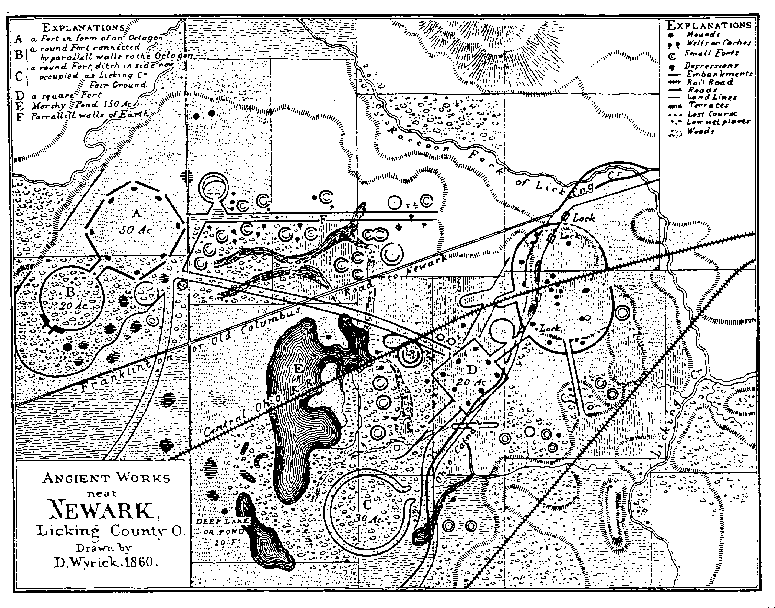
Winter 2012 in class tours http://www.econ.ohio-state.edu/jhm/arch/nrkwrks.gif http://knapsack.blogspot.com/2010/01/links-for-newark-earthworks-tours.html http://newark.osu.edu/Earthworks

Tuesday, January 10, 2012

Faith Works 1-14

Faith Works 1-14-12

Jeff Gill


Contemplating our mortality

___


Tuesday morning was a good time to contemplate our mortality.


I stood over the casket of my friend Tom Shonebarger; Father Tom, as he was known by all. Looking down, I saw his kindly face, diminished both by death and the illnesses that had worn away at him these last few years. He was fully vested as a priest in the Roman Catholic Church, a rosary in his hand, a chalice laid by his side.


Back in the pews, I sat down next to Rev. Bill Rauch, two Protestant pastors from Newark just trying not to stand up or sit down at the wrong time during the funeral mass at St. Mary's in Lancaster.


Bill and I both had known Father Tom when he served as pastor at Blessed Sacrament; Bill had talked him into becoming CROP Walk treasurer, and when I came to Newark as a new associate pastor pretty fresh out of seminary, I'd met both of them and they'd gotten me right away on the CROP Walk committee, since I'd done that back in Indianapolis.


In those years, the CROP Walk committee met every month over lunch in the back of the Old Landmark downtown. Father Tom recommended the French onion soup, and it became my regular order (and I still miss that place, now a vacant lot next to the McDonald's drive-up off the square).


That wasn't the only advice I got from him. I'd had a very good mentor in my student placement during seminary, but Father Tom was probably the next most influential person I had in developing my sense of pastoral care, a ministry both public and private with a congregation and a community.


We talked during those lunches, when he would come in and sit and say without prelude or preface "we all should spend more time contemplating our mortality!" Which he said, as he said all things, with a smile.


And of course he was serious; his point, from devotional reading and prayer time he'd spent earlier that day (a point he never belabored, but you were always aware of this source of his strength), was that it could actually make us happier and more focused on the things of God's interest when we reflected on the fact that someday we will die, and the world will go on. "Those reflections don't have to be sad, unless we wallow in them; it should point us to what endures, what is truly eternal."


Our group would debate these declarations, along with planning the work of the CROP Walk, and often Father Tom and I would continue the conversation after lunch, carrying it across the street while buying socks from Floyd Maybold, and get his opinion (which was usually to agree with what Father Tom said, with elaborations all his own).


These ten kilometer walks were planned to move through the city in a visible but safe manner, passing through quiet residential streets, rundown neighborhoods, business strips, public parks. The idea was to get the hundreds of walkers to experience more of their own community (where a quarter of the funds raised stay to fight hunger), not through car windows, but at a walking pace.


Father Tom and I as route designers would lag back and stay at the end of the pack, checking for folks who were struggling and needed a ride flagged down, or whatever. We'd discuss everything from hymn tunes to Thomas Merton, for whom Father Tom had been a secretary during his days as a Trappist monk at Gethsemani Abbey, and whose funeral he had returned for as a pallbearer. He didn't make a Catholic of me, nor I a Protestant of him. We simply shared our respective understandings of Christian faith as best we could. He talked about how the importance of the Papacy as something more than any one Pope, and I explained my love of the Anglican poets, George Herbert & John Donne, and how they helped open a door for me into ministry.


But most importantly, we talked about the nuts and bolts of pastoral care. "What do you do when" and "how do you respond if" in reference to emergency rooms at 2 am, or when sitting in a family's living room after the world has come to an (apparent) end. How to show the face of Christ in a world full of fright masks.


I thought about that smile, and the injunction to "contemplate our mortality" looking into his casket. And I smiled, too; something I learned from the face of my Christian brother, Father Tom.


Rest in peace, my friend.


Jeff Gill is a writer, storyteller, and supply preacher around central Ohio; tell him what you contemplate at knapsack77@gmail.com or follow Knapsack @Twitter.

Thursday, January 05, 2012

Knapsack 1-12

Notes From My Knapsack 1-12-12

Jeff Gill


2012, the year of the cloud

___


If you are one of the benighted view worrying about the Mayan prediction of the end of the world this coming Dec. 21st, I really can't help you, other than to suggest that it's the end of something the same way 2000 was an end…and a beginning.


2012 is looking to be a significant phase in the movement to what's generally referred to as "the cloud."


"The cloud" is the location, in virtual terms, where our data and info and personal materials all are starting to reside on the internet. Where is the cloud? If you must be so tiresomely concrete and particular, I guess it would be in a server farm (a building full of server/hard-drives/technology) that could be in Redmond, Washington, might be in Shanghai, China, and could even be in unexotic places like Dusseldorf, Germany or Poughkeepsie, New York.


One of the characteristics of the cloud, and a value of it, is that it is "backed up," so isn't just in Shanghai, but is simultaneously in Washington State and Dusseldorf, so if it suddenly melts down in one place, it can be recovered from another physical location, as the cloud drifts calmly on.


After decades of carrying around a bricklike daily/monthly/yearly planner, my calendar through 2012 is in the cloud, accessible in a smaller device I carry with me, but updateable on any computer I happen to land at through the day, with a user name and a password, and another password, and I can tweak or update my calendar for next May. It being in "the cloud," when I check it at home on my own computer, the update from the morning shows up right there, bouncing by way of Dusseldorf through my home router into the wifi and there as the Lovely Wife and I compare calendars. She pays more and more, now most of our household bills online, and checks our debit card and account balance online, where paychecks (her one, my four or five) are more and more going directly into that same encompassing cloud.


This all seems odd, until I recall that, over the last decade, I've gone from the last ribbon on my Smith-Corona to where my columns for the Sentinel & Advocate rarely ever "exist" anywhere until they come out of the business end of a printing press. The initial ideas go onto Evernote, the columns are typed in Word and sent by e-mail, edited in Quark, and I save my own copies on a hard drive and my own little corner of the cloud. There is literally no physical writing or typing until the printing…and more and more, people are wanting to skip that step and go to digital subscriptions, seeing the content online.


Will 2012 be the year that becomes the majority desire?


Many of my holiday books, magazines, and music, are in "the cloud." I can have them on my device, but I can delete them for space and go back to the cloud later to access them again. Are they mine? Well, yes, but…and the Lovely Wife notes serenely that, for all the potential downsides, they aren't taking up space in our house, or using up resources to make physical forms which then are warehoused until use.


Is "the cloud" a good thing? There's room for debate, especially if you're selling those physical forms, but the one solid reality of 2012 looks to be that we're moving towards the cloud.


Jeff Gill is a writer, storyteller, and supply preacher around central Ohio; tell him about your experience of "the cloud" at knapsack77@gmail.com, or follow Knapsack @Twitter.

Faith Works 1-7-12

Faith Works 1-7-12

Jeff Gill


Ghosts and good health in a new year

___


Not as a new year's resolution, but for the last four months, I've been running.


I turned 50, and quite frankly, it was starting to become noticeable that I could either continue eating the way I had the last many years, and buy lots of new pants, or keep my pants, and start eating less.


Eating less. Hmmm. Not necessarily a bad idea, but I wasn't really eating that much (in my opinion, and the dieticians in the audience can just pipe down), and making meaningful cuts in my caloric intake seemed unpleasant, or at least enough to make me consider the alternative.


The alternative was more, and more regular exercise, which I'd been fiddling with for a while, but not with enough seriousness. Having to eat less seemed serious enough.


But running. Once upon a time, I ran quite a bit; not marathons, but plenty of miles. The complication there was that this running was mostly in high-top black leather boots, and some of the United States Marine Corps' best trained, highly fit sergeants ran alongside of me at what seemed like for them a slow trot, screaming various imprecations at me for not running fast enough, even as I felt my lungs and legs burning on the last hill back to the squad bay.


Poor me, yeah, right. I volunteered for it. And after Uncle Sugar sent me a lovely honorable discharge from the USMCR, it felt like an official document permitting me to not run anymore.


So I had run, but not for thirty years. Or at least, not longer than, say, the distance from the center of the Great Circle earthworks to the Grand Gateway, or from the bridge from the picnic area to the center of the circle atop Eagle Mound. Often I get to lead 4th grade tours out at the earthworks, and sometimes just to wear out the poor little dears, I'd offer to race them, and can still beat all but the most energetic two or three (after all, I am twice their height).


Anytime I did that I remembered that I did enjoy running, and could cover a few hundred yards at a steady lope and still speak loudly to a hundred kids at the other end, and thought "I could try running again." But I never did.


I didn't, in part, because if I were to run more than a couple of football fields' worth, and started to gasp, I'd slow down, and if I slowed down, that sergeant would start yelling at me about my general & particular worthlessness. So why start?


In religious terms, with all due respect to Staff Sgt. Camire as a person back in 1980, what I needed was an exorcism. The demon of doubt, the spectre of failure, masquerading as Sgt. Camire, kept whispering in my ear "you can't do this, and if you do, you can't do it right." So I didn't even try.


What exorcised my demon, aside from my own personal desire to not have to eat less, was a vision. I was reading a blog from a friend of a friend, a guy whose faith and practice had long been meaningful to me, and he talked one day about running in these weird "barefoot" running shoes. He posted a picture of the shoes, and then of his feet wearing the shoes: and as I looked at them, I saw my feet wearing those shoes. That's all, no trumpets, but I saw my feet wearing those shoes. It felt real, and it felt right.


So I went to get a pair of them, and the whole way, I kept hearing a voice saying "I can't do this. I can't do this." I got home, changed clothes, and put them on, and heard what more and more seemed to be a voice NOT my own saying "I can't, I can't, YOU can't do this, YOU can't do this."


And then I ran.


Here's the thing. I didn't run that far. I still haven't run, all of a piece, more than a mile. People ask me about my plans for a 5K or a marathon, and I smile and say "No, I'm just running." What I did was I ran as far as I could without gasping, and then I walked. Once my heart and my breathing calmed down, I started running again. And so on. I "run" one, one and a half, two miles now that way. If I get up to three, great; three miles without walking, maybe, but I don't care.


Because the ghost, the demon is gone. It was prayer, and discernment, and intention, and the realization that a voice from the past is just that. Today, I need to run a bit, and walk a bit, and run some more, and that's good enough.


And thank you, Sgt. Camire, wherever you are; I know you didn't mean it.


Jeff Gill is a writer, storyteller, and supply preacher around central Ohio; he spent some time in the military in his youth, ooh-rah. Tell him about the ghosts you've laid to rest at knapsack77@gmail.com or follow Knapsack @Twitter.

Friday, December 09, 2011

Faith Works 12-24-11 & 12-31-11

Faith Works 12-24-11 & Faith Works 12-31-11

Jeff Gill


The Tree on the Porch

___


Grandma's hospital bed had been in the front room for two years now.


When she got to the point that she couldn't make the steep stairway to the second floor, Mom made up the front room for her, and got a better pair of drapes to keep out the cold and the light. Grandma slept mostly, even during the day. You could hear the psst of the oxygen even upstairs at night, every half-minute or so.


They'd put the TV in the kitchen, and tried the first year to wedge the Christmas tree in next to the dinette, sticking out into the opening to the front room. After the umpteenth person had brushed against it, knocking ornaments to the floor, Mom had said that was it, and the tree went out on the side porch.


Actually, it was kind of cool, and his friends liked the look of it, lights glowing, as you drove by in the busy alley alongside the narrow house. You could see it clearly through the big window behind the dinette, which was where they ate when it wasn't a meal over the sink, and Grandma could see a bit of it out the narrow window opposite her bed. The side door opened into the kitchen, and they rarely used it, mostly coming in the long hallway from the back into the other end of the kitchen. That was now the tree door, getting the most use when for twenty-five days they dashed out to plug in the tree each evening and the last person to bed dashed out to unplug it.


The three of them made it through the year fairly well, with Grandma's social security and Mom's job, but it was never easy. At Christmastime, Mom always went down to the Salvation Army and signed up for an Angel Tree gift package for him, but he was getting kind of old for that.


He'd gotten some good clothes and a few fun little toys, even one year a bike that he rode way past where the frame really suited him. Other times you could tell that either the people who'd picked his card hadn't read it, or (he figured) were older people who didn't know what a nine or ten or eleven year old boy would like, putting a stuffed bunny or craft set in with the sensible clothes.


Most of his friends at school had experience with Angel Tree gifts, and the ones with older brothers and sisters had ruefully pointed out that as you got to twelve and thirteen or fourteen, you generally got a gift card if you were lucky (because it didn't get picked, they guessed) or a bottle of cologne you'd never heard of. The game cartridges were usually not for a game he or his friends had, but you could trade them in downtown.


Mom was pretty smart about watching at Dollar General or Big Lots for the fall months, and she could usually pull out something kind of cool to add to the Christmas pile: a gadget to take apart and put back together, a radio control car in an odd color, or a dvd they'd watch together, joking about the bad acting. To tell the truth, those gifts he liked best because they came from her, not that they were better than what came from the nameless people who got his name off the Angel Tree.


Grandma, when she talked more, would tell him that when she was a girl there was no gift under the tree, but an orange in the stocking and a new toothbrush hanging from a branch with red ribbon. Mom would whisper to him "that wasn't her, that was her mother, your great-grandmother; she got toys and such just like you did, just no batteries." He'd saved up some money, and got her a tube of body lotion and silk flower in a vase from Big Lots; Mom thought that was wonderful he wanted to do that with his money, but warned him "don't feel bad if she doesn't react much when you give it to her. She knows, it's just hard for her to show much. Feelings are hard work for her with all the medications and all."


It looked to be a good Christmas, with a pie in the freezer they'd been given at the food pantry, and a little turkey that came with the Angel Tree gifts. He wondered what they were, but not too much. Expecting too much just led to disappointment, he'd figured that much out. They were together, the tree on the porch, the bird in the oven.


And he had a package for Mom. It wasn't much, but it was something, and he knew she'd love it. It might even be a pleasant surprise. She could use some joy this Christmas, and he wanted to give that to her.


Jeff Gill is a writer, storyteller, and supply preacher around central Ohio. Tell him a Christmas story at knapsack77@gmail.com, or follow Knapsack @Twitter.


*  *  *

Faith Works 12-31-11

Jeff Gill

December 31, 1945

George hung up the phone and looked up at the picture of his father.

Just beneath it was the cross-stitch his mother had made for him of his dad's favorite quote – 'All you can take with you is that which you give away.'

He looked past them to the window, where the snow was still falling outside. The building whose owner had just been speaking to him was sifting into invisibility behind the mist and growing dark.

Potter wanted him to know they had "found something of interest to both of them." It was the much-searched for $8,000, in an envelope left in a deposit slip rack. A good-hearted customer had discovered the crumpled packet and turned it in to a teller; they had given $50 of it to the finder, which he was sure George would approve of.

Sure, said George. He was surprised how little excitement he felt at the return of the prodigal deposit, although he was amused at Potter's generosity with George's money. For a moment, he thought about asking "If I had found $10,000 of yours, and had given $20 as a reward, would you have been fine with that?" But he just added "Thank you for thinking of that, Mr. Potter."

There was a peculiar tone to the rest of the call, though. Potter sounded positively wistful, asking him about his children's Christmas day, and how the aftermath of that already fading Christmas eve had gone, with half of Bedford Falls crowded into his house on Sycamore Street.

It was true that the hall carpet was essentially ruined, but he didn't tell Potter that.

Harry had left yesterday for Pensacola, where he would be training new pilots. "Watch out for that Potter," he said at the train station, adding "he's got something he wants to prove, and you're in the way of it."

So it was with an extra sense of unease George had heard the words "Why don't you and that charming family come over to my house for dinner tonight, and toast a new year, and the prosperity of peace?"

There was silence on both sides of the line, long enough to punctuate with a couple of Potter's carefully controlled wheezes, just enough sound to indicate listening silence.

"I'll have to check with Mary first, Mr. Potter; to tell you the truth, things have been so busy I'm not sure what our plans at home might be."

"Of course, of course my boy, you do that; wouldn't want to upset the missus. Just give me all call when you get home out here to Beech Grove."

Potter's father had begun a large rambling Georgian home on a knoll well out of town, and built barns and a pond and trails for horseback riding around the wooded acreage. It was along those, everyone knew, that a young Potter Junior had been thrown by a spooked horse, and been paralyzed ever since. There were stories about a young woman and a broken engagement, but all that was before George was even born.

The current Mr. Potter had added wings and grey stone and a high iron fence, but the few who had been on the grounds reported back food that was excellent, cooked in Continental style by a chef who it was rumored spoke no English. George said "I will certainly call as soon as I get home."

"Excellent, excellent. George, we have much to talk about. My best to your Mary," followed by a decisive clunk.

Should he go out there, he wondered? Should he even mention the invitation to Mary? She would wince and shake her head, but then say sternly, "We ought to say yes, if only to find out what he's up to."

And just how would it be, with his children, no doubt in danger of breaking a priceless object at every turn, sitting there about to say things they'd heard at home? There was no way it would be a pleasant evening.

Yet there was something in the old man's voice, or in that silence as he chose not to wheedle or plead ingratiatingly, as was his usual style. Something *was* up, that's for sure.

George reached for his hat, and thought "at the very least, I'll have a story for Harry the next time he calls." And then stopped and read for the millionth time those words of his father, neatly stitched by his mother - 'All you can take with you is that which you give away.'

Well, I'll always have this evening then, thought George.

Jeff Gill is a writer, storyteller, and supply preacher around central Ohio; tell him a story of a new year at knapsack77@gmail.com or follow Knapsack @Twitter. 

Wednesday, December 07, 2011

Faith Works 12-17

Faith Works 12-17-11

Jeff Gill


Walking down the sidewalk, hand in hand

___


Christmas eve, and in a light snow, they pulled up to the church.


It was such a joy to see the lights shining through stained glass, the full parking lot, the children's heads bobbing in the basement windows. He had helped dig that basement out fifty years ago, one coffee can at a time to start, crawling beneath the sanctuary. Now it just seemed to everyone there had always been a fellowship hall below the church, including them.


He picked his way across the asphalt carefully, recalling when it had been gravel. Safer, when his step was surer, but it certainly helped keep the carpets! Opening the car door, she swiveled to get out, as he opened up the walker.


They made their way to the elevator, another thing that wasn't part of the building when he'd been a trustee; she'd been president of the women's fellowship when they raised the money to put it in, one pie at a time.


In a way, there were no secrets between them. He knew about the early marriage she'd had that no one else who knew her even suspected; she knew how he wept each year watching "It's a Wonderful Life," not at the end of the movie when the basket full of money comes in, but when Clarence tells George that Harry Bailey didn't save the troopship from an enemy fighter crashing into it, because George wasn't there to save Harry.


He was a quartermaster's mate during the war (no further label needed for them as to what war), and piloted an LST across the Pacific. It had no name, just a number, even though she displaced 5,000 tons, more than many cocky ships that cruised past her with a name on the stern. They had names for their ship, but few worth repeating, or remembering. She'd heard them all, though.


She'd also heard him tell of when a Japanese Betty drilled into the starboard bow, not quite sinking the nameless Landing Ship Tank, but killing hundreds of soldiers who were helplessly waiting, and never landed on their island. She'd gotten letters from him out of Evansville where the ship was built, from Fort Knox, Kentucky, where he joked about how joining the Navy meant seeing the world, but the Midwest first (they were drilling on a mockup LST constructed in a vast building deep within the encampment, for security).


Then the long silence, the fears, and then a letter cryptical in wording, and even so half blacked out by a Navy censor. But she could tell something had happened, something changed. He told her all about it when he came home, once. And wept at that scene in the movie.


They had no secrets. He hadn't told her how bad the doctor had said the congestive heart failure was getting, but she knew; she hadn't told him that she suspected the breast cancer might be back, but he knew she'd asked if he could take her to the doctor, "after the holidays."


When the elevator got to the sanctuary floor, it stopped with a thump, and the door slowly slid open, revealing the Christmas decorations and the line of children now waiting to enter, holding small battery-powered candles. They both smiled, having spend hours (years?) on their knees with irons, paper towels, and wax paper cleaning candle wax out of the carpet after Christmas.


Their pew was marked, in a way, with a cushion that always sat there. New custodians would bring it to the office on Monday (once), and it would go back to her spot. Both hips had been replaced "back when they used hickory and pot metal" she joked, and the doctor had gently said it probably wouldn't be a good idea to go under anesthetic again.


No children had ever been raised in their home, "God had other plans for us" they both quickly answered whenever someone would ask. But here at church, they had helped raised hundreds (thousands?) over the years, and it was a family reunion more than anyone knew when everyone came together for Christmas Eve.


They had no secrets, but few knew all their sorrows; everyone knew, though, about  the joy they shared, with each other, and in being at worship. They smiled, and a light shone round about them, and no one was afraid to sit next to them.


It was Christmas Eve, and they were at home.


Jeff Gill is a writer, storyteller, and supply preacher around central Ohio; if you think you know who this story is about, I'm sure you're right, all of you! Tell him your story of Christmas joy at knapsack77@gmail.com or follow Knapsack @Twitter.

Tuesday, December 06, 2011

Knapsack 12-15

Notes From My Knapsack 12-15-11

Jeff Gill


Just south of Granville

___


There is something about this time of year that makes you think about times gone by, the "auld lang syne" of pioneers and predecessors. The nutmeg and allspice and cloves we use so infrequently the rest of the year mingle with cinnamon and maple to create a memory-rich atmosphere with but a single whiff of seasonal scent.


Some of these memories are ones we can only know second-hand, but are often no less vivid for their distance. I think it right and meet for us to reflect at Christmastide on how the holiday preparations once felt, and looked, and smelled.


In 1881, N.N. Hill wrote a history of Licking County, Ohio, and he included as part of the book a lengthy reminiscence where "Samuel Park, esq., of Marshall, Illinois, a former resident of Union township in this county, writes:


"I was born in Union township, November 21, 1810, and at four weeks old, in midwinter, was taken into a green beech cabin, without floor, door, or chimney, which, however, was soon made comfortable by the industry of my, then, young parents. Nor did I enjoy the luxury of a nice baby-crib set on rockers. I was cradled in a sugar-trough, and often lulled to sleep by the notes of the owl and the howl of the wolf. But, even then, the sweeter songsters of the forest, such as the mocking bird, the nightingale and the whip-poor-will, sang just as sweetly from our wild forest surroundings, as they do now from the fancy groves of our finest villas. The attempt to resurrect and place upon record the history of our pioneer fathers and mothers, has caused me to live much of my life over again. The scenes and associations of my youth have many of them been brought vividly before my mind, as in other years.


The old fashioned log cabin with puncheon floor, clapboard door,

wooden chimney, warmed by a massive log fire at one end,

and lighted by oiled paper windows;

the chimney corners hung full of jerk;

the rich, juicy, fresh venison, broiled on the end of a sharp stick;

the noble wild turkey, roasted for Thanksgiving and Christmas;

the occasional feast upon a fat coon or opossum;

the johnnycake, baked on a board;

the rich and healthy coffee and tea;

the product of the garden, the field and the forest,

and made doubly palatable by rich cream and maple sugar.


The pleasant social gathering of our fathers and mothers around the cheerful log fire,

relating the incidents and anecdotes of their lives;

the hilarity sometimes produced by the exhilarating effects of egg-nog or warm toddy;

the happy associations of the young folks;

the trippings to the charming notes of the violin;

the cabin-raisings, the log-rollings, the corn-huskings, the wood-choppings, flax-pullings;

the sentimental songs;

the jumping, hopping, wrestling and foot-racing exercises of the young men;

the quilting parties of the ladies; the buzz of the spinning-wheel in the cabin;

the whack, whack of the flaxbreak at the barn;

the guns, the dogs and the chase;

all, all of these have been brought freshly to our mind,

and we are in a great degree permitted to live over again

the happy days of our innocence and youth;

and that, too, with the most happy reminiscences of those youthful associations.

But amidst these pleasant reflections there are some sad thoughts.

These revered fathers and mothers have all passed away;

more than half of our youthful associates are numbered among the dead,

and those that are left have lost the vigor and elasticity of youth

and are blossoming for the grave.

The school children of to-day greet us as grandparents,

and we, too, must soon be numbered with the dead."


And Hill concludes this section by simply adding: "It is pleasant to record the fact that Mr. Park is yet living in Marshall, Illinois."


Jeff Gill is a writer, storyteller, and supply preacher around central Ohio; it is pleasant to record the fact that Mr. Gill is yet living in Granville, Ohio. Tell him your favorite seasonal scent at knapsack77@gmail.com, or follow Knapsack @Twitter.

Monday, December 05, 2011

Faith Works 12-10

Faith Works 12-10-11

Jeff Gill


A Simple Twist of Wire

___


Every year about this time, I think of them.


In a modern American home, you find the approach of the commemoration of Our Lord and Savior's birth coming when days get short, and nights lengthen to where they start shortly after lunch. This time of year, darkness wraps itself around you like a cheap rain poncho in the wind. You gotta do something, and that something is go to [insert big box store name here] and shop for Christmas lights.


They come in green wire or white wire, the latter a prayerful hope for a proverbial White Christmas, with tree-colored wire for wrapping around, well, trees, both indoor and outdoor.


They are white or multi-colored, and now they're LED or old-fashioned: although for me, an old-fashioned Christmas light is a bulb the size of what you plant as tulips, a proper bulb. (Of incandescents and CFLs we will not speak.) I'm told there are those who shop for all blue bulbs or other such specialty displays, but those are further back in the towering aisles than I ever get. Green wire, white wire, white bulbs or multicolor, LED or regular – all confusing enough for me.


Especially when there are 50 light, 100 light, 150 light strands, even 250 to 500 of 'em. There are probably 1000 light strings back with the blue bulbs. Each January, when the lights come down after Epiphany, some have died, some are flaring with a manic intensity that bodes ill for us all, and others are fine, but the blue spruce insists on growing, so more are needed.


Each year, I stow and toss and make notes for what I need next December 6 (St. Nicholas' Day, as Epiphany is January 6, a tidy frame for décor rituals in our house). And each year I struggle to remember what my note from eleven months previously was getting at.


So it's the odd year that I don't end buying a few more boxes or reels of Christmas lights. They have to be unsealed from their secure packaging which insulated them from the shocks and strife of being shipped across oceans, dropped on docksides, heaved into trains, and tumbled from trucks into loading zones before being carefully shelved by the guy down the street in his blue or red or orange apron.


You slit or gnaw the tape off the plastic or cardboard, and get down to the strings of lights themselves, but there's one last step. The twist ties.


This is when I think about them. If you open up enough boxes, even of outwardly identical lights, you start to realize that the twist ties are where you see the mark of an individual, actual person, someone in China, because yes, they all (as far as I can tell) come from the People's Republic of China now. Somewhere along the Huangpu or Yangtze Rivers, or up Suzhou Creek (as far as I can tell online, most of these lights are coming out of the Shanghai area), there's a vast factory in the middle of a sea of vast factories. Last summer, or earlier, the shop floor retooled to turn out the pre-tangled strands of Christmas tree wire, and throngs of basic laborers stood along lines to place bulbs in sockets and wind handfuls of seasonal joy into proper lengths after the outlets are snapped into place.


All of this among dozens of boxes or reels looks exactly identical across the packages, with a monotonous, almost inhuman sameness. You think only of machines and an acres-wide roof in a desolate landscape.


But then I get to the twist ties. They're always a little bit different. Year by year, you sense the encroachment of the bean counters, with less and less excess on the ties that are themselves snipped off a no doubt large reel, a few inches at a time. The work of squeezing the bundle of 150 or 250 lights tightly enough, then anchoring it in place with a flick of the wrist, a spin of the fingertips. It can't be terribly rewarding work, and I suspect is the lowest job on the totem pole.


Still I see in each box the particular mark of a fellow human being, the loop or knot or bow last touched literally around the world, next unwound by me, here in Ohio. What do they think of us, and what we're doing with these things? What does it mean to them?


I think of them, as persons, and I say a prayer, and touch an infinitesimal part of their lives, in contact with mine.


Jeff Gill is a writer, storyteller, and supply preacher around central Ohio; he no doubt will need just one more trip for lights. Tell him where you come into contact with "the other" this Christmas season at knapsack77@gmail.com, or follow Knapsack @Twitter. 

Thursday, December 01, 2011

Faith Works 12-3

Faith Works 12-3-11

Jeff Gill


Everyone, have a wonderful Advent

___


What should everyone do?


Once you get past the Ten Commandments, there's not much agreement on what choices or decisions are right for every-everyone.


We live in an individualistic age (I'm sure you needed me to point that out), and blanket solutions or one-size-fits-all answers are rarely heeded.


Still, we created, finite persons have quite a bit in common. I was doing a program that touched on this subject for Monday Talks, and a good doctor of the community rose to observe that after having performed surgery on all sorts of people with a wide variety of skin tones, they all had the same red blood and general arrangement of internal organs once you got past the subcutaneous layers.


And I've been to three different churches' potlucks in the last couple weeks, and saw almost the exact same assortment of casseroles and desserts at each one, so there's that.


I got to thinking about this because we preachers can fall into the trap of saying, almost as an aside, things about what Christians should do that are heard as "what everyone should be doing," with the implication, intentional or no, that if you aren't or don't, you're not a good person. Or at least not *as* good as those who do.


Which may be more message than we intend, but if that's what people hear, then . . . we have to take that into account.


Take the Bible (please! *rimshot*) – I just read in print a fine Baptist columnist just sort of toss off the observation that every believer should have the practice of reading the Bible through every year. It wasn't his main point, but it kind of stuck out as one.


Should's and ought's aside, I am quite certain that it is a vanishingly small fraction of even regular churchgoers who do this; leaving me to suspect that the vast majority hear such exhortations not as a spur to Bible reading, but as reason for a bit more guilt in their ditty bag of life.


Let me suggest this: every practicing Christian should read a book of the Bible, all the way through, preferably a Gospel (Matthew, Mark, Luke, or John) every year. Yes, some will cheat even on that and go with Ruth or Philemon, but that's their call.


Or prayer – if you read anything that's focused on the subject, you're likely to run into the off-handed comment that a person with solid spirituality spends at least an hour a day in prayer. They're likely to concede that you could start slowly, with thirty or maaaaaaybe twenty minutes a day, and then work up.


Again, I think the bulk of truly striving churchfolk read that and just give up. They don't see it happening, and they don't want to start knowing they'll fail. Can I offer an olive branch to the rest of us? If each of us just made space for five uninterrupted minutes of prayerful quiet, focused on God, at the start of each day, I think we'd all be amazed at what could happen.


Ditto tithing. I know the Scriptural citations, and have preached the sermons, but seriously: most people don't even have a household budget. So what does 10% mean when you don't know what your 100% is? How's this: people of faith, please sit down this very day, and figure out a) what you earn per annum, b) what you take home (pause for a drink when you see what percentage of your gross income goes to taxes), and c) calculate honestly what percentage of your income you give to mission, outreach, your church. That's your total giving divided by your takehome times a hundred.


Yeah, not pretty, is it? So what would it take to push that percentage up by one?


Then there's small groups. They're the catnip of church growth these days, and they are much more important & nutritious than catnip, but it does have the same deranging effect on some consultants. Look, some people just are not comfortable in a small group per se, and making it a universal (let alone accountability groups for everyone) is just an incitement to guilt, and guilt doesn't grow anything, let alone a church.


How about this: every person who regularly worships in a church should be committed to making a personal connection with people they don't already know each year? If it's just one family, one new couple, even one older person you've never talked to before – that could be so powerful.


Four ideas. They may be lowered expectations, but if they really represent what we all could do, and we did them, I think it might leave all the more room for God to do something even greater in our midst.


Jeff Gill is a writer, storyteller, and supply preacher around central Ohio; he has generally found low expectations to be highly rewarding. Tell him to up his game at knapsack77@gmail.com, or follow Knapsack @Twitter.

Tuesday, November 22, 2011

Knapsack 12-1

Notes From My Knapsack 12-1-11

Jeff Gill


A December to remember

___


The candlelight walking tour is upon us!


Some leave town, some just lock their doors and settle in with a stack of movies (or stream a night's worth through their widget), and the rest of us embrace the insanity with open arms.


C'mon, we all know it's insane. The kids most of all, and bless 'em, they aren't yet sold on the value of sanity and sensibility, so they are most ready to run forward with arms open wide.


They glory in the red-suited fellow and his soft-spoken wife, elves on duty all around; they run to the kettle corn copper pot and the cocoa urn; they try to be more restrained in Monomoy House, but even the Lad still loves to count the number of Christmas trees and report back the census to President Knobel.


Older youth get to walk about more dignifiedly with candle-lighters to keep the luminaries burning, or shuttle cookies from inside to outdoor tables; many of this community's young people put their talents to good work in church chancels and other performance venues, with plays and recitals and concerts from the elementary school's daytime craft fair on the east side of the village, to Pilgrim Lutheran and the Newark High School strings in the evening where Cherry St. points to Broad Street and the west.


Everyone gets to share their talents; my afternoon challenge is that my friend Mary Borgia is singing & strumming at the United Church of Granville in the afternoon while the Lovely Wife is playing at the Robbins Hunter Museum (sorry, Mary!). Andy Carlson and some bluegrass desperados will be holding up Park National Bank, even as Spring Hills Baptist's musicians will be trying to make connections with passing audiences in Windstream Park.


And the hardest choice of all: St. Luke's Episcopal offers a sing-along "Messiah" at 8:00 pm, just when the Denison University Concert Choir performs atop College Hill in Swasey Chapel.


There are certain family traditions about where to go and what to do, but they can't be set in stone. Monomoy is only open every other year, certain groups in various churches come and go, and through the years there are new, changing responsibilities (setting out those luminaries, helping erect sets at Centenary, shoveling snow in front of the Avery-Downer House). We used to always start the evening, just before Santa & Mrs. Claus' arrival, with Don Snelling making the Lad a grilled cheese – times change, people pass, memories endure.


There's the walk through the Christmas lights behind the Buxton Inn, and the admiration of ice sculptures in front of the Granville Inn (weather permitting, of course). I see that the Soup Loft will have bean soup & cornbread: a new tradition, perhaps?


We can't dawdle, because Common Thread is starting down the street, and we might just get them in before the "Hallelujah Chorus." As I will always remember, thinking of the Granville Candlelight Walking Tour, the sound of a child's voice that might be my own, but is just as likely to be someone else's son or daughter:


"C'mon, let's go!"


Jeff Gill is a writer, storyteller, and supply preacher around central Ohio; tell him your walking tour tale at knapsack77@gmail.com, or follow Knapsack @Twitter.

Monday, November 21, 2011

Faith Works 11-26

Faith Works 11-26-11

Jeff Gill


Think faithfully, shop locally

___


Tomorrow is the First Sunday in Advent.


There are probably more people in general (if not reading this) who are aware that yesterday was "Black Friday" than know what the First Sunday in Advent is, or means.


A new liturgical year begins, and the lectionary cycle of Scripture readings turns; we'll now be in Year B, with a special emphasis through the year on the Gospel of Mark (A=Matthew, C=Luke, and John gets heavy rotation in special seasons like Easter, but not his own year in the cycle).


I've talked about Advent before, but not so much about Black Friday. Not that I really want to do that now.


There is a small push on to declare today "Small Business Saturday," It's an interesting idea, with some major retail interests behind it, ironically, but the concept has more than just merit.


Some would suggest that a truly faithful, and particularly Christian few should be to consume, to shop, to buy stuff less. I think there's something worth considering there; why would committed Christians buy consumer goods in volume and type and brand indistinguishably from the community around them? Not to be different for difference's sake, but if your faith commitment doesn't change your shopping habits, I think it might be fair for an outsider to wonder: what does it change, then?


You can also take this line of reflection too far. Some claim that Christmas shopping and gift-giving is "the problem," and a kind of neo-Amish retreat from commercial society is what our beliefs should lead us to.


Consumer society can be a big, big part of "the problem" (my departure from most such rants is that the problem is "sin" and not shopping isn't "redemption," but save that for later). How we shop, though, might also be part of a solution to finding a form of faithful living that proclaims what we believe.


I find a small business emphasis, not just for today, but in general, one that appeals to my understanding of "the beloved community," the new creation that God is seeking through Christ not just "in our hearts" but in our shared reality, right now. A sign of the Kingdom, if you like.


Giving gifts can be a blessing, and where or how you get them can bless in multiple directions. Everyone knows there's a certain wonderment in handmade gifts.


And many of us quake in fear and trembling at the idea of crafting anything at all.


Do we have to jump from home-made offerings to objects, entombed in plastic, shipped from overseas, bought in big box stores? Is there no middle ground here?


Buying locally is an affirmation of community, of common ties. Even buying internationally rooted consumer goods from a local, nearby retailer, says something if only to that business and their employees with whom you interact.


I wonder what would happen if, as part of the Christmas season, more churches spent a moment or some bulletin or newsletter space to promote, not as an advertisement, but as a gift itself, those in their fellowship who make gift items? What I'm not so crazy about are so-called "Christian businesses," in whose name I've seen too much incompetence and opportunistic profit taking be done. What I mean is a purchase that has some relationship in it. A local artist's CD, jewelry made by LICCO, preserves from the farm just a township over.


There's also the next circle of connection, where faith & practice mean not an endorsement, but just a gracious hint. My wife & I give a number of out-of-town gifts through Gethsemani Abbey in Kentucky, a Trappist monastery whose emphasis on prayer & work I value, and whose products are handmade on the grounds. There may be better fruitcakes, but not only do I think they're tasty, I like what the gift says, and what I'm supporting by giving through them.


So shop as you discern that you must, and wrap away for the celebrations of month's end, but think a bit about from whom, and where, and how you buy – and see what you can do to bring the gift a little closer to the life and living you would affirm.


Jeff Gill is a writer, storyteller, and supply preacher around central Ohio; yes, he does like fruitcake, some do! Tell him about a Christmas gift at knapsack77@gmail.com or follow Knapsack @Twitter.

Friday, November 18, 2011

Faith Works 11-19

Faith Works 11-19-11

Jeff Gill


Communities of Thanksgiving

___


One of the best byproducts of the ecumenical movement of the 1960s & 70s was the development in cities and locations all over the country of "community Thanksgiving services."


I grew up with one that was always Wednesday night, rotating among churches downtown, which was (to me, at least) always exciting about getting to see the inside of churches I had never been in, and get a taste of how other traditions worshiped God.


Wednesday night always had the downside of excluding no small number of women who were, at 7 pm on Wednesday night, literally up to their elbows in a turkey. Over time, most of these have continued, but moved to the Sunday evening before. This also helps draw in the many of us who are traveling on Wednesday, over various rivers and through "Leafy Woods" subdivisions, to grandmothers' or other relatives houses. The horse may not know the way, but we have our pilgrim paths that are part of the holiday.


Licking County is no exception, with three that I can tell you about for sure, and I don't doubt there's a combined service or two out there I've not gotten definitive word about.


Down by Buckeye Lake, the Lakewood Area Ministerial Association is holding a community Thanksgiving service hosted by First Community Church there, Sunday night at 7:00 pm. Churches from Jacksontown to Hebron and along the north shore are joining together for that gathering.


The Newark Area Ministerial Association is gathering at Trinity Episcopal Church, just east of Courthouse Square, also at 7:00 pm Sunday night. Kitty Clausen & Sam Harnish have led an effort to invite folks from all around the Newark area both to participate and come worship.


They very kindly invited me to join them, but I was already helping with arrangements for the Granville Ministerium service, Sunday night at (wait for it!) 7:00 pm, hosted by the Church of St. Edward the Confessor on Newark-Granville Road. We will have readings from youth lectors out of a number of the participating churches, and John Ball, an 8th grader from the United Church of Granville has organized a shoe drive for a mission project their youth group is supporting. The shoes may be used, or if they can't benefit a wearer, they get recycled in bulk and the proceeds drill wells in developing countries around the world. So we're having a shoe offering!


Each Thanksgiving service has it's own rhythm and special offering traditions, plus that chance to see inside a different worship space, and hear other voices in both preaching and song. Often there's a combined choir singing at these services, with folks showing up early to rehearse together an anthem and lift up voices in harmony, with unity.


That is truly something to be thankful for, whenever and wherever it happens!


Jeff Gill is a writer, storyteller, and supply preacher around central Ohio (who gets to preach tomorrow morning at Hebron Christian!); tell him what you are thankful for this year at knapsack77@gmail.com or follow Knapsack @Twitter.

Friday, November 11, 2011

Knapsack 11-17

Notes From My Knapsack 11-17-11

Jeff Gill


A Thankful Connection

___


This Sunday, you all are invited to St. Edward's Catholic Church at 7:00 pm for a Community Thanksgiving worship service.


Rev. Dwight Davidson of the United Church of Granville will offer a message on "Making the most of the time" from Ephesians 5:16. A community chorus will rehearse together at 5:00 pm for the 7:00 pm service, and a number of young people from different congregations will share the readings.


One particular young person, John Ball, from UCG, is organizing a shoe drive which the Granville Minsterium wants to support this year. If you have old, worn shoes, tie or rubber band them together, and bring them to deposit at the service. John and his youth group are collecting them for Edge Outreach, a non-profit ministry which both sends on into the developing world shoes which can be worn, and recycles the others in bulk to earn cash that is then used to drill wells where they're needed, from Haiti to Sudan.


The shoes, like the canned goods we often collect in other years at the ecumenical service, are a small token, but a reminder, and one that has its own place. The offering makes us stop and think in a way writing even a fifty dollar check might not; walking into a church with barely useful shoes dangling from our hands gives a sense of the limits of our giving, but a practical insight into what's needed. Hope and healing, and clean water, may just be a few grubby sneakers away.


It's this question of how faraway places matter to us, and how we are connected to them, which dogs my question about what kind of "empire" our country, our culture is going to be. As Christians in a country with global impact, we can shape some ends with our actions, and resist some initiatives with our votes, even as we struggle to define which global matters truly do matter to a life of faith, and which means are right and proper to use as faithful people in the world.


Sending a check used to be safe, but we've gotten wise to the foolishness that money alone will announce the gospel, the good news. Sometimes you can't buy what God wants to see done; actually, that's usually the case.


Overseas mission, along with our local work recently celebrated and supported at places like a concert of gospel music in Newark, needs the kind of support that can only be participated in. Granville is blessed with the fact that most of our churches contain people who have actually gone and been and done in distant places, returning to tell us those stories, to make real to us what good news looks like in Myanmar and Mexico. Participation is more important than contribution, it seems, and even if we can't physically go, we can participate through holy listening, just as a gospel concert isn't complete without an audience softly singing along at times.


Overseas, counterinsurgency against violent threats is being rethought as well. Apparently we can neither bomb nor drone our way to a lasting peace, who knew? And "existential threats" may be best fought in a struggle that begins before the first IED is set, when skills and talents are better spent in building a life with hope & promise, rather than building bombs and booby traps.


I don't entirely know how we help others make that choice. I'm guessing learning more about why people make the choice to blow people like me up (or their own folk) is going to be one part of it. Figuring that out doesn't excuse their choices for evil acts, but it does give people like me a starting point to figure out what could be done. You don't have to concede terrorism is our own fault to realize that there may have been something we could have done sooner to prevent it.


And far enough back, it might have been as simple as a pair of shoes. Given with love.


Jeff Gill is a writer, storyteller, and supply preacher around central Ohio; he hopes to see you at the ecumenical Thanksgiving service! Say hello at knapsack77@gmail.com or follow Knapsack @Twitter.

Wednesday, November 09, 2011

Faith Works 11-12

Faith Works 11-12-11

Jeff Gill


The More Things Change

___


"The Lord be with you"


"And . . ."


Those statements are familiar, as far as they go, across many Christian traditions.


They have long taken the form, in America, of "The Lord be with you" from the priest, preacher, or presider, with a response from the people gathered of "And also with you." It comes from the Mass in English after the great transition of the Vatican II conference for the Roman Catholic Church, and sets the worship service rolling.


Those responsive statements are so effective that actually in the vast majority of Protestant churches you could step up to the platform or pulpit and say "The Lord be with you," and count on the majority of worshipers to respond in booming tones "And also with you."


This will get a little complicated come the end of the month.


Nov. 27 is the first Sunday of Advent, which is, for liturgical churches (and to some degree for any congregation which follows the lectionary cycle of Scripture readings), the beginning of the year. Everything resets, from the texts in weekly worship to the colors of pulpit covers and table paraments (purple for Advent).


Catholic Christians will find on that day, and I presume in the "vigil masses" on Saturday evening before, a bit more of a change. Well, more than a bit.


It turns out that the Mass translations from the Latin many of us have heard for years have been provisional, awaiting a more carefully considered effort from an international commission on worship texts. They've been provisional for over 40 years, but Rome likes to remind people that they don't think in terms of years, but of centuries (and wags would add, "yes, the fourteenth century").


After some politick-ing that I've read about but can't claim to understand (there was a draft worked on for some 30 years that was liked by many, but pitched at the last minute and reformulated under different management to reach the new, final translation), this new liturgical year ushers in an official, non-provisional "Missal of the Roman Mass" for use in worship among Catholics throughout the English-speaking world.


With this first Sunday of Advent, you will hear the priest say "The Lord be with you," and your response will be "And with your spirit."


Is that all, you might ask? Oh no, there's much more. The form and sense of the whole is really not much changed at all, but some have said that a certain preference for Latinate constructions is what most marks this translation, with words like "consubstantial" likely to trip up unsuspecting tongues.


I've spoken to two priests and a few church musicians about the coming change, and the consensus is that the adjustment for the congregation should be relatively simple & straightforward (watch the card that's going to be in the pew!), but the real problem will be for priests and musicians who have been putting off wrestling with their parts, where the largest number of changes in wording have been made (I'm told). Some have begun already "saying the Mass" in this form in their private devotions, even practicing it in front of the bathroom mirror ("like being back in seminary!" one said).


But all agree the rumors and worries are a bit out of scale with what's actually going on. When you read the Latin text the 1970 translation was based on, you don't have to know the language to see why the 2011 adjustment makes a certain sense: Priest: Dominus vobiscum.  People: Et cum spiritu tuo. You can see it: "And with your spirit."


There is also returned from traditions of an earlier day a practice which is behind the common idiom "breast-beating": instead of what the 1970 version asks the people to pray as "that I have sinned through my own fault," the new translation returns, in English, to the Latin mass usage of inviting worshipers to tap their chest three times while saying "that I have greatly sinned in my thoughts and in my words, in what I have done and in what I have failed to do, through my fault, through my fault, through my most grievous fault," from an original Latin "mea culpa, mea culpa, mea maxima culpa."


Meanwhile, for all us Protestants, the question now arises: do we change, too? Or does the sacramental meaning of acknowledging the Holy Spirit at work in the presider, reclaimed with "And with your spirit," mean that most of us would do well to keep "And also with you"?


Jeff Gill is a writer, storyteller, and supply preacher around central Ohio; he hopes that the Lord is with you! You may respond as you prefer to knapsack77@gmail.com or follow Knapsack @Twitter.

Wednesday, November 02, 2011

Faith Works 5-5

Faith Works 5-5-11

Jeff Gill


Just a knock on the door

___


So, you all know where to show up tomorrow, right? No, after church.


Sunday, 3:30 pm, Midland Theatre in downtown Newark, Gospel Celebration, a concert for the "Coalition of Care" helping congregations serve those in need around Licking County (www.coalitionofcare.net). Lots of great choirs, ensembles, & soloists, with the ticket just $20. Come help us pack the house!


With that, I've asked you to come where I'll be at (and it's a sincere invitation). But if I come to where you are, especially if I'm your pastor or clergyperson of any sort, it's a "call."


Pastoral calls have been the single biggest thing that's changed in ministry over the last thirty years. Some would argue that it should be technology, which has changed greatly, but it hasn't transformed the work of ministry in the same way . . . yet.


And others might say that the rise of contemporary Christian music and the worship style that goes with it is the biggest change, but even there, it's one of those things where your congregation has either done it, or not. Many are still relatively untouched by contemporary worship, or have never known any other style.


Pastoral calling, on the other hand, has really changed right across the board for anyone who's been in a ministry position since the 1980s. One aspect of that is the explosion of hospitals, and the shortening of stays. Thirty years ago, a pastor in Newark rarely went to Franklin County to pray with a parishoner before surgery, while now it's a regular event (some might even say weekly). And if you don't get right over there, you might just arrive to find them dismissed already.


While many folks still have some of the same expectations today that they did then, which most clergy I know try to meet.


That's actually not what I'm thinking about, though. It's the other side of pastoral calls, the "home visit."


It came to mind because I was recently reading in the annals of Rev. Jacob Little, the legendary Granville pastor at First Presbyterian there, who served from the end of the pioneer period to the Civil War, and left a large amount of written material along with the general church records.


Apparently, what Parson Little did each Sunday was post, in the vestibule, two lists. One was of those who had not paid their pew rents (long story, but just call it "their pledge"), and the other was a list of those families he intended to visit that week.


These weren't social calls, either. Little would quiz the children about their studies in Scripture, invite the parents to discuss doctrine, and generally inquire about the state of their souls and fitness to receive communion.


The posted list helps to explain why the Reverend would often come to the door of a home and hear the head of the household loudly already at prayer, with special blessings asked for the pastor. Old Jacob had very little sense of irony, so I'm not sure he got what was going on, since he would report these incidents with great approval.


Anyhow, Rev. Little would call on parish families three or four days a week, between the noon meal and supper, two or three families each day. Apparently he could count on arriving at a house, on a weekday afternoon, and find the entire family, father included, there waiting for him.


Today, catching people at home? You'd have to call in the evening, if then, and quite frankly, there aren't many people who like having visitors at home in the evening. The new reality is that most pastoral home visits tend to be associated with crisis and bad news, which warps the sense of having a minister at the door even more.


We are still coming up with what a new model can be for pastoral calls on a good day, when there's not a problem to be dealt with, and maybe even for a relaxed but serious conversation. Most clergy are really interested in the state of your soul, the condition of your heart, and welcome a chance to talk and pray with you about things of the spirit.


We do have those conversations with people in assisted living, nursing homes, and yes, even in hospitals when the stay isn't measured in hours but there's a day or two at hand. For everyone else – should we try going back to posting lists?


Jeff Gill is a writer, storyteller, and supply preacher around central Ohio; tell him a story at knapsack77@gmail.com or follow Knapsack @Twitter.