Faith Works 2-24-23
Jeff Gill
Foundations and new buildings and restoration
___
One hundred years ago is a long time. Five generations almost, at least more than a human lifetime.
A century ago is a different era, a completely different time and place. Yet we enjoy the little connections and associations; there are Facebook groups which treasure the buildings we still have from back then and earlier, and mourn the ones long gone.
From a historian's point of view, a century is not as long as you think. It's certainly tied to a period with documentation, print and written records, even photographs.
An anthropologist would say much the same about a hundred year span; yes, change, but not as much as you might think, and some of it on the surface, not the real differences of social transformation that take centuries and more. And an archaeologist would call a century a margin of error, plus or minus at best.
Church history, especially for a Christian scholar, is focused on a framework of about two thousand years; Protestants get excited about five hundred years ago while the Eastern Orthodox lean more towards millennia. And you get back in written records to Sumeria and Ur of the Chaldees and some six thousand years ago, meandering forward with Abraham and Sarah, Ruth then David, on to Mary and Joseph and that boy of theirs.
So is one hundred years too long to matter, or too short a time to tell? I have learned this, writing a string of essays about events in early 1923 around Newark, Ohio and Valparaiso, Indiana: it is both, and neither.
The emails and messages and posts saying the work of remembering and recovering this period in Midwestern and American history is important have been encouraging, and I appreciate them all. Between some personal travel issues and the sudden increase in volume, I may have missed a few but not intentionally.
That includes the folk who ask "why?" Why bother, why bring this up now, why do we, here today, need to care? Is this some woke exercise in guilt, some scheme to burden the present with the dry bones of the past, am I trying to deal with my own issues — all questions I've been asked? And some who worry that by raising the tensions and faults of then, one hundred years back, I can inadvertently cause stresses and anxieties today, linking past sins to present problems. Well, it hasn't been inadvertent. It's been quite intentional.
Along with a number of individuals telling me stories about personal property inherited from family, and landowners asking about stories they've heard in the last few decades about what went on where they now live in past times, I've heard from a few who think I should just drop it. This is not subject matter that really relates to today. The Klan is dead, and in many ways, they're right. The hoods (or helmets, as they called them), the robes, the horseback parades, the dues and newsletters of the "Fiery Cross" are all part of history themselves.
But just as a building can be 150 years old, and have been a grocery, a dry goods store, an office, and now a remodeled loft apartment, there are foundation stones with a history that still subtly shape today's landscape, in language and institutions and historical outlines as well.
How do we come to terms with the past in the present, or is it something we never can accomplish? Can we learn a lesson now we chose not to learn generations before? I think we can. Lent is a pretty good time to do just that.
Jeff Gill is a writer, storyteller, and preacher in central Ohio; he appreciates all the family stories shared with him at knapsack77@gmail.com about the Klan era.
Tuesday, February 21, 2023


Wednesday, February 15, 2023
Notes from my Knapsack 2-23-23
Notes from my Knapsack 2-23-23
Jeff Gill
Should I help? How can I help?
___
There are some impending rollbacks & unwinding of COVID-era benefits. You may not think this is relevant to you, but bear with me a bit.
First, some 16,000 Licking Countians will see cuts shortly to the SNAP benefits, aka "food stamps" that have given the last three years. Call that 9% of all residents in households receiving nutrition assistance. Who are SNAP participants?
Official data from the Center on Budget and Policy Priorities: "Pre-pandemic data show that nearly 90 percent of participants are in households with a child under age 18, an adult age 60 or older, or an individual who is disabled. Children under age 18 constitute nearly half (44 percent) of all SNAP participants. About two-thirds of SNAP participants are in families with children; over one-third are in households with older adults or disabled people."
That other 10% of single adult able-bodied individuals, between ages 18 and 50, can only receive three months of assistance across a three year period, and must reapply to qualify each time. Further, our county's Food Pantry Network tells me over 80% of people coming to local pantries utilize them once or twice in a year. That's all.
On Medicaid, estimates are around 4,000 Licking County residents will lose coverage in April or May. That's 2% of our 178,500 citizens. Some will no longer qualify, many will simply not keep up with requirements to maintain coverage, often because they moved between March 2020 & 2023.
And while the number of children in foster care are just below 300, for the first time in about a decade, the total number of juveniles in foster care resident in this county is around 600 some. Of 34,000 children that's approaching 2%.
If you're worried about people living on the margins, and believe these benefit programs are in our moral & long-term national interests, you may wonder what you can do to help maintain & improve our social safety net programs: I have some simple suggestions.
1.) If you know anyone receiving SNAP or Medicaid assistance, remind them to keep their current address and contact info current with the relevant agencies. Non-response is the chief reason people get cut, and they find out when accessing services, setting them back weeks or months.
2.) Likewise, encourage in your circles of contact responding to notices & inquiries. People have automatically stayed enrolled for nearly three years; many of us in helping professions have forgotten the old patterns & processes. Help each other keep up!
3.) And in that same vein: discouragement, despair, & fatalism lose more people coverage FOR WHICH THEY QUALIFY than any other reason. Poverty — news flash — is hard work. Anything anyone can do to encourage, provide hope, and offer support, is going to be invaluable in this transition.
4.) Finally, let your elected officials know you support a measure of discretion & flexibility to local agencies. Ironbound federal & state rules handicap helpers both for providing support, and in managing complex issues.
This will not be a "disaster" like tornadoes or train derailments, but people will get hurt, almost always by accident, usually unintentionally, by losses of coverage and lower levels of assistance in this coming year. We need all the compassion & encouragement we can find to share, in order to find a firmer path to stable footing for everyone.
Jeff Gill is a writer, storyteller, and preacher in central Ohio; he's seen enough to know we need to help each other, maybe even love one another. Tell him where you find hope at knapsack77@gmail.com or follow @Knapsack on Twitter.
Jeff Gill
Should I help? How can I help?
___
There are some impending rollbacks & unwinding of COVID-era benefits. You may not think this is relevant to you, but bear with me a bit.
First, some 16,000 Licking Countians will see cuts shortly to the SNAP benefits, aka "food stamps" that have given the last three years. Call that 9% of all residents in households receiving nutrition assistance. Who are SNAP participants?
Official data from the Center on Budget and Policy Priorities: "Pre-pandemic data show that nearly 90 percent of participants are in households with a child under age 18, an adult age 60 or older, or an individual who is disabled. Children under age 18 constitute nearly half (44 percent) of all SNAP participants. About two-thirds of SNAP participants are in families with children; over one-third are in households with older adults or disabled people."
That other 10% of single adult able-bodied individuals, between ages 18 and 50, can only receive three months of assistance across a three year period, and must reapply to qualify each time. Further, our county's Food Pantry Network tells me over 80% of people coming to local pantries utilize them once or twice in a year. That's all.
On Medicaid, estimates are around 4,000 Licking County residents will lose coverage in April or May. That's 2% of our 178,500 citizens. Some will no longer qualify, many will simply not keep up with requirements to maintain coverage, often because they moved between March 2020 & 2023.
And while the number of children in foster care are just below 300, for the first time in about a decade, the total number of juveniles in foster care resident in this county is around 600 some. Of 34,000 children that's approaching 2%.
If you're worried about people living on the margins, and believe these benefit programs are in our moral & long-term national interests, you may wonder what you can do to help maintain & improve our social safety net programs: I have some simple suggestions.
1.) If you know anyone receiving SNAP or Medicaid assistance, remind them to keep their current address and contact info current with the relevant agencies. Non-response is the chief reason people get cut, and they find out when accessing services, setting them back weeks or months.
2.) Likewise, encourage in your circles of contact responding to notices & inquiries. People have automatically stayed enrolled for nearly three years; many of us in helping professions have forgotten the old patterns & processes. Help each other keep up!
3.) And in that same vein: discouragement, despair, & fatalism lose more people coverage FOR WHICH THEY QUALIFY than any other reason. Poverty — news flash — is hard work. Anything anyone can do to encourage, provide hope, and offer support, is going to be invaluable in this transition.
4.) Finally, let your elected officials know you support a measure of discretion & flexibility to local agencies. Ironbound federal & state rules handicap helpers both for providing support, and in managing complex issues.
This will not be a "disaster" like tornadoes or train derailments, but people will get hurt, almost always by accident, usually unintentionally, by losses of coverage and lower levels of assistance in this coming year. We need all the compassion & encouragement we can find to share, in order to find a firmer path to stable footing for everyone.
Jeff Gill is a writer, storyteller, and preacher in central Ohio; he's seen enough to know we need to help each other, maybe even love one another. Tell him where you find hope at knapsack77@gmail.com or follow @Knapsack on Twitter.
Monday, February 13, 2023
Faith Works 2-17-23
Faith Works 2-17-23
Jeff Gill
Public votes and private pressures in church life
___
On Feb. 20, 1923, my home church, First Christian Church of Valparaiso, Indiana, had a special called board meeting.
It was a Tuesday night, and any minister knows a special called board meeting is never a good thing. Or at least, rarely so.
Rev. C.E. Burns had asked for the meeting, in fact, with what I infer was the support of a few of the elders of the congregation. In some way, a request had been presented to ask for the use of the sanctuary on Wednesday, Feb. 21, for a public meeting of the Ku Klux Klan in Valparaiso.
There are almost no records of that meeting, how long it went, or what arguments were presented pro or con. In the church history it is simply recorded that permission was denied. As I grew up there, some fifty years later I only heard "our church faced down the Klan." And in fact the public meeting was held elsewhere, and the planning for the coming May multi-state rally would continue without the support of First Christian Church. That's almost all I know from the official record.
What I do know in more detail is from a March, 1923 article in the Klan's weekly newspaper, published in Indianapolis titled, of course, "The Fiery Cross." Their coverage bemoans the bias and unfairness of Rev. Burns and his supporters, noting that the motion failed to host the Klan meeting, but adding that the vote was 13 to 9. Not exactly an overwhelming mandate.
And when my father in 1987 was working on a 150th anniversary history of the church, he got a letter from Myrtle Burns Grant, who was the daughter of Rev. C.E. Burns and was a little girl in 1923. She told a pair of funny stories about a potato peeler in the church kitchen, and how her brothers had fallen asleep behind the organ one Sunday during their father's sermon, so when it came time to play the closing hymn, there was no one to pump the bellows and no music came out. Those both made it into the history book published that year.
What the Sesquicentennial Committee voted to have my dad edit out of her letter was a further story, about looking out the front windows of the parsonage one night to see a group of hooded men burning a cross on the front lawn of their home. And about how it happened again, and again, and so the family moved at the end of the year, two states away. That story didn't make it into the history; I heard about it from my frustrated father.
Growing up in that Indiana town, I heard about how the Klan was denied the chance to purchase Valparaiso University, a story which turned out to be untrue in many particulars, and how my church stood up to the Klan, which was true in part, but not true enough to protect a minister with three children in his home.
And paging through the online copies of "The Fiery Cross" to find the hidden details, to compare and contrast their slant to the narratives I knew from more "official" sources, I kept finding headlines next to each other about Valparaiso, Indiana and Newark, Ohio.
You may ask if events 100 years old are relevant today; I note for myself how stories I heard fifty and forty years ago turn out to be oddly edited and often partial. As both a pastor and a historian, I'm interested in what those edits might tell us about what stories we're telling today, and how we can tell truer stories, both to and about ourselves.
Jeff Gill is a writer, storyteller, and preacher in central Ohio; he's got a few more chapters of this story to assemble. Share your feedback with him as some already have done at knapsack77@gmail.com (all responses will be kept confidential unless you specifically ask otherwise).
Jeff Gill
Public votes and private pressures in church life
___
On Feb. 20, 1923, my home church, First Christian Church of Valparaiso, Indiana, had a special called board meeting.
It was a Tuesday night, and any minister knows a special called board meeting is never a good thing. Or at least, rarely so.
Rev. C.E. Burns had asked for the meeting, in fact, with what I infer was the support of a few of the elders of the congregation. In some way, a request had been presented to ask for the use of the sanctuary on Wednesday, Feb. 21, for a public meeting of the Ku Klux Klan in Valparaiso.
There are almost no records of that meeting, how long it went, or what arguments were presented pro or con. In the church history it is simply recorded that permission was denied. As I grew up there, some fifty years later I only heard "our church faced down the Klan." And in fact the public meeting was held elsewhere, and the planning for the coming May multi-state rally would continue without the support of First Christian Church. That's almost all I know from the official record.
What I do know in more detail is from a March, 1923 article in the Klan's weekly newspaper, published in Indianapolis titled, of course, "The Fiery Cross." Their coverage bemoans the bias and unfairness of Rev. Burns and his supporters, noting that the motion failed to host the Klan meeting, but adding that the vote was 13 to 9. Not exactly an overwhelming mandate.
And when my father in 1987 was working on a 150th anniversary history of the church, he got a letter from Myrtle Burns Grant, who was the daughter of Rev. C.E. Burns and was a little girl in 1923. She told a pair of funny stories about a potato peeler in the church kitchen, and how her brothers had fallen asleep behind the organ one Sunday during their father's sermon, so when it came time to play the closing hymn, there was no one to pump the bellows and no music came out. Those both made it into the history book published that year.
What the Sesquicentennial Committee voted to have my dad edit out of her letter was a further story, about looking out the front windows of the parsonage one night to see a group of hooded men burning a cross on the front lawn of their home. And about how it happened again, and again, and so the family moved at the end of the year, two states away. That story didn't make it into the history; I heard about it from my frustrated father.
Growing up in that Indiana town, I heard about how the Klan was denied the chance to purchase Valparaiso University, a story which turned out to be untrue in many particulars, and how my church stood up to the Klan, which was true in part, but not true enough to protect a minister with three children in his home.
And paging through the online copies of "The Fiery Cross" to find the hidden details, to compare and contrast their slant to the narratives I knew from more "official" sources, I kept finding headlines next to each other about Valparaiso, Indiana and Newark, Ohio.
You may ask if events 100 years old are relevant today; I note for myself how stories I heard fifty and forty years ago turn out to be oddly edited and often partial. As both a pastor and a historian, I'm interested in what those edits might tell us about what stories we're telling today, and how we can tell truer stories, both to and about ourselves.
Jeff Gill is a writer, storyteller, and preacher in central Ohio; he's got a few more chapters of this story to assemble. Share your feedback with him as some already have done at knapsack77@gmail.com (all responses will be kept confidential unless you specifically ask otherwise).
Sunday, February 05, 2023
Faith Works 2-10-23
Faith Works 2-10-23
Jeff Gill
Missing stories and broken fragments
___
When I discussed the beginning of the public efforts of the Ku Klux Klan in Licking County, one hundred years ago in January, I knew it would provoke some interesting and I hope useful discussions.
Right from the outset, both in my own social media posts and in this column, I've been hearing back from people who have heard these same stories, and seen the same robes and hoods in family closets (the Klan actually called them "helmets" with "detachable visors," but I'll mostly call them hoods and masks).
I'm talking about stories shared within families and tales told secondhand because there's an interesting gap in the official record. If you go to any library or archive, in person or online, you will find that the Newark Advocate is missing for most of 1923, all of 1924 and 1925, and the first months of 1926.
Year after year before back through the turn of the century, and after 1926 pretty much without a gap to the present day, but the pages of the "first draft of history" in our local daily paper are gone.
They were gone when I first went to the old Newark Public Library as I moved here in August of 1989, and I found the same at the State Archives a few months later in 1990. It's as if a methodical effort was made years ago to erase the published record of the period whose centennial we're passing through.
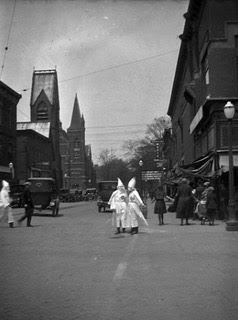
I went immediately to look what I could find on microfilm (waving at everyone in the audience who remembers microfilm readers, and cranking through history squinting at the images projected onto the hooded screens), or perhaps in older bound volumes, because I had done the same in my hometown of Valparaiso, Indiana in researching our Klan history there. In May of 1923 there was a massive Klan event in Valparaiso, a gathering of 50,000 or more which would only be eclipsed by a larger rally on July 4th in Kokomo, which totaled some 100,000 to possibly 200,000, in attendance from multiple states around the Midwest.
But if you read in the 1970s and 1980s as I did about Klan rallies of the 1920s, you also saw that there were not one but two "konklaves," or state assemblies at a place called Buckeye Lake, Ohio: first in that busy year of 1923 following the Kokomo rally, numbering around 75,000, and another in 1925 which exceeded 100,000.
Spoiler alert: after 1926, this "second era" Klan would collapse in a steaming pile of corruption and graft and rape and murder. The political gains of 1923 and 1924 would not save D.C. Stevenson, Grand Dragon of Indiana from his legal troubles, but not before he bought houses in a nice suburb of Indianapolis and on the shores of Buckeye Lake. The man who said in public, "I am the law" about the influence of his secret society and their thousands of supporters would go to prison, but not before releasing information about membership and officers and deals made with elected officials . . . in Indiana.
So we know a great deal through those court records about the Indiana Klan. In Ohio, not so much. The secret records all disappeared elsewhere after Stevenson's conviction. As I learned while expecting to read contemporary accounts from our local paper about the summer of 1923, someone made them all go away at some point.
Well, not all. Because there are other sources, if not local ones. And locally, even one hundred years later, people have their own stories, those of parents and grandparents and others who once donned robes and hoods and saluted a burning cross, right here in Licking County.
Putting those broken fragments together, a more complete picture comes into view. And one which draws together places like Valparaiso, Indiana and Newark, Ohio.
Jeff Gill is a writer, storyteller, and preacher in central Ohio; he's got a few more of these stories to tell, if you're willing to listen. Tell him what pieces you have at hand through knapsack77@gmail.com, or follow @Knapsack on Twitter.


Jeff Gill
Missing stories and broken fragments
___
When I discussed the beginning of the public efforts of the Ku Klux Klan in Licking County, one hundred years ago in January, I knew it would provoke some interesting and I hope useful discussions.
Right from the outset, both in my own social media posts and in this column, I've been hearing back from people who have heard these same stories, and seen the same robes and hoods in family closets (the Klan actually called them "helmets" with "detachable visors," but I'll mostly call them hoods and masks).
I'm talking about stories shared within families and tales told secondhand because there's an interesting gap in the official record. If you go to any library or archive, in person or online, you will find that the Newark Advocate is missing for most of 1923, all of 1924 and 1925, and the first months of 1926.
Year after year before back through the turn of the century, and after 1926 pretty much without a gap to the present day, but the pages of the "first draft of history" in our local daily paper are gone.
They were gone when I first went to the old Newark Public Library as I moved here in August of 1989, and I found the same at the State Archives a few months later in 1990. It's as if a methodical effort was made years ago to erase the published record of the period whose centennial we're passing through.
I went immediately to look what I could find on microfilm (waving at everyone in the audience who remembers microfilm readers, and cranking through history squinting at the images projected onto the hooded screens), or perhaps in older bound volumes, because I had done the same in my hometown of Valparaiso, Indiana in researching our Klan history there. In May of 1923 there was a massive Klan event in Valparaiso, a gathering of 50,000 or more which would only be eclipsed by a larger rally on July 4th in Kokomo, which totaled some 100,000 to possibly 200,000, in attendance from multiple states around the Midwest.
But if you read in the 1970s and 1980s as I did about Klan rallies of the 1920s, you also saw that there were not one but two "konklaves," or state assemblies at a place called Buckeye Lake, Ohio: first in that busy year of 1923 following the Kokomo rally, numbering around 75,000, and another in 1925 which exceeded 100,000.
Spoiler alert: after 1926, this "second era" Klan would collapse in a steaming pile of corruption and graft and rape and murder. The political gains of 1923 and 1924 would not save D.C. Stevenson, Grand Dragon of Indiana from his legal troubles, but not before he bought houses in a nice suburb of Indianapolis and on the shores of Buckeye Lake. The man who said in public, "I am the law" about the influence of his secret society and their thousands of supporters would go to prison, but not before releasing information about membership and officers and deals made with elected officials . . . in Indiana.
So we know a great deal through those court records about the Indiana Klan. In Ohio, not so much. The secret records all disappeared elsewhere after Stevenson's conviction. As I learned while expecting to read contemporary accounts from our local paper about the summer of 1923, someone made them all go away at some point.
Well, not all. Because there are other sources, if not local ones. And locally, even one hundred years later, people have their own stories, those of parents and grandparents and others who once donned robes and hoods and saluted a burning cross, right here in Licking County.
Putting those broken fragments together, a more complete picture comes into view. And one which draws together places like Valparaiso, Indiana and Newark, Ohio.
Jeff Gill is a writer, storyteller, and preacher in central Ohio; he's got a few more of these stories to tell, if you're willing to listen. Tell him what pieces you have at hand through knapsack77@gmail.com, or follow @Knapsack on Twitter.
Klan members in Valparaiso downtown on May 19, 1923
Tuesday, January 31, 2023
Notes from my Knapsack 2-9-23
Notes from my Knapsack 2-9-23
Jeff Gill
Engaged in a losing proposition
___
When it comes to weight loss, the best advice always is to take it slowly, not to go after crash diets and drastic measures.
Which makes sense.
So I have some good news and bad news on that front. I've lost 72 pounds, which is a large amount, but over three years. Taking that long is supposed to a good way to lose weight, and perhaps to keep it off.
Losing the 72 pounds over three years should be the good news, but the bad news is I've lost twelve pounds twice a year, six times over.
Right: if you're good at math, which is a great skill to have, you've figured out I weigh about what I did as 2020 dawned.
Given the time period, we can talk about COVID and restrictions and changes in social patterns and doom scrolling and stress eating, but I'll just sum up by saying I'm much better at gaining weight than losing it. Not that I can't lose it: 72 pounds! But it comes back.
I have plenty of excuses and personal justifications for my lack of exercise (at least consistent exercise) and poor nutritional choices (those darn ads for pizza!), but I also know there's lots of company out there. My suspicion is a number of you are already doing the math to figure out, if you use my admittedly odd metric, how much weight you've lost in the last few years. Many of you might well be ahead of me.
Meanwhile, I am working with an elderly relative who keeps losing weight who really shouldn't be. This gets complex and challenging to explain, and I won't (yes, I know about those cans of calorie rich shake-like stuff, and no, they won't drink it), but the irony here is that of the great many friends and fellow travelers through this bourn who are also or have previously cared for very elderly family members all say "let them eat whatever they want!" Oh, and I am. But the nutritional value of "whatever they want" can make the average picky toddler's diet sound healthy.
So I oscillate between a senior who eats truly unhealthy stuff and is losing weight, and trying to be more judicious and healthful in my own pantry, but end up putting weight back on (yes, and eating in my car is not a ticket to good health, but as my doctor says with a grin "you can carry apples in your car as easily as you buy a bag of chips, can't you?").
If I actually stayed 72 pounds less than I am right now, I'd likely have medical worries right there. That's not my actual goal. My real goal is not to sit in a car for ten to twelve hours a week, and that's where lifestyle choices get much more dramatic than choosing between fresh fruit and real imitation processed cheese food.
Jeff Gill is a writer, storyteller, and preacher in central Ohio; he's fit as a fiddle if by that you mean shaped like one. Tell him how you stay healthy in the wintertime at knapsack77@gmail.com, or follow @Knapsack on Twitter.
Jeff Gill
Engaged in a losing proposition
___
When it comes to weight loss, the best advice always is to take it slowly, not to go after crash diets and drastic measures.
Which makes sense.
So I have some good news and bad news on that front. I've lost 72 pounds, which is a large amount, but over three years. Taking that long is supposed to a good way to lose weight, and perhaps to keep it off.
Losing the 72 pounds over three years should be the good news, but the bad news is I've lost twelve pounds twice a year, six times over.
Right: if you're good at math, which is a great skill to have, you've figured out I weigh about what I did as 2020 dawned.
Given the time period, we can talk about COVID and restrictions and changes in social patterns and doom scrolling and stress eating, but I'll just sum up by saying I'm much better at gaining weight than losing it. Not that I can't lose it: 72 pounds! But it comes back.
I have plenty of excuses and personal justifications for my lack of exercise (at least consistent exercise) and poor nutritional choices (those darn ads for pizza!), but I also know there's lots of company out there. My suspicion is a number of you are already doing the math to figure out, if you use my admittedly odd metric, how much weight you've lost in the last few years. Many of you might well be ahead of me.
Meanwhile, I am working with an elderly relative who keeps losing weight who really shouldn't be. This gets complex and challenging to explain, and I won't (yes, I know about those cans of calorie rich shake-like stuff, and no, they won't drink it), but the irony here is that of the great many friends and fellow travelers through this bourn who are also or have previously cared for very elderly family members all say "let them eat whatever they want!" Oh, and I am. But the nutritional value of "whatever they want" can make the average picky toddler's diet sound healthy.
So I oscillate between a senior who eats truly unhealthy stuff and is losing weight, and trying to be more judicious and healthful in my own pantry, but end up putting weight back on (yes, and eating in my car is not a ticket to good health, but as my doctor says with a grin "you can carry apples in your car as easily as you buy a bag of chips, can't you?").
If I actually stayed 72 pounds less than I am right now, I'd likely have medical worries right there. That's not my actual goal. My real goal is not to sit in a car for ten to twelve hours a week, and that's where lifestyle choices get much more dramatic than choosing between fresh fruit and real imitation processed cheese food.
Jeff Gill is a writer, storyteller, and preacher in central Ohio; he's fit as a fiddle if by that you mean shaped like one. Tell him how you stay healthy in the wintertime at knapsack77@gmail.com, or follow @Knapsack on Twitter.
Sunday, January 29, 2023
Faith Works 2-3-23
Faith Works 2-3-23
Jeff Gill
When visitors to church are not welcome
___
Exactly one hundred years ago, this newspaper and other Midwest publications started printing descriptions of church services in Newark and Licking County from the Sundays just before.
On January 21 and 28, in different locations around the area, groups of men in hoods and gowns silently entered after worship had begun, and left behind envelopes filled with money.
The Ku Klux Klan had come to town. This was what's called today the "second era" of the Klan. The first was a guerrilla organization led by Confederate veterans which fought Reconstruction; after the shameful settlement following the Tilden-Hayes election of 1876, Union troops were removed from the Southern states for the most part, and by the end of 1877 segregation and legal discrimination returned to open politics, and the first Klan ended because secrecy was no longer needed. Klan leaders became governors and senators and other officials, exerting their authority out in the open.
The second Klan erupted in the wake of the first major silent film epic, "The Birth of a Nation." 1915 saw a new rise in anxiety over maintaining Jim Crow in the South, and the Midwest was concerned about central and southern Europeans in general, and Catholicism in particular. Imagery out of D.W. Griffith's movie inspired a rebirth of the Klan.
While the second era of the Klan launched in the Atlanta, Georgia area and was quite racist in rhetoric and activity, it was the Midwestern Klan which drove their numbers through the roof, especially after some sales-oriented organizers saw an opportunity in 1921 to turn a simple dues paying model for Klan membership into a form of mutual aid and insurance, and to sell commercially produced gowns and hoods and other regalia at a steep mark-up to new Klansmen, along with a growth model that was very much a multi-level marketing approach. Hate, and modern sales techniques, and soon some Grand Dragons and Imperial Wizards were getting rich, in Atlanta and in Indianapolis.
We know the Ku Klux Klan was active in Licking County at some point in 1922 because on January 18th, 1923 crosses were burnt on high points visible to most of Newark, and in Hanover. They were signals for a mass meeting on the 19th which had around 500 in attendance, all of which points to some serious organization well before the first public cross burnings and church visitations.
As the year went on, events were staged at Sixth Street Park, the county fairgrounds, and other locations around the county with both hooded members and ordinary citizens massed to hear the speakers, who used some of the newfangled "public address system" technology to share their message of hate and exclusion.
What can be confusing if you mostly know the Klan from their post-Civil War, "Gone With the Wind" image, and "Birth of a Nation" simply a call-back to that era, or the third era Klan which emerged during the rise of the Civil Rights movement in the South during the 1950s and 60s, is that the 1920s Klan was biggest in the Midwest, and this second era Klan spat almost all of its bile at the Catholic Church. They presented themselves as protectors of Prohibition, and as opponents to bootleggers, and to the 20s Klan, anyone not in favor of Prohibition was a bootlegger, at least in spirit. They were racist, no doubt, but their public efforts were aimed largely at priests and parishes, arguing "Americanism" could not co-exist with Catholicism.
From 1923 to 1927, the Klan ran our county, politically and culturally, and much of the Midwest. Then it collapsed, and good people as well as guilty parties tried to pretend it never happened. I think we still need to confront and confess and deal with the wounds of that era; you'll learn more about the Klan's impact on churches and the community through this year.
Jeff Gill is a writer, storyteller, and preacher in central Ohio; he's been studying the Klan's Indiana & Ohio history for many years. Tell him about how you've seen the past as a place for present healing at knapsack77@gmail.com, or follow @Knapsack on Twitter.
Jeff Gill
When visitors to church are not welcome
___
Exactly one hundred years ago, this newspaper and other Midwest publications started printing descriptions of church services in Newark and Licking County from the Sundays just before.
On January 21 and 28, in different locations around the area, groups of men in hoods and gowns silently entered after worship had begun, and left behind envelopes filled with money.
The Ku Klux Klan had come to town. This was what's called today the "second era" of the Klan. The first was a guerrilla organization led by Confederate veterans which fought Reconstruction; after the shameful settlement following the Tilden-Hayes election of 1876, Union troops were removed from the Southern states for the most part, and by the end of 1877 segregation and legal discrimination returned to open politics, and the first Klan ended because secrecy was no longer needed. Klan leaders became governors and senators and other officials, exerting their authority out in the open.
The second Klan erupted in the wake of the first major silent film epic, "The Birth of a Nation." 1915 saw a new rise in anxiety over maintaining Jim Crow in the South, and the Midwest was concerned about central and southern Europeans in general, and Catholicism in particular. Imagery out of D.W. Griffith's movie inspired a rebirth of the Klan.
While the second era of the Klan launched in the Atlanta, Georgia area and was quite racist in rhetoric and activity, it was the Midwestern Klan which drove their numbers through the roof, especially after some sales-oriented organizers saw an opportunity in 1921 to turn a simple dues paying model for Klan membership into a form of mutual aid and insurance, and to sell commercially produced gowns and hoods and other regalia at a steep mark-up to new Klansmen, along with a growth model that was very much a multi-level marketing approach. Hate, and modern sales techniques, and soon some Grand Dragons and Imperial Wizards were getting rich, in Atlanta and in Indianapolis.
We know the Ku Klux Klan was active in Licking County at some point in 1922 because on January 18th, 1923 crosses were burnt on high points visible to most of Newark, and in Hanover. They were signals for a mass meeting on the 19th which had around 500 in attendance, all of which points to some serious organization well before the first public cross burnings and church visitations.
As the year went on, events were staged at Sixth Street Park, the county fairgrounds, and other locations around the county with both hooded members and ordinary citizens massed to hear the speakers, who used some of the newfangled "public address system" technology to share their message of hate and exclusion.
What can be confusing if you mostly know the Klan from their post-Civil War, "Gone With the Wind" image, and "Birth of a Nation" simply a call-back to that era, or the third era Klan which emerged during the rise of the Civil Rights movement in the South during the 1950s and 60s, is that the 1920s Klan was biggest in the Midwest, and this second era Klan spat almost all of its bile at the Catholic Church. They presented themselves as protectors of Prohibition, and as opponents to bootleggers, and to the 20s Klan, anyone not in favor of Prohibition was a bootlegger, at least in spirit. They were racist, no doubt, but their public efforts were aimed largely at priests and parishes, arguing "Americanism" could not co-exist with Catholicism.
From 1923 to 1927, the Klan ran our county, politically and culturally, and much of the Midwest. Then it collapsed, and good people as well as guilty parties tried to pretend it never happened. I think we still need to confront and confess and deal with the wounds of that era; you'll learn more about the Klan's impact on churches and the community through this year.
Jeff Gill is a writer, storyteller, and preacher in central Ohio; he's been studying the Klan's Indiana & Ohio history for many years. Tell him about how you've seen the past as a place for present healing at knapsack77@gmail.com, or follow @Knapsack on Twitter.
Monday, January 23, 2023
Faith Works 1-27-23
Faith Works 1-27-23
Jeff Gill
It's still cold out there
___
Five years ago at the end of January, a number of churches came together and did a new thing. A wide assortment of people, motivated by a variety of faith perspectives and beliefs about God, humanity, and community, pitched in to create a solution when there wasn't any obvious answer.
Our first community emergency overnight warming center was opened at the end of January, 2018, because it was about to reach ten degrees below zero even without wind chill effects, with heavy wet snow right behind something called a "polar vortex" . . . and speaking for myself, I'd never heard of such a thing before.
We all knew it could get cold in Licking County during the winter, and some nights bitterly so. Some of us knew there were people who are what's called unsheltered homeless, not in an emergency shelter of a traditional sort, who were getting by "sleeping rough," in a variety of doorways and stairwells and creek banks around the downtown area. Then and now, the total numbers are open for question, but anyone involved with people who were dealing with homelessness knew we had at least dozens who were unsheltered, in tents or under tarps or sleeping in cars, with that polar vortex on the way.
And while our formal shelters were doing the best they could, they had children and families already in residence. A few emails and calls confirmed there just was no provision in place for people who were unsheltered. So a few more phone calls and emails and social media blasts later, some churches and groups and individuals said "we're going to do it, and figure it out as we go."
Five years later, we still are. Figuring it out, that is. Such as the question of when we open up an emergency warming shelter. The threat of negative ten or worse mobilized us in 2018 (as I recall, it hit minus thirteen that first night, and windchills were frightful), and we ended up opening between two church locations for six nights that winter. A group of us working on the issue set the benchmark at 10 degrees, then bumped it up to 15 degrees forecast lows as our criteria for planning to be open last year, but we ended up providing 15 nights of shelter, which pushed our capacity to the brink, so we nudged the threshold back to 10 degrees this winter.
What we hadn't dealt with before was having our first season's warming shelter needing to open on Christmas Eve, which is what happened last month. Volunteers, which is what we all are, can be hard to pin down for Dec. 24 or 25, but they came through; church buildings are busy Christmas Eve, but our hosts this year were good innkeepers, let's say. Everything else closed, as we were opening up. But it was going to be cold outside. So we opened up, and for the first time stayed open 65 hours straight, because there was no other answer out there.
Over the last five years, people came together. Churches opened doors; some realized this program may not work at their location, but we appreciate every building that has hosted or even considered it. Volunteers have come and gone; a few keep coming back, and often they end up helping guide the effort.
Listing every church and organization that has shared in this effort would take my whole space and the rest of the page. And this isn't where we're going to recruit or announce training for volunteers: watch Newark Homeless Outreach on social media for more on that, and the Licking County Health Department helps with our outreach along with Pathways.
I just want to remind all those who read this: it's still cold out there. And when it's deadly cold, we have to do something. The emergency warming centers are not much, but they're something. Something, I have to say, that is marvelous, and even occasionally, something miraculous.
Jeff Gill is a writer, storyteller, and preacher in central Ohio; he's proud to have been involved with this effort, and happy to invite others to join. Tell him where you see our community coming together at knapsack77@gmail.com or follow @Knapsack on Twitter.
Jeff Gill
It's still cold out there
___
Five years ago at the end of January, a number of churches came together and did a new thing. A wide assortment of people, motivated by a variety of faith perspectives and beliefs about God, humanity, and community, pitched in to create a solution when there wasn't any obvious answer.
Our first community emergency overnight warming center was opened at the end of January, 2018, because it was about to reach ten degrees below zero even without wind chill effects, with heavy wet snow right behind something called a "polar vortex" . . . and speaking for myself, I'd never heard of such a thing before.
We all knew it could get cold in Licking County during the winter, and some nights bitterly so. Some of us knew there were people who are what's called unsheltered homeless, not in an emergency shelter of a traditional sort, who were getting by "sleeping rough," in a variety of doorways and stairwells and creek banks around the downtown area. Then and now, the total numbers are open for question, but anyone involved with people who were dealing with homelessness knew we had at least dozens who were unsheltered, in tents or under tarps or sleeping in cars, with that polar vortex on the way.
And while our formal shelters were doing the best they could, they had children and families already in residence. A few emails and calls confirmed there just was no provision in place for people who were unsheltered. So a few more phone calls and emails and social media blasts later, some churches and groups and individuals said "we're going to do it, and figure it out as we go."
Five years later, we still are. Figuring it out, that is. Such as the question of when we open up an emergency warming shelter. The threat of negative ten or worse mobilized us in 2018 (as I recall, it hit minus thirteen that first night, and windchills were frightful), and we ended up opening between two church locations for six nights that winter. A group of us working on the issue set the benchmark at 10 degrees, then bumped it up to 15 degrees forecast lows as our criteria for planning to be open last year, but we ended up providing 15 nights of shelter, which pushed our capacity to the brink, so we nudged the threshold back to 10 degrees this winter.
What we hadn't dealt with before was having our first season's warming shelter needing to open on Christmas Eve, which is what happened last month. Volunteers, which is what we all are, can be hard to pin down for Dec. 24 or 25, but they came through; church buildings are busy Christmas Eve, but our hosts this year were good innkeepers, let's say. Everything else closed, as we were opening up. But it was going to be cold outside. So we opened up, and for the first time stayed open 65 hours straight, because there was no other answer out there.
Over the last five years, people came together. Churches opened doors; some realized this program may not work at their location, but we appreciate every building that has hosted or even considered it. Volunteers have come and gone; a few keep coming back, and often they end up helping guide the effort.
Listing every church and organization that has shared in this effort would take my whole space and the rest of the page. And this isn't where we're going to recruit or announce training for volunteers: watch Newark Homeless Outreach on social media for more on that, and the Licking County Health Department helps with our outreach along with Pathways.
I just want to remind all those who read this: it's still cold out there. And when it's deadly cold, we have to do something. The emergency warming centers are not much, but they're something. Something, I have to say, that is marvelous, and even occasionally, something miraculous.
Jeff Gill is a writer, storyteller, and preacher in central Ohio; he's proud to have been involved with this effort, and happy to invite others to join. Tell him where you see our community coming together at knapsack77@gmail.com or follow @Knapsack on Twitter.
Thursday, January 05, 2023
Notes from my Knapsack 1-26-23
Notes from my Knapsack 1-26-23
Jeff Gill
Five years, progress still needed
___
Five years ago as January was nearing its end, something new was heading our way.
A "polar vortex" was forecast to rumble across central Ohio, with lows in the negative two digits. I'd been involved in housing and homelessness responses in Licking County since 1992, and knew from recent work in the community we had at minimum dozens of unsheltered homeless, people who for a variety of reasons were outside of the hatful of emergency shelters we had and blessedly do have in our area.
Whatever the reason, the expected ten below and half a foot of snow was going to put unbearable stress on the lives of people living without shelter, so I did some checking around, by phone and email, for what our emergency response plan was. To boil down a slew of communications, the replies came down to "yeah, we need to think about that, too; maybe next year."
So I called a few leaders of the church I served in 2018, and another person seeing the same grim prospects heading our way did the same. Over the next three nights, a motley array of volunteers and donated materials came into two church basements that opened hearts and doors to sheltering people who had nowhere else to go.
I'll be blunt: when people ask me if it worked, my reply was "no one died." That's really what was at stake. It got to minus thirteen at my location, and not my tongue but my fingertips did, in fact, stick to the metal of the church sign as I was putting up a notice that we were open. I went inside to warm up before I did the other side. It was dangerously cold. We were not trying to save souls or herd people into recovery or even urge folks to sign up for housing programs, though information was made available, and a few individuals asked to pray upstairs.
But we did this simply to ensure that, unlike some other places around Ohio and the Midwest, we didn't let death end a person's story. I heard those nights myriad reasons why people were homeless; some stories made sense and put a chill down my back in a warm basement, and others didn't quite add up, but I heard them out, offered what support and guidance we could. Most of them had a plan, some realistic, others less so, but they all had a dream of not living like this, sooner or later. The point of the warming shelter was to give them a chance to work out those dreams in practical terms, in due time.
That's still why we do it. Later on in 2019 we were blessed with the support of the Licking County Foundation to put together a Warming Center Task Force. It's still volunteers and church basements and bits and pieces of a plan. We set a guideline of opening up if it got colder than 10 degrees overnight, bumped it up to 15 degree overnight lows, and this past year pushed it back to 10 degrees simply because we are NOT trying to stay open all winter.
The emergency warming centers are not a solution for anything, honestly. They exist, when the steering committee decides to open, to save lives. You could make a case for being open whenever it's below freezing at night, but that's a different program and frankly it can't work on an all volunteer basis. Thank you to the many of you reading this who have helped out, in large ways and small.
The work continues, the solutions imperfect, but where there is life, there is hope.
Jeff Gill is a writer, storyteller, and preacher in central Ohio; he's been cold, but not that cold. Tell him how you keep your heart warm at knapsack77@gmail.com, or follow @Knapsack on Twitter.
Jeff Gill
Five years, progress still needed
___
Five years ago as January was nearing its end, something new was heading our way.
A "polar vortex" was forecast to rumble across central Ohio, with lows in the negative two digits. I'd been involved in housing and homelessness responses in Licking County since 1992, and knew from recent work in the community we had at minimum dozens of unsheltered homeless, people who for a variety of reasons were outside of the hatful of emergency shelters we had and blessedly do have in our area.
Whatever the reason, the expected ten below and half a foot of snow was going to put unbearable stress on the lives of people living without shelter, so I did some checking around, by phone and email, for what our emergency response plan was. To boil down a slew of communications, the replies came down to "yeah, we need to think about that, too; maybe next year."
So I called a few leaders of the church I served in 2018, and another person seeing the same grim prospects heading our way did the same. Over the next three nights, a motley array of volunteers and donated materials came into two church basements that opened hearts and doors to sheltering people who had nowhere else to go.
I'll be blunt: when people ask me if it worked, my reply was "no one died." That's really what was at stake. It got to minus thirteen at my location, and not my tongue but my fingertips did, in fact, stick to the metal of the church sign as I was putting up a notice that we were open. I went inside to warm up before I did the other side. It was dangerously cold. We were not trying to save souls or herd people into recovery or even urge folks to sign up for housing programs, though information was made available, and a few individuals asked to pray upstairs.
But we did this simply to ensure that, unlike some other places around Ohio and the Midwest, we didn't let death end a person's story. I heard those nights myriad reasons why people were homeless; some stories made sense and put a chill down my back in a warm basement, and others didn't quite add up, but I heard them out, offered what support and guidance we could. Most of them had a plan, some realistic, others less so, but they all had a dream of not living like this, sooner or later. The point of the warming shelter was to give them a chance to work out those dreams in practical terms, in due time.
That's still why we do it. Later on in 2019 we were blessed with the support of the Licking County Foundation to put together a Warming Center Task Force. It's still volunteers and church basements and bits and pieces of a plan. We set a guideline of opening up if it got colder than 10 degrees overnight, bumped it up to 15 degree overnight lows, and this past year pushed it back to 10 degrees simply because we are NOT trying to stay open all winter.
The emergency warming centers are not a solution for anything, honestly. They exist, when the steering committee decides to open, to save lives. You could make a case for being open whenever it's below freezing at night, but that's a different program and frankly it can't work on an all volunteer basis. Thank you to the many of you reading this who have helped out, in large ways and small.
The work continues, the solutions imperfect, but where there is life, there is hope.
Jeff Gill is a writer, storyteller, and preacher in central Ohio; he's been cold, but not that cold. Tell him how you keep your heart warm at knapsack77@gmail.com, or follow @Knapsack on Twitter.
Tuesday, January 03, 2023
Faith Works 1-20-23
Faith Works 1-20-23
Jeff Gill
Faithful fitness deep in wintertime
___
How's that resolution going?
Yep, rhetorical question. I know, it's not going well, because they rarely do. You haven't read me recommending resolutions for a new year, because I just don't see them as a good tool for self-change. Great for gym memberships, terrible for transformation.
Speaking pastorally, I've got to start out by saying, and as a Christian I'm going to Jesus this up a bit: you really need to do some spiritual surrender to see your life change, and not try harder. Seriously. (Or srsly, if I were texting you this.)
It all starts with God, and about God. It's a God thing, I'm saying. So much personal improvement runs onto the rocks of "me"; not so much in terms of selfishness, but in framing the issue as something you can and should and must do. I must put myself on the path to change, I must do the work, I must be able to . . .
Look, I have a gospel message for you. God loves you. Exactly as you are. Period.
Yeah, I hear the chorus: but God hates sin, God doesn't love brokenness, we are called and chosen to . . . fine, all true, but let's start where Jesus started. Not where most personal trainers start. You are a beloved child of the Most High right where you are, whatever your weight or resting heart rate is. God loves you, and has a plan and a purpose for you. Rest in THAT, please, and get rooted in that. Now. To start with. As you are.
Got it? God loves you, and yes, loves you so much that you might just find God working to move you somewhere different than where you are right now. Where? I may not be the best person to answer that. You and God can, though. You don't talk to God much? Well, that's my one personal trainer, physical fitness mandate to offer. You should spend more time getting in tune with, in listening to God, until you have some faint sweet sense that you are hearing where God wants you to go.
I strongly doubt that will mean running for most of you. But I have a friend who finds God out there on the running track or plodding along the slushy streets even in winter, putting in miles, and communing with the Lord. That's not a commandment for us all, that is his communion.
Again, the point is not that you put more effort or work or will power into trying to do what God wants out of you: God loves you. Know that. And in accepting that knowledge, and living into it, I firmly believe you will find a path opening for you.
That path might go to and through a gym, a program, a coach, a friend or accountability partner; God might guide you around the block, to the park, or just around your living room in high-stepping during the commercials as you watch TV. You may adjust your diet, but I have to admit I don't even like that word. Too much baggage, I say, and I'm a preacher who likes to try to renew words with baggage, like repentance and salvation. But the word diet may just be beyond redemption.
Just eat, eat what you like, and more importantly, eat what blesses you. And I do believe that if you come to an awareness of how God is at work in you already, you'll figure out what to eat to live, and be blessed, and in communion with God's purposes.
Maybe even with some bread and wine.
Jeff Gill is a writer, storyteller, and preacher in central Ohio; he's working on both surrender and acceptance, and praying for health as a consequence, not a reward. Tell him how you stay fit for God's glory at knapsack77@gmail.com, or follow @Knapsack on Twitter.
Jeff Gill
Faithful fitness deep in wintertime
___
How's that resolution going?
Yep, rhetorical question. I know, it's not going well, because they rarely do. You haven't read me recommending resolutions for a new year, because I just don't see them as a good tool for self-change. Great for gym memberships, terrible for transformation.
Speaking pastorally, I've got to start out by saying, and as a Christian I'm going to Jesus this up a bit: you really need to do some spiritual surrender to see your life change, and not try harder. Seriously. (Or srsly, if I were texting you this.)
It all starts with God, and about God. It's a God thing, I'm saying. So much personal improvement runs onto the rocks of "me"; not so much in terms of selfishness, but in framing the issue as something you can and should and must do. I must put myself on the path to change, I must do the work, I must be able to . . .
Look, I have a gospel message for you. God loves you. Exactly as you are. Period.
Yeah, I hear the chorus: but God hates sin, God doesn't love brokenness, we are called and chosen to . . . fine, all true, but let's start where Jesus started. Not where most personal trainers start. You are a beloved child of the Most High right where you are, whatever your weight or resting heart rate is. God loves you, and has a plan and a purpose for you. Rest in THAT, please, and get rooted in that. Now. To start with. As you are.
Got it? God loves you, and yes, loves you so much that you might just find God working to move you somewhere different than where you are right now. Where? I may not be the best person to answer that. You and God can, though. You don't talk to God much? Well, that's my one personal trainer, physical fitness mandate to offer. You should spend more time getting in tune with, in listening to God, until you have some faint sweet sense that you are hearing where God wants you to go.
I strongly doubt that will mean running for most of you. But I have a friend who finds God out there on the running track or plodding along the slushy streets even in winter, putting in miles, and communing with the Lord. That's not a commandment for us all, that is his communion.
Again, the point is not that you put more effort or work or will power into trying to do what God wants out of you: God loves you. Know that. And in accepting that knowledge, and living into it, I firmly believe you will find a path opening for you.
That path might go to and through a gym, a program, a coach, a friend or accountability partner; God might guide you around the block, to the park, or just around your living room in high-stepping during the commercials as you watch TV. You may adjust your diet, but I have to admit I don't even like that word. Too much baggage, I say, and I'm a preacher who likes to try to renew words with baggage, like repentance and salvation. But the word diet may just be beyond redemption.
Just eat, eat what you like, and more importantly, eat what blesses you. And I do believe that if you come to an awareness of how God is at work in you already, you'll figure out what to eat to live, and be blessed, and in communion with God's purposes.
Maybe even with some bread and wine.
Jeff Gill is a writer, storyteller, and preacher in central Ohio; he's working on both surrender and acceptance, and praying for health as a consequence, not a reward. Tell him how you stay fit for God's glory at knapsack77@gmail.com, or follow @Knapsack on Twitter.
Faith Works 1-13-23
Faith Works 1-13-23
Jeff Gill
Considerations post- and pre-Christmases to come
___
When I was in elementary school, and Walt Disney World was newly opened in Florida, it was a point of amazement and no little envy that one of our classmates announced her family was going to spend Christmas, as in Christmas Eve and Christmas Day itself plus another day or two, at the Magic Kingdom.
It was a mix of fascination with Uncle Walt's creation in those swamps and orange groves, and a touch of horror at the idea of not spending Christmas, well, at home. Home, be it ever so humble, et cetera. Your own house, with your own tree, and your family traditions no matter how peculiar (don't ask, we all have 'em). To spend Christmas walking past Cinderella's Castle and Mister Toad's Wild Ride just seemed borderline unimaginable.
Later on I would start to find out what it is like to Christmas, if I can verb that noun, in a strange place. It's not all bad, you bring your traditions with you to the degree that you can, and you learn about those of others. It can make Christmas feel more special, and helps you think about "the reason for the season," the birth of that child whose life would transform the old familiar broken world.
This past holiday season made me think very sternly about the holidays I have ahead. Practically speaking, while I'm blessed with relatively excellent health and full mobility, it would be foolish not to realize I can't assume at 86 or so I can, well, walk ten miles a day as a tourist, or feel confident about navigating whatever travel logistics are necessary when I'm another couple of decades older.
Which boils down to this: I've got about twenty years left where I could do something away from home. Two-zero, two decades' worth. A very envision-able number. Realistically, there will be family needs which trim that number down, let alone costs and budgets restricting just how wild I can get. But if I want to do a different sort of Christmas, I'd better get cracking.
Epcot can take care of itself, I don't want to spend a Christmas there, but I'm reliably told it can be great fun. But my wife and I have pitched Paris and London back and forth for years, just to go in the first place, let alone during a holiday season. We band-parented our way to Manhattan during Thanksgiving week a few years ago, and that box is checked. But would we want to see the Eiffel Tower decorated for Joyeux Noel, or see Westminster Abbey adorned for Advent?
We've been blessed to visit Santa Fe a number of times, but always in the summer. I've long wondered what it would be like to see the Sangre de Cristos in the winter, and Archbishop Lamy's cathedral at Christmastime. An internet acquaintance with no more Spanish than I have went to a small village in Mexico, and intrigued me deeply with what that experience would be like in some future December. My wife got to visit Finland for work across a first weekend of Advent, and loved it, and would love to take me there to experience more of it.
And I really can't explain it, but I'd love to visit Vienna around Christmas. I can't explain it, haven't heard a great deal about it, but what I have heard has me wanting to go there. Oh, and Mackinac Island, which can be seen as December ends, but it takes some planning.
If I'm even going to do a couple of those, I need to start planning now. What have you long dreamed of experiencing during the holidays?
Jeff Gill is a writer, storyteller, and preacher in central Ohio; he's imagined all sorts of trips he's not likely to take. Tell him what your grand tour looks like at knapsack77@gmail.com, or follow @Knapsack on Twitter.
Jeff Gill
Considerations post- and pre-Christmases to come
___
When I was in elementary school, and Walt Disney World was newly opened in Florida, it was a point of amazement and no little envy that one of our classmates announced her family was going to spend Christmas, as in Christmas Eve and Christmas Day itself plus another day or two, at the Magic Kingdom.
It was a mix of fascination with Uncle Walt's creation in those swamps and orange groves, and a touch of horror at the idea of not spending Christmas, well, at home. Home, be it ever so humble, et cetera. Your own house, with your own tree, and your family traditions no matter how peculiar (don't ask, we all have 'em). To spend Christmas walking past Cinderella's Castle and Mister Toad's Wild Ride just seemed borderline unimaginable.
Later on I would start to find out what it is like to Christmas, if I can verb that noun, in a strange place. It's not all bad, you bring your traditions with you to the degree that you can, and you learn about those of others. It can make Christmas feel more special, and helps you think about "the reason for the season," the birth of that child whose life would transform the old familiar broken world.
This past holiday season made me think very sternly about the holidays I have ahead. Practically speaking, while I'm blessed with relatively excellent health and full mobility, it would be foolish not to realize I can't assume at 86 or so I can, well, walk ten miles a day as a tourist, or feel confident about navigating whatever travel logistics are necessary when I'm another couple of decades older.
Which boils down to this: I've got about twenty years left where I could do something away from home. Two-zero, two decades' worth. A very envision-able number. Realistically, there will be family needs which trim that number down, let alone costs and budgets restricting just how wild I can get. But if I want to do a different sort of Christmas, I'd better get cracking.
Epcot can take care of itself, I don't want to spend a Christmas there, but I'm reliably told it can be great fun. But my wife and I have pitched Paris and London back and forth for years, just to go in the first place, let alone during a holiday season. We band-parented our way to Manhattan during Thanksgiving week a few years ago, and that box is checked. But would we want to see the Eiffel Tower decorated for Joyeux Noel, or see Westminster Abbey adorned for Advent?
We've been blessed to visit Santa Fe a number of times, but always in the summer. I've long wondered what it would be like to see the Sangre de Cristos in the winter, and Archbishop Lamy's cathedral at Christmastime. An internet acquaintance with no more Spanish than I have went to a small village in Mexico, and intrigued me deeply with what that experience would be like in some future December. My wife got to visit Finland for work across a first weekend of Advent, and loved it, and would love to take me there to experience more of it.
And I really can't explain it, but I'd love to visit Vienna around Christmas. I can't explain it, haven't heard a great deal about it, but what I have heard has me wanting to go there. Oh, and Mackinac Island, which can be seen as December ends, but it takes some planning.
If I'm even going to do a couple of those, I need to start planning now. What have you long dreamed of experiencing during the holidays?
Jeff Gill is a writer, storyteller, and preacher in central Ohio; he's imagined all sorts of trips he's not likely to take. Tell him what your grand tour looks like at knapsack77@gmail.com, or follow @Knapsack on Twitter.
Friday, December 30, 2022
Faith Works 1-6-23
Faith Works 1-6-23
Jeff Gill
How far would you travel to know
___
Epiphany, also known as the Twelfth Day of Christmas, is necessarily on January the Sixth.
In the Christian calendar it marks the visit of the Magi, or "wise men from the East" in certain translations, to the presence of the newborn Jesus and his parents, Mary and Joseph.
In parts of Christendom, Epiphany is the day for gifts and celebration; in our neck of the woods, it's when the tree comes down if it hadn't long before. Across the history of Biblical interpretation around the birth of Jesus, from Balaam's prophecy in the Book of Numbers to the statements about camels and gifts in Isaiah, to the nativity tale in Matthew's Gospel, these mages, these wise folk, astronomers or perhaps astrologers, bearing three gifts whether that's how many of them there were or not, are said to have traveled.
They came from the east, the tribes and nations and peoples beyond the conquering arc of Alexander the Great, extending beyond the orbit of the Pax Romana. In this place beyond everything familiar, there were wise people who watched the skies and the stars, and who saw signs leading them first to Jerusalem in Judea, and then on to Bethlehem (or Nazareth, some suggest, but the question is open).
We don't get the details in the Matthean account, but we are told the consequences. The Magi traveled a long distance, which took a long time, across hazardous terrain. They entered a place they didn't know before, they had the boldness needed to approach the court of a distant king, by the name of Herod, and they continued even when they realized they'd backed into some vicious internecine conflict in this land.
Somehow, in some way, the movements of stars and planets and their positions in relation to the circling constellations, all told these intrepid pilgrims there was good news of some sort worth taking the effort to see first hand. Which leads me to a question.
Mark Twain in his "Innocents Abroad" of 1869 said: "To do something, say something, see something, before anybody else — these are the things that confer a pleasure compared with other pleasures are tame and commonplace, other ecstasies cheap and trivial. Lifetimes of ecstasy crowded into a single moment." Is this why the Magi came to the manger?
Contrariwise, Samuel Johnson in the late 1700s told potential tourists about a site in northern Ireland: "[The Giant's Causeway] is worth seeing, but not worth the effort of going to see." Yet the Magi, without knowing for sure what or who it was they would see at the end of their journey, continued on in the face of dangers and distractions and surely just the temptation to turn around and go home, where they had no doubt comfortable beds and knew in their sleep where the alarm clock was, to reach out and turn it off and doze another half hour.
Which makes one lesson of Epiphany, for me, this question: what news would motivate and empower me to make that kind of trip? Is there out there any learning or knowledge or illumination that I need or want enough I'd cross the Tigris AND the Euphrates to reach?
What possible information would keep me atop a camel, across a desert, and in defiance of a king's powerful and vicious will, to gain for myself, to know firsthand and see face to face?
My your Epiphany start you off on a journey of illumination and inspiration in 2023.
Jeff Gill is a writer, storyteller, and preacher in central Ohio; he's made some trips, but usually just to see family. Tell him what's put you on the road to find what you're looking for at knapsack77@gmail.com, or follow @Knapsack on Twitter.
Jeff Gill
How far would you travel to know
___
Epiphany, also known as the Twelfth Day of Christmas, is necessarily on January the Sixth.
In the Christian calendar it marks the visit of the Magi, or "wise men from the East" in certain translations, to the presence of the newborn Jesus and his parents, Mary and Joseph.
In parts of Christendom, Epiphany is the day for gifts and celebration; in our neck of the woods, it's when the tree comes down if it hadn't long before. Across the history of Biblical interpretation around the birth of Jesus, from Balaam's prophecy in the Book of Numbers to the statements about camels and gifts in Isaiah, to the nativity tale in Matthew's Gospel, these mages, these wise folk, astronomers or perhaps astrologers, bearing three gifts whether that's how many of them there were or not, are said to have traveled.
They came from the east, the tribes and nations and peoples beyond the conquering arc of Alexander the Great, extending beyond the orbit of the Pax Romana. In this place beyond everything familiar, there were wise people who watched the skies and the stars, and who saw signs leading them first to Jerusalem in Judea, and then on to Bethlehem (or Nazareth, some suggest, but the question is open).
We don't get the details in the Matthean account, but we are told the consequences. The Magi traveled a long distance, which took a long time, across hazardous terrain. They entered a place they didn't know before, they had the boldness needed to approach the court of a distant king, by the name of Herod, and they continued even when they realized they'd backed into some vicious internecine conflict in this land.
Somehow, in some way, the movements of stars and planets and their positions in relation to the circling constellations, all told these intrepid pilgrims there was good news of some sort worth taking the effort to see first hand. Which leads me to a question.
Mark Twain in his "Innocents Abroad" of 1869 said: "To do something, say something, see something, before anybody else — these are the things that confer a pleasure compared with other pleasures are tame and commonplace, other ecstasies cheap and trivial. Lifetimes of ecstasy crowded into a single moment." Is this why the Magi came to the manger?
Contrariwise, Samuel Johnson in the late 1700s told potential tourists about a site in northern Ireland: "[The Giant's Causeway] is worth seeing, but not worth the effort of going to see." Yet the Magi, without knowing for sure what or who it was they would see at the end of their journey, continued on in the face of dangers and distractions and surely just the temptation to turn around and go home, where they had no doubt comfortable beds and knew in their sleep where the alarm clock was, to reach out and turn it off and doze another half hour.
Which makes one lesson of Epiphany, for me, this question: what news would motivate and empower me to make that kind of trip? Is there out there any learning or knowledge or illumination that I need or want enough I'd cross the Tigris AND the Euphrates to reach?
What possible information would keep me atop a camel, across a desert, and in defiance of a king's powerful and vicious will, to gain for myself, to know firsthand and see face to face?
My your Epiphany start you off on a journey of illumination and inspiration in 2023.
Jeff Gill is a writer, storyteller, and preacher in central Ohio; he's made some trips, but usually just to see family. Tell him what's put you on the road to find what you're looking for at knapsack77@gmail.com, or follow @Knapsack on Twitter.
Notes from my Knapsack 1-5-23
Notes from my Knapsack 1-5-23
Jeff Gill
Taking responsibility, sharing accountability
___
Welcome to a new year, 2023!
Or as Pete Townshend might have said, meet the new year, same as the old year. But I suspect we will get fooled again, now and then.
I do expect new events and changes in circumstances during the coming twelve months, simply because if the last twelve or the dozen before that are any indication, a year is long enough for stuff to happen.
But most of the stuff will be fairly predictable.
One of the challenges for a columnist is to ask of oneself, let alone of readers, what change or transformation or shift is possible, let alone necessary.
For myself and in my own views of the community in which I live, I find myself wrestling often with the tension between personal responsibility and community values. I do think it's important, as a general rule, for individuals to take responsibility for their choices, because that's the best way we can learn from them. If you do something dumb, a bad outcome is a great way to internalize the lesson "don't do that again." A common phrase which I think contains some deep wisdom goes "play stupid games, win stupid prizes."
A modest form of this is one adults wrestle with in Scouting. We can work overtime to ensure every youth has all the items they're supposed to bring when they camp out or do an activity out in nature, away from home and stores and security. But at a certain point, you need to learn the lesson of packing your own gear, checking your supplies, ensuring your own comfort. If you skip layers, and it gets cold in the sleeping bag, you learn things that long night, awaiting the chilly dawn.
We adults are there to ensure safety, and I'd never want a youth in my care to be harmed or hurt or frostbitten just to learn a lesson. But there's a certain amount of discomfort we know it's not our job to prevent, in the interests of the young Scouts themselves.
In the adult world, this gets trickier in matters like, say, harm reduction. If you've never heard of it, let me say it boils down — for me, anyhow — to this: people may make decisions I don't agree with, but no one should die to learn a lesson.
Because death, and I ask y'all to bear with me, is the opposite of any lessons whatsoever. You don't learn anything, at least in an earthly sense, by dying. You cease to learn. And your opportunities to learn new lessons, to make different decisions, end.
This can result in some actions and interventions which cause us as a community to wrestle hard with that interplay between personal responsibility and community values. And I get it that providing life saving interventions to people who keep making the same mistakes which lead to hazard and unconsciousness and near-death seems like we would be not leading people to different decisions.
Except I will say again: death is the end of learning, in any earthly sense. I have good friends with different views on substance use and abuse than my own, but we agree on this: people should be able to live long enough to make different choices. Harm reduction may keep people using dangerous and even illegal substances for longer, but that's longer versus ending. Period.
In 2023, I hope and pray we can have some new conversations about harm reduction, and addiction, and recovery, and hope. Because I have grown tired of having some of the same ones for too many years.
Jeff Gill is a writer, storyteller, and preacher in central Ohio; he's sure we can do better but isn't certain we will. Tell him how our community can balance responsibility and respect at knapsack77@gmail.com, or follow @Knapsack on Twitter.
Jeff Gill
Taking responsibility, sharing accountability
___
Welcome to a new year, 2023!
Or as Pete Townshend might have said, meet the new year, same as the old year. But I suspect we will get fooled again, now and then.
I do expect new events and changes in circumstances during the coming twelve months, simply because if the last twelve or the dozen before that are any indication, a year is long enough for stuff to happen.
But most of the stuff will be fairly predictable.
One of the challenges for a columnist is to ask of oneself, let alone of readers, what change or transformation or shift is possible, let alone necessary.
For myself and in my own views of the community in which I live, I find myself wrestling often with the tension between personal responsibility and community values. I do think it's important, as a general rule, for individuals to take responsibility for their choices, because that's the best way we can learn from them. If you do something dumb, a bad outcome is a great way to internalize the lesson "don't do that again." A common phrase which I think contains some deep wisdom goes "play stupid games, win stupid prizes."
A modest form of this is one adults wrestle with in Scouting. We can work overtime to ensure every youth has all the items they're supposed to bring when they camp out or do an activity out in nature, away from home and stores and security. But at a certain point, you need to learn the lesson of packing your own gear, checking your supplies, ensuring your own comfort. If you skip layers, and it gets cold in the sleeping bag, you learn things that long night, awaiting the chilly dawn.
We adults are there to ensure safety, and I'd never want a youth in my care to be harmed or hurt or frostbitten just to learn a lesson. But there's a certain amount of discomfort we know it's not our job to prevent, in the interests of the young Scouts themselves.
In the adult world, this gets trickier in matters like, say, harm reduction. If you've never heard of it, let me say it boils down — for me, anyhow — to this: people may make decisions I don't agree with, but no one should die to learn a lesson.
Because death, and I ask y'all to bear with me, is the opposite of any lessons whatsoever. You don't learn anything, at least in an earthly sense, by dying. You cease to learn. And your opportunities to learn new lessons, to make different decisions, end.
This can result in some actions and interventions which cause us as a community to wrestle hard with that interplay between personal responsibility and community values. And I get it that providing life saving interventions to people who keep making the same mistakes which lead to hazard and unconsciousness and near-death seems like we would be not leading people to different decisions.
Except I will say again: death is the end of learning, in any earthly sense. I have good friends with different views on substance use and abuse than my own, but we agree on this: people should be able to live long enough to make different choices. Harm reduction may keep people using dangerous and even illegal substances for longer, but that's longer versus ending. Period.
In 2023, I hope and pray we can have some new conversations about harm reduction, and addiction, and recovery, and hope. Because I have grown tired of having some of the same ones for too many years.
Jeff Gill is a writer, storyteller, and preacher in central Ohio; he's sure we can do better but isn't certain we will. Tell him how our community can balance responsibility and respect at knapsack77@gmail.com, or follow @Knapsack on Twitter.
Tuesday, December 06, 2022
Notes from my Knapsack 12-22-22
Notes from my Knapsack 12-22-22
Jeff Gill
How modern are we, really, in December?
___
We are modern, connected, high tech, highly evolved people here in 2022, and maybe we're ready for 2023 and maybe we aren't.
What we're still afraid of is the dark.
When nighttime starts just after noon, and morning doesn't come until long after we're up and at 'em, there's not enough daylight to give us the strength and hope and vision we need.
Our screens and texts and online content can't generate enough light and illumination to get us through our days, and we need . . . well, we need light.
So whatever your religion or spiritual orientation, you probably have some lights strung around somewhere. Garlands or menorahs or trees, strands outside or mantlepieces in the family room, we crave and covet and display our lights, shining out as evening settles around us and glowing where otherwise shadows would dominate.
Yard displays and candles in the windows are everywhere, and almost always welcomed. In downtown Newark, the longstanding tradition of lighting the courthouse has been shrouded by the necessity to limit the decorations, due to work finishing the refurbishment of the long-neglected seat of our county judiciary. Windows being replaced and cranes rolling about the lawn means the festive whole is about half this year — not forever, just for now — and the larger displays out on the grounds are nowhere to be seen. And people are fussing like you wouldn't believe, because we do not want less light, we want more.
More colors, more bulbs, in more places. Lighting the tree is not enough, it's got to be the staircases and side tables and up on the housetop if possible. Lights everywhere we can put them.
Because truth be told we're not all that modern. It may be 2022 but it's a thousand years ago or more in our hearts, and while the astronomers and almanac makers are confident that after about the 25th of December days will get longer, there's a part of us that's not sure. Daylight gets shorter and shorter and shorter and we're all getting to where we can't hardly remember what it's like to drive home under the sun and enjoy an evening on the porch. We dress in the dark in the morning and come home to . . . well, we hope to see our lights on if the timers work, because that's what we're pushing back against.
I do think each year at this time about the people who lived here for millennia, building mounds and earthworks, living in their log and bark and hide homes, looking into the fire and watching the smoke rise up to the opening overhead, tracking the sun and the moon but wondering: will days ever get longer again? Will all become night? How can we summon again the light and life of spring?
It's too easy to think of those as primitive times, and the people likewise, but we feel it in our bones as well. A certain uncertainty about day and night and light and dark. So we string our lights, light our candles, shine bulbs and spots and projectors into the night, to push it away, and call back the sun.
Soon, though, we will see it. And feel that, too, in our bones. Life will return; hope is coming.
Jeff Gill is a writer, storyteller, and preacher in central Ohio; he's ready for some blue sky if not green shoots any day now. Tell him how you get through winter at knapsack77@gmail.com, or follow @Knapsack on Twitter.
Jeff Gill
How modern are we, really, in December?
___
We are modern, connected, high tech, highly evolved people here in 2022, and maybe we're ready for 2023 and maybe we aren't.
What we're still afraid of is the dark.
When nighttime starts just after noon, and morning doesn't come until long after we're up and at 'em, there's not enough daylight to give us the strength and hope and vision we need.
Our screens and texts and online content can't generate enough light and illumination to get us through our days, and we need . . . well, we need light.
So whatever your religion or spiritual orientation, you probably have some lights strung around somewhere. Garlands or menorahs or trees, strands outside or mantlepieces in the family room, we crave and covet and display our lights, shining out as evening settles around us and glowing where otherwise shadows would dominate.
Yard displays and candles in the windows are everywhere, and almost always welcomed. In downtown Newark, the longstanding tradition of lighting the courthouse has been shrouded by the necessity to limit the decorations, due to work finishing the refurbishment of the long-neglected seat of our county judiciary. Windows being replaced and cranes rolling about the lawn means the festive whole is about half this year — not forever, just for now — and the larger displays out on the grounds are nowhere to be seen. And people are fussing like you wouldn't believe, because we do not want less light, we want more.
More colors, more bulbs, in more places. Lighting the tree is not enough, it's got to be the staircases and side tables and up on the housetop if possible. Lights everywhere we can put them.
Because truth be told we're not all that modern. It may be 2022 but it's a thousand years ago or more in our hearts, and while the astronomers and almanac makers are confident that after about the 25th of December days will get longer, there's a part of us that's not sure. Daylight gets shorter and shorter and shorter and we're all getting to where we can't hardly remember what it's like to drive home under the sun and enjoy an evening on the porch. We dress in the dark in the morning and come home to . . . well, we hope to see our lights on if the timers work, because that's what we're pushing back against.
I do think each year at this time about the people who lived here for millennia, building mounds and earthworks, living in their log and bark and hide homes, looking into the fire and watching the smoke rise up to the opening overhead, tracking the sun and the moon but wondering: will days ever get longer again? Will all become night? How can we summon again the light and life of spring?
It's too easy to think of those as primitive times, and the people likewise, but we feel it in our bones as well. A certain uncertainty about day and night and light and dark. So we string our lights, light our candles, shine bulbs and spots and projectors into the night, to push it away, and call back the sun.
Soon, though, we will see it. And feel that, too, in our bones. Life will return; hope is coming.
Jeff Gill is a writer, storyteller, and preacher in central Ohio; he's ready for some blue sky if not green shoots any day now. Tell him how you get through winter at knapsack77@gmail.com, or follow @Knapsack on Twitter.
Faith Works 12-30-22
Faith Works 12-30-22
Jeff Gill
Work, for the night is coming
___
Imperceptibly, the days are getting longer. You may have to take it on faith, but they are.
At year's end, we feel the darkness weighing down on us. Night is coming, we think, starting about half past noon. There's more evening than daylight, and night goes on forever. Or so it seems, getting up in the dark to head to work.
There's a hymn from my childhood that comes to mind this time of year: "Work, for the night is coming." I didn't realize until more recently the song comes from the Bible, in John 9:4 where Jesus says "We must work the works of him that sent me, while it is day: the night cometh, when no man can work." Literally, the Greek of that last phrase is "it is coming night, when no one is able to work," inclusive in emphasis. No woman or man, no one can work when night falls, so let's get the job done now.
Or as the lyrics say: "Work, for the night is coming: Work through the morning hours; Work while the dew is sparkling: Work mid springing flowers…" The first verse starts with a hint of hope before turning to night, reminding us of the light we have, going on with "Work when the day grows brighter; Work in the glowing sun; Work, for the night is coming, When man's work is done."
Anna Louisa Walker was born in England, and when she wrote the lyrics of this hymn as a poem in the 1860s, her family had moved to Sarnia, Ontario where nights would have been even longer in the winter than they are in Ohio. Her father was an engineer on the railroads, which would certainly have been a daylight endeavor in the Nineteenth Century, building them or running on them. "Work, for the night is coming."
There's a somber turn in the lyrics: "Work, for the night is coming, Under the sunset skies; While their bright tints are glowing, Work, for daylight flies." And then downright morbidly: "Work till the last beam fadeth, Fadeth to shine no more; Work, while the night is darkening, When man's work is o'er."
Jesus may not have meant quite what Annie was saying, but in either case, the point is the same: use the time you have. Use it well, because as another more recent song says, we may never pass this way again.
If there is a midnight thought, a nighttime reflection I would take from both Christ's words in John's Gospel and this old-fashioned hymn, it's less about the waning of the light, as the fact that with night comes rest, and dreams, and in what Jesus is fairly directly implying, a new sort of day is coming where things are different, where work may not even be part of the next phase of the plan. We have light to do the work set before us, but when night falls, the task changes.
May the turn to the new year open up new light for you, as the sun sets on the year now past. Not so much an end, as a new beginning; but until then, let's finish what's at hand, or at least be ready to set it aside and move on to where God calls us.
Jeff Gill is a writer, storyteller, and preacher in central Ohio; he's ready to move on from 2022. Tell him what you're looking forward to at knapsack77@gmail.com, or follow @Knapsack on Twitter.
Jeff Gill
Work, for the night is coming
___
Imperceptibly, the days are getting longer. You may have to take it on faith, but they are.
At year's end, we feel the darkness weighing down on us. Night is coming, we think, starting about half past noon. There's more evening than daylight, and night goes on forever. Or so it seems, getting up in the dark to head to work.
There's a hymn from my childhood that comes to mind this time of year: "Work, for the night is coming." I didn't realize until more recently the song comes from the Bible, in John 9:4 where Jesus says "We must work the works of him that sent me, while it is day: the night cometh, when no man can work." Literally, the Greek of that last phrase is "it is coming night, when no one is able to work," inclusive in emphasis. No woman or man, no one can work when night falls, so let's get the job done now.
Or as the lyrics say: "Work, for the night is coming: Work through the morning hours; Work while the dew is sparkling: Work mid springing flowers…" The first verse starts with a hint of hope before turning to night, reminding us of the light we have, going on with "Work when the day grows brighter; Work in the glowing sun; Work, for the night is coming, When man's work is done."
Anna Louisa Walker was born in England, and when she wrote the lyrics of this hymn as a poem in the 1860s, her family had moved to Sarnia, Ontario where nights would have been even longer in the winter than they are in Ohio. Her father was an engineer on the railroads, which would certainly have been a daylight endeavor in the Nineteenth Century, building them or running on them. "Work, for the night is coming."
There's a somber turn in the lyrics: "Work, for the night is coming, Under the sunset skies; While their bright tints are glowing, Work, for daylight flies." And then downright morbidly: "Work till the last beam fadeth, Fadeth to shine no more; Work, while the night is darkening, When man's work is o'er."
Jesus may not have meant quite what Annie was saying, but in either case, the point is the same: use the time you have. Use it well, because as another more recent song says, we may never pass this way again.
If there is a midnight thought, a nighttime reflection I would take from both Christ's words in John's Gospel and this old-fashioned hymn, it's less about the waning of the light, as the fact that with night comes rest, and dreams, and in what Jesus is fairly directly implying, a new sort of day is coming where things are different, where work may not even be part of the next phase of the plan. We have light to do the work set before us, but when night falls, the task changes.
May the turn to the new year open up new light for you, as the sun sets on the year now past. Not so much an end, as a new beginning; but until then, let's finish what's at hand, or at least be ready to set it aside and move on to where God calls us.
Jeff Gill is a writer, storyteller, and preacher in central Ohio; he's ready to move on from 2022. Tell him what you're looking forward to at knapsack77@gmail.com, or follow @Knapsack on Twitter.
Faith Works 12-23-22
Faith Works 12-23-22
Jeff Gill
A manger is also a library of sorts
___
When you look at a manger scene, or crèche as some call them, you see a visual sermon that goes back to St. Francis of Assisi, we're told.
He arranged what today we call a "living nativity" outside a church at Christmastime, and you still see those, but from Italy now around the world it's common to see manger scenes in ceramic or plastic, woodcarved or handcrafted in any number of media, to depict the scene of Jesus having been born in Bethlehem.
We don't know there were three magi, but we go with it because of three gifts; the wise men are in a completely different account than the shepherds adoring the child born to be the Christ, in Matthew versus Luke's account where the stable setting may or may not be accurate to the time and place.
However, I want to sing out loud and strong on behalf of crèche sets and manger scenes, whether anachronistic or historically accurate. With good Francis and many other manger aficionados I celebrate how the classic crèche actually nods to a wide range of prophecies and citations from across the Bible to get us to that holy night. It's a library in miniature, the Bible fleshed out in an assembly of figures.
First there's the overall setting of Bethlehem, which we get from Micah 5:2: "But you, Bethlehem Ephrathah, though you are small among the clans of Judah, out of you will come for me one who will be ruler over Israel, whose origins are from of old, from ancient times."
As for the stable, however you translate "ketaluma" from the Greek, there's Isaiah 1:3: "The ox knows its owner, and the donkey its master's crib, but Israel does not know, my people do not understand" as the prophet notes that people in general will not realize what's going on, but everyday farm animals might.
A little further on in Isaiah, chapters 7 & 9, we get the young woman, a virgin giving birth, a baby to save the nation: "Therefore the Lord himself will give you a sign. Behold, the virgin shall conceive and bear a son, and shall call his name Immanuel… For to us a child is born, to us a son is given; and the government shall be upon his shoulder - and his name shall be called Wonderful Counselor, Mighty God, Everlasting Father, Prince of Peace."
In Hosea 11 we hear of how the Messiah will come "out of Egypt" and in Psalm 72 the kings of the East come with gifts and gold; again we hear from Isaiah in chapter 60, "A multitude of camels shall cover you, the young camels of Midian and Ephah; all those from Sheba shall come. They shall bring gold and frankincense, and shall bring good news, the praises of the LORD."
In fact, the star they follow along with the idea of distant kings coming to draw near and worship is foretold all the way back in Numbers 24, with the narrative of Balak the king and Balaam the vessel of God's blessings, and specifically in verse 17 "a star shall come out of Jacob, and a scepter shall rise out of Israel."
And shepherds are all over scripture, but Isaiah 40:11 gives us a familiar picture of God: "He will tend his flock like a shepherd; he will gather the lambs in his arms; he will carry them in his bosom, and gently lead those that are with young."
Your manger scene is a three-dimensional Bible waiting to be read by you this Christmas.
Jeff Gill is a writer, storyteller, and preacher in central Ohio; he's got a few manger scenes around the house with stories of their own. Tell him your tales at knapsack77@gmail.com, or follow @Knapsack on Twitter.
Jeff Gill
A manger is also a library of sorts
___
When you look at a manger scene, or crèche as some call them, you see a visual sermon that goes back to St. Francis of Assisi, we're told.
He arranged what today we call a "living nativity" outside a church at Christmastime, and you still see those, but from Italy now around the world it's common to see manger scenes in ceramic or plastic, woodcarved or handcrafted in any number of media, to depict the scene of Jesus having been born in Bethlehem.
We don't know there were three magi, but we go with it because of three gifts; the wise men are in a completely different account than the shepherds adoring the child born to be the Christ, in Matthew versus Luke's account where the stable setting may or may not be accurate to the time and place.
However, I want to sing out loud and strong on behalf of crèche sets and manger scenes, whether anachronistic or historically accurate. With good Francis and many other manger aficionados I celebrate how the classic crèche actually nods to a wide range of prophecies and citations from across the Bible to get us to that holy night. It's a library in miniature, the Bible fleshed out in an assembly of figures.
First there's the overall setting of Bethlehem, which we get from Micah 5:2: "But you, Bethlehem Ephrathah, though you are small among the clans of Judah, out of you will come for me one who will be ruler over Israel, whose origins are from of old, from ancient times."
As for the stable, however you translate "ketaluma" from the Greek, there's Isaiah 1:3: "The ox knows its owner, and the donkey its master's crib, but Israel does not know, my people do not understand" as the prophet notes that people in general will not realize what's going on, but everyday farm animals might.
A little further on in Isaiah, chapters 7 & 9, we get the young woman, a virgin giving birth, a baby to save the nation: "Therefore the Lord himself will give you a sign. Behold, the virgin shall conceive and bear a son, and shall call his name Immanuel… For to us a child is born, to us a son is given; and the government shall be upon his shoulder - and his name shall be called Wonderful Counselor, Mighty God, Everlasting Father, Prince of Peace."
In Hosea 11 we hear of how the Messiah will come "out of Egypt" and in Psalm 72 the kings of the East come with gifts and gold; again we hear from Isaiah in chapter 60, "A multitude of camels shall cover you, the young camels of Midian and Ephah; all those from Sheba shall come. They shall bring gold and frankincense, and shall bring good news, the praises of the LORD."
In fact, the star they follow along with the idea of distant kings coming to draw near and worship is foretold all the way back in Numbers 24, with the narrative of Balak the king and Balaam the vessel of God's blessings, and specifically in verse 17 "a star shall come out of Jacob, and a scepter shall rise out of Israel."
And shepherds are all over scripture, but Isaiah 40:11 gives us a familiar picture of God: "He will tend his flock like a shepherd; he will gather the lambs in his arms; he will carry them in his bosom, and gently lead those that are with young."
Your manger scene is a three-dimensional Bible waiting to be read by you this Christmas.
Jeff Gill is a writer, storyteller, and preacher in central Ohio; he's got a few manger scenes around the house with stories of their own. Tell him your tales at knapsack77@gmail.com, or follow @Knapsack on Twitter.
Faith Works 12-16-22
Ben — you've got the last of the courthouse series in hand, I trust, for 12-9, and here's 12-16; I will send along 12-23 & 12-30 shortly since I'm sure you're doing set-ups early.
Pax, Jeff
Faith Works 12-16-22
Jeff Gill
Angels in the architecture
___
Angels are part of the Christmas story, in Luke & Matthew, speaking and singing to shepherds and sleepers alike. Both Mary & Joseph hear from angels of the Lord, messengers of God.
Some are named, like Gabriel, others part of a heavenly host, a solid phalanx of angelic representatives.
I like how angels can appear in dreams, or in person; in the air, or behind closed doors. They are wherever God wants them to be; they speak for God, and keep the plans of God on track.
Jesus is not an angel; those who die are not transformed into angels although folk spirituality has created that impression. You could debate at length the nature and make-up of a heavenly host, which perhaps includes both angels and the saints in glory, all mixed together in a chorus of celebration.
What angels are is the Word of God made active; messenger is a close approximation of the Hebrew or Greek we translate into our English word which is mostly a transliteration of the Greek. "Messengers divinely appointed and empowered" is a wordy way to translate "angelos" or "mal'akh" but it helps to get away from the sweet faced winged robe-wearer, which is the visually "wordy" way we see angels when we think of them.
"Angels bending near the earth" is the carol's phrase, evoking their heavenly home while pointing out where they're at work, right here. A perennial challenge of the Christmas season is to get to where we "in solemn stillness" can get ourselves to that we might "hear the angels sing."
We may not talk about "cloven skies" as that Unitarian minister did in 1849 for his lyrics, a war ending in Mexico and peace, then as now, elusive, but we share with Rev. Sears a desire to "rest beside the weary road, and hear the angels sing." Over the cacophony of our world's "Babel sounds, the blessed angels sing" but we have to listen, we have to hear with open ears, welcoming hearts, in order to notice that God's messengers really are at work in the world. Angels, yes, some noticeable; some, well, as Hebrews 13:2 says "Forget not to show love unto strangers: for thereby some have entertained angels unawares."
Angels may sing through classic carols and new, contemporary praise songs; they're even more likely to be encountered through those you help or even, God help us, those we let help ourselves. God can use almost anyone, even any donkey or ox or lamb, as a messenger, but kindly person is perhaps the most likely to be a messenger, intended or otherwise, unawares or entirely mindful.
We have angels in the art at the courthouse, whispering something I'm still straining to hear; there are angels at work in the streets, on Saturdays at noon along Main Street or evenings at the Salvation Army, on Sundays in churches and on any given Tuesday in the most unexpected of places. The world in solemn stillness waits, perhaps, to hear the angels speak of good will; to hear fellow creatures sing for joy, to hope for peace on earth, in angelic music or more earthly whispered reassurances.
May you never drive faster than your guardian angel can fly, as the old saying goes, and may your hearing never grow so dim as to not be able to hear the angels singing.
Jeff Gill is a writer, storyteller, and preacher in central Ohio; he's glad to run into angels even when they have to remind him to be not afraid. Tell him what you hear them singing at knapsack77@gmail.com, or follow @Knapsack on Twitter.
Pax, Jeff
Faith Works 12-16-22
Jeff Gill
Angels in the architecture
___
Angels are part of the Christmas story, in Luke & Matthew, speaking and singing to shepherds and sleepers alike. Both Mary & Joseph hear from angels of the Lord, messengers of God.
Some are named, like Gabriel, others part of a heavenly host, a solid phalanx of angelic representatives.
I like how angels can appear in dreams, or in person; in the air, or behind closed doors. They are wherever God wants them to be; they speak for God, and keep the plans of God on track.
Jesus is not an angel; those who die are not transformed into angels although folk spirituality has created that impression. You could debate at length the nature and make-up of a heavenly host, which perhaps includes both angels and the saints in glory, all mixed together in a chorus of celebration.
What angels are is the Word of God made active; messenger is a close approximation of the Hebrew or Greek we translate into our English word which is mostly a transliteration of the Greek. "Messengers divinely appointed and empowered" is a wordy way to translate "angelos" or "mal'akh" but it helps to get away from the sweet faced winged robe-wearer, which is the visually "wordy" way we see angels when we think of them.
"Angels bending near the earth" is the carol's phrase, evoking their heavenly home while pointing out where they're at work, right here. A perennial challenge of the Christmas season is to get to where we "in solemn stillness" can get ourselves to that we might "hear the angels sing."
We may not talk about "cloven skies" as that Unitarian minister did in 1849 for his lyrics, a war ending in Mexico and peace, then as now, elusive, but we share with Rev. Sears a desire to "rest beside the weary road, and hear the angels sing." Over the cacophony of our world's "Babel sounds, the blessed angels sing" but we have to listen, we have to hear with open ears, welcoming hearts, in order to notice that God's messengers really are at work in the world. Angels, yes, some noticeable; some, well, as Hebrews 13:2 says "Forget not to show love unto strangers: for thereby some have entertained angels unawares."
Angels may sing through classic carols and new, contemporary praise songs; they're even more likely to be encountered through those you help or even, God help us, those we let help ourselves. God can use almost anyone, even any donkey or ox or lamb, as a messenger, but kindly person is perhaps the most likely to be a messenger, intended or otherwise, unawares or entirely mindful.
We have angels in the art at the courthouse, whispering something I'm still straining to hear; there are angels at work in the streets, on Saturdays at noon along Main Street or evenings at the Salvation Army, on Sundays in churches and on any given Tuesday in the most unexpected of places. The world in solemn stillness waits, perhaps, to hear the angels speak of good will; to hear fellow creatures sing for joy, to hope for peace on earth, in angelic music or more earthly whispered reassurances.
May you never drive faster than your guardian angel can fly, as the old saying goes, and may your hearing never grow so dim as to not be able to hear the angels singing.
Jeff Gill is a writer, storyteller, and preacher in central Ohio; he's glad to run into angels even when they have to remind him to be not afraid. Tell him what you hear them singing at knapsack77@gmail.com, or follow @Knapsack on Twitter.
Faith Works 12-2-22 & 12-9-22
Faith Works 12-2-22
Jeff Gill
Turning from thanksgiving to expectation
___
We spent most of November talking about the Courthouse angels, figures perhaps of harvest and death, but perhaps a bit more.
From the outside, four figures of Justice dominate people's image of the courthouse square. But if you go inside, if you are caught up in the austere majesty of the law at work, you will find Ludwig Bang's two angels keeping your attention. But let's not forget the man, the woman, and the child, clearly meant to be the same persons repeated in both paintings, while the angels seem different.
And the tools. In one the man wields a scythe, the other the same man a musket. It does not take a preacher, I think, for this passage to come to mind: "They shall beat their swords into plowshares; and their spears into pruning hooks: nation shall not lift up sword against nation, neither shall they learn war anymore."
From Isaiah 2:4 we get a comprehensive vision of harvest tools, plowshares for grain, pruning hooks for grapevines. Mingled and mixed, grain and grapes, bread and wine.
But there's also an evocation of Revelation, chapter 14, in a section often headed "The Harvest of the Earth": "Then I looked, and behold, a white cloud, and seated on the cloud one like a son of man, with a golden crown on his head, and a sharp sickle in his hand. And another angel came out of the temple, calling with a loud voice to him who sat on the cloud, "Put in your sickle, and reap, for the hour to reap has come, for the harvest of the earth is fully ripe." So he who sat on the cloud swung his sickle across the earth, and the earth was reaped."
You might well be thinking now not only of the Bible or the courthouse paintings, but of a song made famous by the Civil War, often sung in 1901 and still well known now: "The Battle Hymn of the Republic," with the lines "He is trampling out the vintage where the grapes of wrath are stored." Grapes, wheat, pruning hooks, scythes, terrible swift swords, muskets.
The Revelation passage goes on: "Then another angel came out of the temple in heaven, and he too had a sharp sickle. And another angel came out from the altar, the angel who has authority over the fire, and he called with a loud voice to the one who had the sharp sickle, "Put in your sickle and gather the clusters from the vine of the earth, for its grapes are ripe." So the angel swung his sickle across the earth and gathered the grape harvest of the earth and threw it into the great winepress of the wrath of God."
You could ask the question of our two angelic paintings behind the bar of justice in the heart of our courthouse: do I read them left to right like the printed page, or right to left? Is the message one of the soldier with the gun heading into battle, later on to turn his hand to the harvest, symbolically giving up his weapon for farming tools as Isaiah foretold? That works against the story of the nursing infant on the left, now an upright if young child clinging to a protesting mother now also erect on the right. The growing child indicates a traditional narrative from left to right, while the prophetic story runs right to left, as does the echo of Winslow Homer's "Veteran in a New Field."
Perhaps the story is a question for us, the citizens whose courthouse this is.
Jeff Gill is a writer, storyteller, and preacher in central Ohio; he's thinking that the prophetic call to beat swords into plowshares or scythes or pruning hooks is for every generation. Tell him what you think we need for peace to prevail at knapsack77@gmail.com, or follow @Knapsack on Twitter.
=+=+=+=
Faith Works 12-9-22
Jeff Gill
Preach the Gospel at all times, in many ways
___
Ludwig Bang is a minor German regional artist who has been preaching the Good News to Licking County since somewhere around 1901.
That's been my theme for some weeks now: to unveil the symbolism and messages in two paintings that perhaps too long have been seen as cryptic and obscure, not as the richly allusive and potentially compelling narratives they are.
Placed squarely behind the chief judge's bench in the center of the main courtroom in the Licking County courthouse, not only the artist who painted them but the officials who paid for and approved them had to be aware of what was being said in these visual images. They're not just two pictures selected for attractive, placid, decorative value.
There's a saying attributed to St. Francis of Assisi: "Preach the Gospel at all times; if necessary, use words." We're not sure who said it first, and it can be abused (nothing wrong with a good sermon!), but the message is clear. Good news, God's good news in particular, needs to be communicated by image and example and in song and story, not just from pulpits on Sundays.
I do not know Mr. Bang's religion. It would be safe but not certain to call him a Lutheran from his place of origin and ultimate destination, the resort community of Bad Doberan in northern Germany. I'm quite certain he knows his Bible from Isaiah in the Hebrew Scriptures to Revelation at the conclusion of the Christian testament.
And he knows his art, Winslow Homer much beloved in America, and Greek sculpture as seen through the lens of the Louvre.
The echo of "The Veteran in a New Field" is changed not just by the addition of a wife and child and angel overhead, but a subtle difference: he's wearing breeches and stockings in Bang's painting, evocative of Revolutionary garb. And the counterpart work showing the same man going off to war, if you look closely (and perhaps soon more visible after restoration work), shows unmistakably British soldiers marching across a distant battlefield. This may be work done in 1901 or just after, but the year 1876 is still blazoned across the exterior stonework, marking the centennial of American Independence, and the reminders are still all around of a heritage in wars both revolutionary and civil.
You could read the two paintings as a grim harbinger of doom, sacrifice bravely accepted even as a spouse mourns in advance, the child all uncomprehending, invoking the losses in 1776 and the 1860s as having built our republic to this date, flanked by two assassinated presidents on either side, Lincoln and McKinley. The price of liberty.
Or you could read them as a pairing which interrogates one other, and asks of us as the viewers: which way do we want the story to go? The angel of God's presence is with us in either case, but the initiative is with us as citizens, and as a nation. Do we continue to turn scythes into swords, or muskets, or worse, or can we send our veterans back to the farm, to their children and families, to peace?
The choice, Bang is saying, is ours.
You could call these paintings cryptic, and to the casual viewer, they are. But if you spend time reflecting and considering what the respective images are saying, to each other, and jointly to us, the viewers — witnesses and defendants and officers of the court and citizens in general — they are evocative and instructive works, which are still speaking to us, even in 2022.
And I suspect for many years to come.
Jeff Gill is a writer, storyteller, and preacher in central Ohio; he appreciates your patience in letting him guide you through these narrative paintings. Tell him if you think antique art can teach us today at knapsack77@gmail.com, or follow @Knapsack on Twitter.
Jeff Gill
Turning from thanksgiving to expectation
___
We spent most of November talking about the Courthouse angels, figures perhaps of harvest and death, but perhaps a bit more.
From the outside, four figures of Justice dominate people's image of the courthouse square. But if you go inside, if you are caught up in the austere majesty of the law at work, you will find Ludwig Bang's two angels keeping your attention. But let's not forget the man, the woman, and the child, clearly meant to be the same persons repeated in both paintings, while the angels seem different.
And the tools. In one the man wields a scythe, the other the same man a musket. It does not take a preacher, I think, for this passage to come to mind: "They shall beat their swords into plowshares; and their spears into pruning hooks: nation shall not lift up sword against nation, neither shall they learn war anymore."
From Isaiah 2:4 we get a comprehensive vision of harvest tools, plowshares for grain, pruning hooks for grapevines. Mingled and mixed, grain and grapes, bread and wine.
But there's also an evocation of Revelation, chapter 14, in a section often headed "The Harvest of the Earth": "Then I looked, and behold, a white cloud, and seated on the cloud one like a son of man, with a golden crown on his head, and a sharp sickle in his hand. And another angel came out of the temple, calling with a loud voice to him who sat on the cloud, "Put in your sickle, and reap, for the hour to reap has come, for the harvest of the earth is fully ripe." So he who sat on the cloud swung his sickle across the earth, and the earth was reaped."
You might well be thinking now not only of the Bible or the courthouse paintings, but of a song made famous by the Civil War, often sung in 1901 and still well known now: "The Battle Hymn of the Republic," with the lines "He is trampling out the vintage where the grapes of wrath are stored." Grapes, wheat, pruning hooks, scythes, terrible swift swords, muskets.
The Revelation passage goes on: "Then another angel came out of the temple in heaven, and he too had a sharp sickle. And another angel came out from the altar, the angel who has authority over the fire, and he called with a loud voice to the one who had the sharp sickle, "Put in your sickle and gather the clusters from the vine of the earth, for its grapes are ripe." So the angel swung his sickle across the earth and gathered the grape harvest of the earth and threw it into the great winepress of the wrath of God."
You could ask the question of our two angelic paintings behind the bar of justice in the heart of our courthouse: do I read them left to right like the printed page, or right to left? Is the message one of the soldier with the gun heading into battle, later on to turn his hand to the harvest, symbolically giving up his weapon for farming tools as Isaiah foretold? That works against the story of the nursing infant on the left, now an upright if young child clinging to a protesting mother now also erect on the right. The growing child indicates a traditional narrative from left to right, while the prophetic story runs right to left, as does the echo of Winslow Homer's "Veteran in a New Field."
Perhaps the story is a question for us, the citizens whose courthouse this is.
Jeff Gill is a writer, storyteller, and preacher in central Ohio; he's thinking that the prophetic call to beat swords into plowshares or scythes or pruning hooks is for every generation. Tell him what you think we need for peace to prevail at knapsack77@gmail.com, or follow @Knapsack on Twitter.
=+=+=+=
Faith Works 12-9-22
Jeff Gill
Preach the Gospel at all times, in many ways
___
Ludwig Bang is a minor German regional artist who has been preaching the Good News to Licking County since somewhere around 1901.
That's been my theme for some weeks now: to unveil the symbolism and messages in two paintings that perhaps too long have been seen as cryptic and obscure, not as the richly allusive and potentially compelling narratives they are.
Placed squarely behind the chief judge's bench in the center of the main courtroom in the Licking County courthouse, not only the artist who painted them but the officials who paid for and approved them had to be aware of what was being said in these visual images. They're not just two pictures selected for attractive, placid, decorative value.
There's a saying attributed to St. Francis of Assisi: "Preach the Gospel at all times; if necessary, use words." We're not sure who said it first, and it can be abused (nothing wrong with a good sermon!), but the message is clear. Good news, God's good news in particular, needs to be communicated by image and example and in song and story, not just from pulpits on Sundays.
I do not know Mr. Bang's religion. It would be safe but not certain to call him a Lutheran from his place of origin and ultimate destination, the resort community of Bad Doberan in northern Germany. I'm quite certain he knows his Bible from Isaiah in the Hebrew Scriptures to Revelation at the conclusion of the Christian testament.
And he knows his art, Winslow Homer much beloved in America, and Greek sculpture as seen through the lens of the Louvre.
The echo of "The Veteran in a New Field" is changed not just by the addition of a wife and child and angel overhead, but a subtle difference: he's wearing breeches and stockings in Bang's painting, evocative of Revolutionary garb. And the counterpart work showing the same man going off to war, if you look closely (and perhaps soon more visible after restoration work), shows unmistakably British soldiers marching across a distant battlefield. This may be work done in 1901 or just after, but the year 1876 is still blazoned across the exterior stonework, marking the centennial of American Independence, and the reminders are still all around of a heritage in wars both revolutionary and civil.
You could read the two paintings as a grim harbinger of doom, sacrifice bravely accepted even as a spouse mourns in advance, the child all uncomprehending, invoking the losses in 1776 and the 1860s as having built our republic to this date, flanked by two assassinated presidents on either side, Lincoln and McKinley. The price of liberty.
Or you could read them as a pairing which interrogates one other, and asks of us as the viewers: which way do we want the story to go? The angel of God's presence is with us in either case, but the initiative is with us as citizens, and as a nation. Do we continue to turn scythes into swords, or muskets, or worse, or can we send our veterans back to the farm, to their children and families, to peace?
The choice, Bang is saying, is ours.
You could call these paintings cryptic, and to the casual viewer, they are. But if you spend time reflecting and considering what the respective images are saying, to each other, and jointly to us, the viewers — witnesses and defendants and officers of the court and citizens in general — they are evocative and instructive works, which are still speaking to us, even in 2022.
And I suspect for many years to come.
Jeff Gill is a writer, storyteller, and preacher in central Ohio; he appreciates your patience in letting him guide you through these narrative paintings. Tell him if you think antique art can teach us today at knapsack77@gmail.com, or follow @Knapsack on Twitter.
Friday, November 25, 2022
Notes from my Knapsack 12-1-22
Notes from my Knapsack 12-1-22
Jeff Gill
History doesn't repeat, but rhyme?
___
There's a patch of Indiana I've had a chance to watch for the last forty years, as it transitioned from farmland to fully developed exurb.
My wife's family moved to a location on the fringe of Indianapolis as she finished high school; I met her at Purdue, and my first visit to her parents' home was right on forty years back. Her father told me, pointing out the patio doors, that across the way was a dirt airstrip and how they saw pheasants and wild turkeys their first few years at the house.
Driving in, I could trace the clumps of trees that marked homesteads now gone, and over the years we dated and then were first married I watched subdivisions pop up around that one. Our shopping for them slowly shifted from one direction to the west around and along the interstate heading northeast; the route I tended to drive back to Ohio once we moved here took us up through rural Indiana, but year by year it took longer to reach the rural portion of the trip, that used to start just north of their home.
Now, as we care for my father-in-law, still in that house, the "new" shopping stretch is getting worn and tired, and you can tell in the selection and stocking of goods is getting demoted in favor of more upscale outlets now another exit further down the highway. Strip malls have empty storefronts and long frequented stops have memories associated with now vacant stretches which I suspect will be torn down shortly.
There's a church whose groundbreaking, and later new sanctuary dedication I attended with my late father, a pioneering church plant for my denomination not quite forty years ago; it's just a mile east of my father-in-law's home, and I go there when I'm around over a Sunday. The minister is a seminary classmate, and we chuckle ruefully over how this "new start" now is mostly made up of members older than we are, as the suburb itself has aged.
As we've been debating and discussing the implications of what's going on in western Licking County, I think about Marion and Hamilton Counties in Indiana; what I've seen, and what can be learned from their development. Castleton Square Mall was and still is the largest mall in Indiana when it opened in 1972; Easton Town Center opened in 1999, as the Route 161 bypass was completed around New Albany, where the Wexner development opened the door for the 2004 to 2008 expressway which literally paved the way for Intel's arrival.
There's an inevitability to development when you look backwards at it. Dominos falling, framing going up, pavement replacing crops. Or as Terence Mann says in "Field of Dreams": "America has rolled by like an army of steamrollers. It's been erased like a blackboard, rebuilt, and erased again." We have our moments when we want to reach back and undo the erasing, but we really never can. We mark the time, as Terence says about baseball, and claim parts of the past, of "all that once was good, and it could be again." But it gets harder.
What would we, could we preserve, if we can't stop those steamrollers and bulldozers? I'm going to keep thinking about that this winter.
Jeff Gill is a writer, storyteller, and preacher in central Ohio; he's seen quite a few homes built in cornfields, fewer fields of dreams. Tell him what you'd like to see saved at knapsack77@gmail.com, or follow @Knapsack on Twitter.
Jeff Gill
History doesn't repeat, but rhyme?
___
There's a patch of Indiana I've had a chance to watch for the last forty years, as it transitioned from farmland to fully developed exurb.
My wife's family moved to a location on the fringe of Indianapolis as she finished high school; I met her at Purdue, and my first visit to her parents' home was right on forty years back. Her father told me, pointing out the patio doors, that across the way was a dirt airstrip and how they saw pheasants and wild turkeys their first few years at the house.
Driving in, I could trace the clumps of trees that marked homesteads now gone, and over the years we dated and then were first married I watched subdivisions pop up around that one. Our shopping for them slowly shifted from one direction to the west around and along the interstate heading northeast; the route I tended to drive back to Ohio once we moved here took us up through rural Indiana, but year by year it took longer to reach the rural portion of the trip, that used to start just north of their home.
Now, as we care for my father-in-law, still in that house, the "new" shopping stretch is getting worn and tired, and you can tell in the selection and stocking of goods is getting demoted in favor of more upscale outlets now another exit further down the highway. Strip malls have empty storefronts and long frequented stops have memories associated with now vacant stretches which I suspect will be torn down shortly.
There's a church whose groundbreaking, and later new sanctuary dedication I attended with my late father, a pioneering church plant for my denomination not quite forty years ago; it's just a mile east of my father-in-law's home, and I go there when I'm around over a Sunday. The minister is a seminary classmate, and we chuckle ruefully over how this "new start" now is mostly made up of members older than we are, as the suburb itself has aged.
As we've been debating and discussing the implications of what's going on in western Licking County, I think about Marion and Hamilton Counties in Indiana; what I've seen, and what can be learned from their development. Castleton Square Mall was and still is the largest mall in Indiana when it opened in 1972; Easton Town Center opened in 1999, as the Route 161 bypass was completed around New Albany, where the Wexner development opened the door for the 2004 to 2008 expressway which literally paved the way for Intel's arrival.
There's an inevitability to development when you look backwards at it. Dominos falling, framing going up, pavement replacing crops. Or as Terence Mann says in "Field of Dreams": "America has rolled by like an army of steamrollers. It's been erased like a blackboard, rebuilt, and erased again." We have our moments when we want to reach back and undo the erasing, but we really never can. We mark the time, as Terence says about baseball, and claim parts of the past, of "all that once was good, and it could be again." But it gets harder.
What would we, could we preserve, if we can't stop those steamrollers and bulldozers? I'm going to keep thinking about that this winter.
Jeff Gill is a writer, storyteller, and preacher in central Ohio; he's seen quite a few homes built in cornfields, fewer fields of dreams. Tell him what you'd like to see saved at knapsack77@gmail.com, or follow @Knapsack on Twitter.
Monday, November 07, 2022
Notes from my Knapsack 11-17-22
Notes from my Knapsack 11-17-22
Jeff Gill
Even if you have to work at it
___
Understood. You may not feel thankful.
This has been a contentious, conflict-ridden, turmoil-sodden year. No doubt about that.
If you are in that interesting subset of people who read newspapers (print or online, bless you all) but aren't much interested in politics, you may feel differently. And that's a neat trick which many of us might want to learn from you!
I write and work on the assumption, perhaps wrongly, that those of you reading columns like this are more than passingly engaged with political discourse. And whatever your basic orientation, politically, it's been a wild ride the last few years, and it's not likely to slow down.
Full disclosure: I'm writing this just before Election Day. I know, in general we're supposed to keep the seams turned inside, make the rivets not show, but the reality is worth sharing here. I have no idea how the election results turned out from Nov. 8, and what I have to say is, I believe, valid however they go, unless a flotilla of flying saucers came down that Tuesday and declared the entire election null and void in favor of Emperor Zod taking over.
But Zod wouldn't be interested in letting unrestricted media be distributed, so it's a moot point in any case.
Friends, whether your candidate or issue prevailed, I think it's a small blessing of this time of year that shortly after we complete our electoral competitions (and let's be thankful we're not in Georgia with run-offs to keep the TV ads pouring forth), we are invited on a civic level and in most of our churches to contemplate thankfulness.
Yes, Canada already did that last month, but this is our Thanksgiving coming up, and historical debates about whom discovered who aside, there's a complex and rich and entirely proper history to pausing each harvest season to be thankful as a community.
If you think the harvest season has nothing to do with you, well, you're wrong. Pause in the Ross Market parking lot and listen to the musical rattle of corn and soybeans pouring down the chutes into the silos at Granville Milling. As the bumper sticker says, "If you can eat, thank a farmer." For agriculture, in Licking County and beyond, we are thankful.
To carry on the short elliptical phrases, there are bumper stickers which say "If you can read this, thank a teacher." Yes, for educators and their ongoing work in language and math and culture, we are thankful.
And from our food to our basic knowledge, on to our homes and vehicles and utilities: we are thankful for builders and contractors and people who are handy, for autoworkers and gas station clerks and tank truck drivers, mechanics and parts suppliers, for village service department crews keeping the pipes and plants working below ground while picking up leaves and debris above ground.
The point being if you look at your stuff, especially the stuff that is most crucial to your everyday activities, you should have no trouble thinking of people you are necessarily thankful for all the time, just not consciously.
For Thanksgiving, we spend some time being intentionally, mindfully thankful. And every year, I'm thankful for that.
Jeff Gill is a writer, storyteller, and preacher in central Ohio; he knows he's not as thankful as he should be. Tell him who and what you're thankful for at knapsack77@gmail.com, or follow @Knapsack on Twitter.
Jeff Gill
Even if you have to work at it
___
Understood. You may not feel thankful.
This has been a contentious, conflict-ridden, turmoil-sodden year. No doubt about that.
If you are in that interesting subset of people who read newspapers (print or online, bless you all) but aren't much interested in politics, you may feel differently. And that's a neat trick which many of us might want to learn from you!
I write and work on the assumption, perhaps wrongly, that those of you reading columns like this are more than passingly engaged with political discourse. And whatever your basic orientation, politically, it's been a wild ride the last few years, and it's not likely to slow down.
Full disclosure: I'm writing this just before Election Day. I know, in general we're supposed to keep the seams turned inside, make the rivets not show, but the reality is worth sharing here. I have no idea how the election results turned out from Nov. 8, and what I have to say is, I believe, valid however they go, unless a flotilla of flying saucers came down that Tuesday and declared the entire election null and void in favor of Emperor Zod taking over.
But Zod wouldn't be interested in letting unrestricted media be distributed, so it's a moot point in any case.
Friends, whether your candidate or issue prevailed, I think it's a small blessing of this time of year that shortly after we complete our electoral competitions (and let's be thankful we're not in Georgia with run-offs to keep the TV ads pouring forth), we are invited on a civic level and in most of our churches to contemplate thankfulness.
Yes, Canada already did that last month, but this is our Thanksgiving coming up, and historical debates about whom discovered who aside, there's a complex and rich and entirely proper history to pausing each harvest season to be thankful as a community.
If you think the harvest season has nothing to do with you, well, you're wrong. Pause in the Ross Market parking lot and listen to the musical rattle of corn and soybeans pouring down the chutes into the silos at Granville Milling. As the bumper sticker says, "If you can eat, thank a farmer." For agriculture, in Licking County and beyond, we are thankful.
To carry on the short elliptical phrases, there are bumper stickers which say "If you can read this, thank a teacher." Yes, for educators and their ongoing work in language and math and culture, we are thankful.
And from our food to our basic knowledge, on to our homes and vehicles and utilities: we are thankful for builders and contractors and people who are handy, for autoworkers and gas station clerks and tank truck drivers, mechanics and parts suppliers, for village service department crews keeping the pipes and plants working below ground while picking up leaves and debris above ground.
The point being if you look at your stuff, especially the stuff that is most crucial to your everyday activities, you should have no trouble thinking of people you are necessarily thankful for all the time, just not consciously.
For Thanksgiving, we spend some time being intentionally, mindfully thankful. And every year, I'm thankful for that.
Jeff Gill is a writer, storyteller, and preacher in central Ohio; he knows he's not as thankful as he should be. Tell him who and what you're thankful for at knapsack77@gmail.com, or follow @Knapsack on Twitter.
Thursday, November 03, 2022
Faith Works 11-11-22 & 11-18-22 & 11-25-22
Faith Works 11-11-22 & 11-18-22 & 11-25-22
Three columns, one story, and getting a bit ahead for Thanksgiving!
=+=+=+=
Faith Works 11-11-22
Jeff Gill
Angels of thankfulness in Licking County
___
My hope for you is that if you've seen the majestic West Courtroom of the Licking County Courthouse, it was on a tour, or a happy occasion to visit and reflect and learn
The reality is that probably the majority of people who've sat in the West Courtroom, up on the second floor of the 1876 county courthouse, have been there because of a trial. Maybe a jury member, perhaps a witness ready to give testimony, possibly even a defendant. I pray you found justice there, or at least peace.
Over the years I've been in that room in most of those roles (except defendant), watched inaugurations of public officials, shared occasions both joyous and painful as hearings ended and the gavel bangs down.
Judge Thomas Marcelain has presided in that room over many trials; i'd say too many to count, but if I hunted him up I suspect he'd have a precise answer for me. What he doesn't spend a great deal of time looking at (that I know of) is the pair of paintings right behind the judge's bench. He has an excellent view of the famous Tiffany stained glass windows around the upper edge of two walls, and some of the sculpture and bas-relief around the room, even the smoke darkened murals high on the south wall or on the ceiling around the coffered dome at the center.
Yet if you are in that courtroom for any reason, good times or bad, and spend time there, you really can't avoid noticing two angels and a few other figures on two paintings set neatly on either side of the judge's head, whether that was Samuel Hunter of sorrel horse fame, or Judge Marcelain these days. The jurist may change, but the two paintings flanking the judicial office holder have been there for over a century.
They don't date to 1876: the current courthouse, the fourth on the square since 1808 or so (log, brick, Greek Revival, and today's Second Empire rendition), had a bad fire not long after construction was completed, ruining most of the central tower and upper story. The splendors of the West Courtroom began to take shape after the 1880s, and as I will argue in subsequent installments, didn't finish until after 1901 for a reason staring you in the face from one panel of the artwork all around the room.
But it's those two paintings, each with an angel, that have gotten me thinking, and digging, and now writing. Often an escort with groups through the West Courtroom will refer to them as "The Angel of the Harvest" and "The Angel of Death." That's certainly one way of looking at them; those are surely bracing images for a defendant, or a prosector, to face as they work through our legal system towards justice.
I think there's a wider story, and perhaps even a more coherent one, than you get from a pair of angels, proclaiming respectively harvest-time and the sacrifice of death, in this case death in defense of freedom. The parallel of harvest and death have been enough for a few generations, but I think we can try to trace a higher, wider arc, and it starts with a name dimly painted into the corner: "L. Bang" was his name, and he's thankful for something, and wants us to know it.
Jeff Gill is a writer, storyteller, and preacher in central Ohio; he's been curious about our Licking County angels for some time. Tell him about angels you've seen out and about in the area at knapsack77@gmail.com, or follow @Knapsack on Twitter.
=+=+=+=
Faith Works 11-18-22
Jeff Gill
Angels from over the ocean and across our nation
___
What can I tell you about Ludwig Bang?
Or perhaps I should use his full name: Ludwig Friedrich Karl Bang, born in Germany, state of Mecklenburg, and the town of Doberan in 1857.
His friends called him Luden, and Luden Bang was already as a schoolboy noted for his drawing skill. His father was a humble forester, and it's not clear to me yet what sponsors or supporters arranged it, but he ended up in Lübeck and Düsseldorf and finally in Munich for his art training.
What he painted gained Luden enough income and fame to be able to travel, and he visited and studied in Lucerne, Switzerland, on to Italy, and in Paris, France.
At the age of 35 he crossed the pond and ended up in Chicago, Illinois for the 1893 World's Columbian Exposition, where he had paintings on display and may have helped with the decorations of the Germany pavilion for that early world's fair. He spent some time in Chicago, which had a large German community, and shows up later in the 1890s in Toledo, Ohio, also hosting a vibrant German cultural enclave. Bang painted murals in the lobby of the Hotel Kaiserhof, and as I loosely translate out of the pages of Mecklenburg's tourist magazine, "There he created a new sphere of activity and became known in the city and in the surrounding region for his dramatic and lyrical paintings, again murals… [his] topics ranged from Ascension Day to German fairy tales to historical topics."
Somewhere in here, he was invited to Newark, Ohio.
Let's be clear: I'm simply arguing that the Ludwig Bang I've hunted up online is the artist in our West Courtroom who signed his name "L. Bang." I have no other direct linkage, other than he's up the road in Toledo at the right time, and his specialty is what we see our L. Bang at work on. Good enough?
The historic Luden Bang returns to Mecklenburg somewhere in the next decade, and lives out his life in his hometown. The 2018 article I found online says "What he had ended up doing in the USA, he began with at home – with landscapes and historical themes depicted in pictures. But this time with regional motifs…" filled, apparently, with symbolism and allusions to other well-known artistic works.
You can today visit the Möckelhaus, the central building of Bad Doberan and see his works on display; sadly, he ended up living in the municipal poorhouse, sitting afternoons in the park his father once tended, dying during World War II at the age of 87. His memory is still honored there as a "history painter" or "historienmaler," which is his epitaph on a civic monument to Ludwig Bang.
If you accept my assumption that their Luden Bang is Licking County's "L. Bang," then what can the story of this German artist tell us about the central images of two angels in our courthouse? What are they up to in the heart of our modern quest for justice and community, sitting there behind our senior Common Pleas Court judge, inviting the defense and the prosection, plaintiffs and defendants, lawyers and laity, to meditate upon as justice is served?
The artist Bang clearly was noted for taking monks and emperors, religious festivals and nature's turnings, common folk and regal processions, and making out of familiar motifs a story to illuminate the present day. I think whether those who hired him knew it or not, that's what he was doing here in 1901. Sacrifice, yes, and hope, and thankfulness for victories past and triumphs yet to come.
Jeff Gill is a writer, storyteller, and preacher in central Ohio; he's hoping you're getting curious yourself about what these angels are up to. Tell him about how visual images shape your faith at knapsack77@gmail.com, or follow @Knapsack on Twitter.
=+=+=+=
Faith Works 11-25-22
Jeff Gill
Angels of harvest, death, and victory
___
Ludwig Bang, as I've proposed over the last two weeks here, is a German born artist classically trained in Europe, hired to come complete the decoration of Licking County's 1876 courthouse in the now famous West Courtroom, intended as the completion of this centerpiece of Newark.
Since a fire shortly after completion ruined the upper portion, we know the detail work now visible in the West Courtroom is dated to after 1880, and there's reason to believe it was done piecemeal. The Tiffany windows up high went in to start, then the fine plasterwork creating frames and pilasters inside. There's additional stained glass that's not Tiffany, and portrait busts to accent the depictions of leading figures from American history in the windows. And then there are the paintings.
This has been debated elsewhere, but I would argue the choice to put William McKinley in one of the roundels along with the martyred Lincoln, and by-that-date deceased Grant, means these paintings (plus the Great Seal above a currently defunct water fountain) were done after his death in the fall of 1901. I think it's clear the portraits are also by the artist of the two angel paintings behind the judge's bench. The murals up high I would definitely credit to Bang, and once cleaned and conserved we're likely to find a signature we can't see under decades of cigar smoke today.
Then two angel paintings, at the heart of my speculation this Thanksgiving. They've been called "The Angel of the Harvest" and "The Angel of Death."
What I believe the "historienmaler" or history painter Ludwig Bang was after, though, was a bit more subtle. There is a harvest scene, and an angel hovering, in one. A woman is seated with a nursing child to one side; it's not hard to connect the newborn and the new harvest being gathered in by the figure with a scythe facing away from us.
Taken in isolation, the harvester looks quite like the then famous work by Winslow Homer, "The Veteran in a New Field" of 1865. As was well-known, it showed a man returned from the Civil War, some of his surplus military garb and canteen gently obscured in the foreground. Our harvest scene has a humble earthenware jug in the place where Homer nods to the veteran's status. The spouse and child and of course angel are additions, but the tribute and meaning in the center of the painting seems quite clear as referring back to the earlier work, in a time when the role of veterans in American politics was changing - McKinley was the last Civil War veteran, as it turns out, to serve as President. **
Hovering over the counterpart painting, where a similarly dressed figure is now carrying a musket and heading into battle, is the image often called "the angel of death." Its face is obscured, and the robes are shadowed versus the brightly lit harvest angel, though I think cleaning might show them not as dark as we see now.
What I do see is a shape that Bang would have seen, freshly placed in the main staircase of the Louvre when he first visited Paris: the Winged Victory of Samothrace. Like the scythe-bearer in the harvest picture, it's not a precise copy, but Bang would not have been so obvious.
Yet I think it's fair to say that while death and battle may be in the shadows, the message of the second angel is beckoning the central figure not towards his doom, but to victory. In this life, as well as the next.
Jeff Gill is a writer, storyteller, and preacher in central Ohio; he's enjoyed getting to know Luden Bang and hopes you've found his story interesting as well. Tell him what you see in these paintings at knapsack77@gmail.com, or follow @Knapsack on Twitter.
Three columns, one story, and getting a bit ahead for Thanksgiving!
=+=+=+=
Faith Works 11-11-22
Jeff Gill
Angels of thankfulness in Licking County
___
My hope for you is that if you've seen the majestic West Courtroom of the Licking County Courthouse, it was on a tour, or a happy occasion to visit and reflect and learn
The reality is that probably the majority of people who've sat in the West Courtroom, up on the second floor of the 1876 county courthouse, have been there because of a trial. Maybe a jury member, perhaps a witness ready to give testimony, possibly even a defendant. I pray you found justice there, or at least peace.
Over the years I've been in that room in most of those roles (except defendant), watched inaugurations of public officials, shared occasions both joyous and painful as hearings ended and the gavel bangs down.
Judge Thomas Marcelain has presided in that room over many trials; i'd say too many to count, but if I hunted him up I suspect he'd have a precise answer for me. What he doesn't spend a great deal of time looking at (that I know of) is the pair of paintings right behind the judge's bench. He has an excellent view of the famous Tiffany stained glass windows around the upper edge of two walls, and some of the sculpture and bas-relief around the room, even the smoke darkened murals high on the south wall or on the ceiling around the coffered dome at the center.
Yet if you are in that courtroom for any reason, good times or bad, and spend time there, you really can't avoid noticing two angels and a few other figures on two paintings set neatly on either side of the judge's head, whether that was Samuel Hunter of sorrel horse fame, or Judge Marcelain these days. The jurist may change, but the two paintings flanking the judicial office holder have been there for over a century.
They don't date to 1876: the current courthouse, the fourth on the square since 1808 or so (log, brick, Greek Revival, and today's Second Empire rendition), had a bad fire not long after construction was completed, ruining most of the central tower and upper story. The splendors of the West Courtroom began to take shape after the 1880s, and as I will argue in subsequent installments, didn't finish until after 1901 for a reason staring you in the face from one panel of the artwork all around the room.
But it's those two paintings, each with an angel, that have gotten me thinking, and digging, and now writing. Often an escort with groups through the West Courtroom will refer to them as "The Angel of the Harvest" and "The Angel of Death." That's certainly one way of looking at them; those are surely bracing images for a defendant, or a prosector, to face as they work through our legal system towards justice.
I think there's a wider story, and perhaps even a more coherent one, than you get from a pair of angels, proclaiming respectively harvest-time and the sacrifice of death, in this case death in defense of freedom. The parallel of harvest and death have been enough for a few generations, but I think we can try to trace a higher, wider arc, and it starts with a name dimly painted into the corner: "L. Bang" was his name, and he's thankful for something, and wants us to know it.
Jeff Gill is a writer, storyteller, and preacher in central Ohio; he's been curious about our Licking County angels for some time. Tell him about angels you've seen out and about in the area at knapsack77@gmail.com, or follow @Knapsack on Twitter.
=+=+=+=
Faith Works 11-18-22
Jeff Gill
Angels from over the ocean and across our nation
___
What can I tell you about Ludwig Bang?
Or perhaps I should use his full name: Ludwig Friedrich Karl Bang, born in Germany, state of Mecklenburg, and the town of Doberan in 1857.
His friends called him Luden, and Luden Bang was already as a schoolboy noted for his drawing skill. His father was a humble forester, and it's not clear to me yet what sponsors or supporters arranged it, but he ended up in Lübeck and Düsseldorf and finally in Munich for his art training.
What he painted gained Luden enough income and fame to be able to travel, and he visited and studied in Lucerne, Switzerland, on to Italy, and in Paris, France.
At the age of 35 he crossed the pond and ended up in Chicago, Illinois for the 1893 World's Columbian Exposition, where he had paintings on display and may have helped with the decorations of the Germany pavilion for that early world's fair. He spent some time in Chicago, which had a large German community, and shows up later in the 1890s in Toledo, Ohio, also hosting a vibrant German cultural enclave. Bang painted murals in the lobby of the Hotel Kaiserhof, and as I loosely translate out of the pages of Mecklenburg's tourist magazine, "There he created a new sphere of activity and became known in the city and in the surrounding region for his dramatic and lyrical paintings, again murals… [his] topics ranged from Ascension Day to German fairy tales to historical topics."
Somewhere in here, he was invited to Newark, Ohio.
Let's be clear: I'm simply arguing that the Ludwig Bang I've hunted up online is the artist in our West Courtroom who signed his name "L. Bang." I have no other direct linkage, other than he's up the road in Toledo at the right time, and his specialty is what we see our L. Bang at work on. Good enough?
The historic Luden Bang returns to Mecklenburg somewhere in the next decade, and lives out his life in his hometown. The 2018 article I found online says "What he had ended up doing in the USA, he began with at home – with landscapes and historical themes depicted in pictures. But this time with regional motifs…" filled, apparently, with symbolism and allusions to other well-known artistic works.
You can today visit the Möckelhaus, the central building of Bad Doberan and see his works on display; sadly, he ended up living in the municipal poorhouse, sitting afternoons in the park his father once tended, dying during World War II at the age of 87. His memory is still honored there as a "history painter" or "historienmaler," which is his epitaph on a civic monument to Ludwig Bang.
If you accept my assumption that their Luden Bang is Licking County's "L. Bang," then what can the story of this German artist tell us about the central images of two angels in our courthouse? What are they up to in the heart of our modern quest for justice and community, sitting there behind our senior Common Pleas Court judge, inviting the defense and the prosection, plaintiffs and defendants, lawyers and laity, to meditate upon as justice is served?
The artist Bang clearly was noted for taking monks and emperors, religious festivals and nature's turnings, common folk and regal processions, and making out of familiar motifs a story to illuminate the present day. I think whether those who hired him knew it or not, that's what he was doing here in 1901. Sacrifice, yes, and hope, and thankfulness for victories past and triumphs yet to come.
Jeff Gill is a writer, storyteller, and preacher in central Ohio; he's hoping you're getting curious yourself about what these angels are up to. Tell him about how visual images shape your faith at knapsack77@gmail.com, or follow @Knapsack on Twitter.
=+=+=+=
Faith Works 11-25-22
Jeff Gill
Angels of harvest, death, and victory
___
Ludwig Bang, as I've proposed over the last two weeks here, is a German born artist classically trained in Europe, hired to come complete the decoration of Licking County's 1876 courthouse in the now famous West Courtroom, intended as the completion of this centerpiece of Newark.
Since a fire shortly after completion ruined the upper portion, we know the detail work now visible in the West Courtroom is dated to after 1880, and there's reason to believe it was done piecemeal. The Tiffany windows up high went in to start, then the fine plasterwork creating frames and pilasters inside. There's additional stained glass that's not Tiffany, and portrait busts to accent the depictions of leading figures from American history in the windows. And then there are the paintings.
This has been debated elsewhere, but I would argue the choice to put William McKinley in one of the roundels along with the martyred Lincoln, and by-that-date deceased Grant, means these paintings (plus the Great Seal above a currently defunct water fountain) were done after his death in the fall of 1901. I think it's clear the portraits are also by the artist of the two angel paintings behind the judge's bench. The murals up high I would definitely credit to Bang, and once cleaned and conserved we're likely to find a signature we can't see under decades of cigar smoke today.
Then two angel paintings, at the heart of my speculation this Thanksgiving. They've been called "The Angel of the Harvest" and "The Angel of Death."
What I believe the "historienmaler" or history painter Ludwig Bang was after, though, was a bit more subtle. There is a harvest scene, and an angel hovering, in one. A woman is seated with a nursing child to one side; it's not hard to connect the newborn and the new harvest being gathered in by the figure with a scythe facing away from us.
Taken in isolation, the harvester looks quite like the then famous work by Winslow Homer, "The Veteran in a New Field" of 1865. As was well-known, it showed a man returned from the Civil War, some of his surplus military garb and canteen gently obscured in the foreground. Our harvest scene has a humble earthenware jug in the place where Homer nods to the veteran's status. The spouse and child and of course angel are additions, but the tribute and meaning in the center of the painting seems quite clear as referring back to the earlier work, in a time when the role of veterans in American politics was changing - McKinley was the last Civil War veteran, as it turns out, to serve as President. **
Hovering over the counterpart painting, where a similarly dressed figure is now carrying a musket and heading into battle, is the image often called "the angel of death." Its face is obscured, and the robes are shadowed versus the brightly lit harvest angel, though I think cleaning might show them not as dark as we see now.
What I do see is a shape that Bang would have seen, freshly placed in the main staircase of the Louvre when he first visited Paris: the Winged Victory of Samothrace. Like the scythe-bearer in the harvest picture, it's not a precise copy, but Bang would not have been so obvious.
Yet I think it's fair to say that while death and battle may be in the shadows, the message of the second angel is beckoning the central figure not towards his doom, but to victory. In this life, as well as the next.
Jeff Gill is a writer, storyteller, and preacher in central Ohio; he's enjoyed getting to know Luden Bang and hopes you've found his story interesting as well. Tell him what you see in these paintings at knapsack77@gmail.com, or follow @Knapsack on Twitter.
Subscribe to:
Posts (Atom)