Notes from my Knapsack 4-6-23
Jeff Gill
A time to walk around the world
___
Do you see the world around you as a circle, or a square?
Anthropologists surmise that people long ago would have naturally seen their world as a circle, the horizon all around any one of us, before and behind our immediate vision. That imaginative circle would echo the outlines in the sky of the sun and the moon, and you could project from there the circle one would imagine from the orbit around us (as it appears), half in view overhead and half beneath.
When agriculture became a mark of civilization, it's likely the world starts to develop a different imaginative outline, a rectangle or square, after planting rows of crops. A field becomes the near horizon, and with the addition of a compass let alone a map you get north and south, east and west.
Navigate much with those tools, and you quickly pick up four more, northwest and southeast, southwest and northeast. Eight points, a rotated square, even an octagon of sorts for the principal directions.
Since Apollo spacecraft took astronauts around the moon, and back towards an earth rise, we've had a new appreciation of the circles we live in. But our smartphone maps pull us back down into grids and checkerboards, squares and rectangles. The push-pull, tugs back-and-forth, continues in how we imagine the world we see, and the world just beyond the horizon we don't see.
For the Octagon of the Newark Earthworks, the four open house days for 2023 have been announced, and while there's another coming in the summer and one in the fall, two arrive quickly, Sunday and Monday April 16 and 17. At the public area just off of 33rd St. and Parkview Road, there will be interpreters and guided tours from at least Noon to 4 pm, along with the museum at the Great Circle being opened there off of Rt. 79.
The Saturday before those two open house days at the Octagon, I will be leading again a three mile hike around the streets of Newark, on April 15 from 9 am to Noon, beginning and ending at the Great Circle Museum. We won't quite make it to the Octagon, but we will cover about half of the once four-and-a-half square mile complex of interconnected earthworks that the Octagon and Great Circle are 'corners' of, so to speak.
You are welcome to come join my stroll (bring water and a hat) on that Saturday, but I want to encourage anyone who can to take advantage of one of those open house days to simply go and walk the perimeter of the geometry there. 55 acres worth of octagonal enclosure, another 20 acres of the connected Observatory Circle. Take a tour if you wish, say hello at the interpretive tents, but make sure to simply go and walk around the world.
It may not be your world, it might not have been a cosmos in miniature, vast though the earthworks are, it couldn't just have been an observatory alone, but it was built to define a space and connect us to what is seen, and unseen.
Walking the outline of the earthworks makes me more aware of my horizons, even when I'm driving around now. And more conscious of how much is beyond my immediate horizon, but still part of my world. Spring is an excellent time to take such a trip, right here nearby.
Jeff Gill is a writer, storyteller, and preacher in central Ohio; he prefers the view on foot when he can take the time. Tell him how you slow down to see more at knapsack77@gmail.com, or follow @Knapsack on Twitter.
Wednesday, March 29, 2023


Monday, March 27, 2023
Faith Works 3-31-23 & 4-7-23
Thought I'd get ahead a week as has been the usual wish in the past for Easter and other holiday weeks, so you have two columns here, in sequence:
Faith Works 3-31-23 (see below for 4-7-23)
Jeff Gill
Ride on, ride on, King Jesus
___
Palm Sunday opens Holy Week for most Christian congregations, a series of commemorations of events through the culminating week of Jesus at work in Jerusalem.
Maundy Thursday marks the institution of communion in the breaking of bread and the pouring out of the cup, shared together "in remembrance of" Jesus; Good Friday follows closely with the crucifixion narrative through that fateful morning and his death from noon to three in the afternoon.
And then, of course, Easter's coming.
In some churches, the "Passion story" or the events of the week to come are marked all in this Sunday, especially where it's unlikely people will be able to come together for additional services. But my preference is to mark the entry of Jesus, hailed as king and savior by the crowds, to set off the opening of the sequence. It's been said, and rightly so, that you do yourself a disservice to leap from triumph to triumph, from Palm Sunday's regal procession, to the celebration of the resurrection on Easter; that life isn't a journey from victory to victory without a trip down into the valley of the shadow in between from time to time. You'll have to make your own choices about Thursday and Friday.
But Palm Sunday, the ancient cry of "Hosanna!" and the rejoicing of an expectant crowd, it all has a place, both in the story of Jesus, and in our own understanding of how we are called to follow him.
Because there are so many moments like this we are asked to accept, triumphs which we know in the moment will be brief. Every tournament victory gives way to the next season just around the corner; any new opportunity can feel like a grand entrance, though you know there's some heavy slogging ahead. Retirement is an occasion for cake if no longer many gold watches, but so many smile nervously as they already calculate how soon they'll outlive their savings; each reprieve at the doctor's office is also step on down the road of aging and a need to prepare for the next turn in that road to come.
Even finishing the dishes and taking out the trash are quiet celebrations which last only as long as the next plate and fork in the sink, and don't even get me started about the laundry. This is all a universal aspect of life, of living, of staying the course, for buckling down to the long haul.
All of this, I would suggest, is in Jesus's thoughts as he climbs onto his donkey, and starts into Jerusalem. The crowd is ready to celebrate a big victory for God's purposes, and has the very highest of hopes: for Jesus, against Rome, and towards as much a divine plan as their own desires. What Jesus also knows is that the joy of the moment is not going to be enough to fuel their endurance for the days and week and years to come. There's a quiet hope, a lasting intention which is all that can endure against the obstacles of this world. You can't eat birthday cake every morning, and tomorrow the dishes will need to be done all over again.
Traditional art of Jesus on Palm Sunday tends to get this right, I believe. Jesus is not weary, but he is a bit wary, aware as only he could be of what was yet to come. Celebrate, rejoice, shout hosanna . . . and be ready for the next thing. Blessed is he who comes in the name of the Lord, and keeps on going.
Jeff Gill is a writer, storyteller, and preacher in central Ohio; he's cultivating endurance at this stage of his journey. Tell him how you keep going at knapsack77@gmail.com, or follow @Knapsack on Twitter.
=+=+=+=
Faith Works 4-7-23
Jeff Gill
Innkeepers on the road, in the story
___
If you are an innkeeper, a tavern owner, a manager of an establishment for rest and refreshment, you have to worry.
Is there room for all those who come seeking shelter? And will they pay?
You could think having too many customers would be a good problem, but the thing about turning people away is that they might be back your way again in the future, and you want them to think of you and your establishment. This is where you want them to turn aside, to rest their animals, to feed their bellies, to lay down their heads. At your place.
At Christmas time we hear about a couple turned away "because there was no room at the inn." We can debate Koine Greek some other time on the details, but the point was somewhere they might have stayed, they couldn't, and where they did go, this wasn't how it normally would have gone. Mangers, maybe a stable, certainly animals nearby, and we'll trust Isaiah's anticipation that an ox and donkey were in the neighborhood.
This feels like a sweet symmetry to me that from Luke's nativity narrative to the stories of Christ's resurrection we go from inn to inn, from temporary resting place to a table along the road. From Bethlehem's birth to Emmaus and new birth, for Jesus and Clopas and someone else who could be anyone and whom Luke may well have intended to be us, sitting right there, unseeing until the breaking of the bread.
And in between, there's another inn, unambiguously so stated in Luke 10, perhaps just a place in a parable by Jesus, but there had to be a resting place halfway from Jericho up to Jerusalem, a caravansary along the way too far for a single day's journey by foot or even by camel. I've been there, thirty years ago, and I remember clearly the shock and delight of seeing an inn right where the story of the Good Samaritan would place it, and the sign on the door, indicating that Diner's Club was indeed accepted. Perhaps that's changed, but little else in two thousand years.
What happens at that inn? Someone who is hurting is helped; a traveler who may well have been a scamp or a rascal themselves is aided by a stranger, and not just a stranger, but an other, an alien, a Samaritan. Did the fellow fall among robbers by his own fault? We aren't told. Did he deserve help? We most certainly are not told that. The point of the story, and that inn, is that someone in pain was cared for, and that the glory of God was shown in that care, given without regard for persons.
Is there a connection, then, between these three inns? In Bethlehem, where Mary and Joseph are not welcome; on the Jericho Road, where a stranger is cared for as a neighbor; at Emmaus, where in a place of public refreshment, God's love is made known in a simple gesture of hospitality?
May your table be a place where those you love, and those whom God loves, will know Jesus, and his love which is alive and active this very day.
Jeff Gill is a writer, storyteller, and preacher in central Ohio; he's met Jesus in the strangest places. Even in church! Tell him where you've seen Christ at knapsack77@gmail.com, or follow @Knapsack on Twitter.
Faith Works 3-31-23 (see below for 4-7-23)
Jeff Gill
Ride on, ride on, King Jesus
___
Palm Sunday opens Holy Week for most Christian congregations, a series of commemorations of events through the culminating week of Jesus at work in Jerusalem.
Maundy Thursday marks the institution of communion in the breaking of bread and the pouring out of the cup, shared together "in remembrance of" Jesus; Good Friday follows closely with the crucifixion narrative through that fateful morning and his death from noon to three in the afternoon.
And then, of course, Easter's coming.
In some churches, the "Passion story" or the events of the week to come are marked all in this Sunday, especially where it's unlikely people will be able to come together for additional services. But my preference is to mark the entry of Jesus, hailed as king and savior by the crowds, to set off the opening of the sequence. It's been said, and rightly so, that you do yourself a disservice to leap from triumph to triumph, from Palm Sunday's regal procession, to the celebration of the resurrection on Easter; that life isn't a journey from victory to victory without a trip down into the valley of the shadow in between from time to time. You'll have to make your own choices about Thursday and Friday.
But Palm Sunday, the ancient cry of "Hosanna!" and the rejoicing of an expectant crowd, it all has a place, both in the story of Jesus, and in our own understanding of how we are called to follow him.
Because there are so many moments like this we are asked to accept, triumphs which we know in the moment will be brief. Every tournament victory gives way to the next season just around the corner; any new opportunity can feel like a grand entrance, though you know there's some heavy slogging ahead. Retirement is an occasion for cake if no longer many gold watches, but so many smile nervously as they already calculate how soon they'll outlive their savings; each reprieve at the doctor's office is also step on down the road of aging and a need to prepare for the next turn in that road to come.
Even finishing the dishes and taking out the trash are quiet celebrations which last only as long as the next plate and fork in the sink, and don't even get me started about the laundry. This is all a universal aspect of life, of living, of staying the course, for buckling down to the long haul.
All of this, I would suggest, is in Jesus's thoughts as he climbs onto his donkey, and starts into Jerusalem. The crowd is ready to celebrate a big victory for God's purposes, and has the very highest of hopes: for Jesus, against Rome, and towards as much a divine plan as their own desires. What Jesus also knows is that the joy of the moment is not going to be enough to fuel their endurance for the days and week and years to come. There's a quiet hope, a lasting intention which is all that can endure against the obstacles of this world. You can't eat birthday cake every morning, and tomorrow the dishes will need to be done all over again.
Traditional art of Jesus on Palm Sunday tends to get this right, I believe. Jesus is not weary, but he is a bit wary, aware as only he could be of what was yet to come. Celebrate, rejoice, shout hosanna . . . and be ready for the next thing. Blessed is he who comes in the name of the Lord, and keeps on going.
Jeff Gill is a writer, storyteller, and preacher in central Ohio; he's cultivating endurance at this stage of his journey. Tell him how you keep going at knapsack77@gmail.com, or follow @Knapsack on Twitter.
=+=+=+=
Faith Works 4-7-23
Jeff Gill
Innkeepers on the road, in the story
___
If you are an innkeeper, a tavern owner, a manager of an establishment for rest and refreshment, you have to worry.
Is there room for all those who come seeking shelter? And will they pay?
You could think having too many customers would be a good problem, but the thing about turning people away is that they might be back your way again in the future, and you want them to think of you and your establishment. This is where you want them to turn aside, to rest their animals, to feed their bellies, to lay down their heads. At your place.
At Christmas time we hear about a couple turned away "because there was no room at the inn." We can debate Koine Greek some other time on the details, but the point was somewhere they might have stayed, they couldn't, and where they did go, this wasn't how it normally would have gone. Mangers, maybe a stable, certainly animals nearby, and we'll trust Isaiah's anticipation that an ox and donkey were in the neighborhood.
This feels like a sweet symmetry to me that from Luke's nativity narrative to the stories of Christ's resurrection we go from inn to inn, from temporary resting place to a table along the road. From Bethlehem's birth to Emmaus and new birth, for Jesus and Clopas and someone else who could be anyone and whom Luke may well have intended to be us, sitting right there, unseeing until the breaking of the bread.
And in between, there's another inn, unambiguously so stated in Luke 10, perhaps just a place in a parable by Jesus, but there had to be a resting place halfway from Jericho up to Jerusalem, a caravansary along the way too far for a single day's journey by foot or even by camel. I've been there, thirty years ago, and I remember clearly the shock and delight of seeing an inn right where the story of the Good Samaritan would place it, and the sign on the door, indicating that Diner's Club was indeed accepted. Perhaps that's changed, but little else in two thousand years.
What happens at that inn? Someone who is hurting is helped; a traveler who may well have been a scamp or a rascal themselves is aided by a stranger, and not just a stranger, but an other, an alien, a Samaritan. Did the fellow fall among robbers by his own fault? We aren't told. Did he deserve help? We most certainly are not told that. The point of the story, and that inn, is that someone in pain was cared for, and that the glory of God was shown in that care, given without regard for persons.
Is there a connection, then, between these three inns? In Bethlehem, where Mary and Joseph are not welcome; on the Jericho Road, where a stranger is cared for as a neighbor; at Emmaus, where in a place of public refreshment, God's love is made known in a simple gesture of hospitality?
May your table be a place where those you love, and those whom God loves, will know Jesus, and his love which is alive and active this very day.
Jeff Gill is a writer, storyteller, and preacher in central Ohio; he's met Jesus in the strangest places. Even in church! Tell him where you've seen Christ at knapsack77@gmail.com, or follow @Knapsack on Twitter.
Monday, March 20, 2023
Faith Works 3-24-23
Faith Works 3-24-23
Jeff Gill
Faith in the journey, faith of the journey
___
"But some of them said, "Could not he who opened the eyes of the blind man have kept this man from dying?""
If you've been following the Gospel readings through Lent, you know there are people who said Jesus either didn't heal a man born blind, or if he did it was inappropriate. Then after that fellow is clearly seeing clearly who Jesus is, and what the cynics are up to, they pivot from him to accusing Jesus of not having healed a fellow in advance.
It's like Jesus can't win, you know?
If you don't know what happens next with Lazarus, check out John chapter 11. If you don't know what happened next to Jesus, just stay tuned: we will be hearing a great deal more about that.
Could not churches be doing more? I get asked that in a wide variety of settings. Helping the poor, feeding the hungry, sheltering the homeless, caring (as indeed the Bible instructs us to do) for the widow and the orphan. Wherever there is a gap, a social failing, an economic need, it's a place where people of faith can and should be found. Yet the needs continue, and our civic shortcomings seem to expand.
Could not a faith that claims to open the eyes of the spiritually blind also keep people from perishing on our streets and in our communities?
Here's what I think first, as a pastor, about needs. The problem with crafting your ministry around needs alone is that they are, in a very practical sense, never ending. If you decide to pursue faithfulness by going where the needs are greatest, you may find yourself going in circles, round and round.
This is where discernment comes in. A spiritually grounded process of the community to understand where God is at work, and what it means to follow faithfully.
Sometimes God calls people to feed the hungry, but that doesn't mean every church has to open a food pantry. Sometimes God calls people to build houses, but that doesn't make every congregation a chapter of Habitat.
I know a place where the members have an assortment of skills in construction, but they focus the time and energy they have to build access ramps for people in wheelchairs. Is that God's will for them? I believe so, for that congregation; that's not the same as saying now every church group should be building ramps.
All of which is to suggest that, practical though it may not seem, prayer is the first and foremost ministry of any church. To seek the paths of spiritual awareness and rootedness and roundedness that help people of faith figure out where they should be extending and expanding their ministries. We all should be constantly looking for where we can serve as God wants us to, but needs alone won't give us that guidance.
Should Jesus have kept Lazarus from dying in the first place? Could he have? As a Christian believer, I have no doubt he could have. Should he? Well, he didn't. Death is part of our story, too. We each have a role to play in God's plan before we reach that turning; we all would like God to smooth the path along the way, but we know that isn't promised to any of us, either.
We are promised comfort and company along the rocky, narrow way, and a secure destination. Until then, the work we have to do is not how we earn our entry to that final door, it's a witness to those around us of our faith in the way we have chosen to walk.
Jeff Gill is a writer, storyteller, and preacher in central Ohio; he's been wrestling recently with God's call to do less, not more. Tell him how you hear God's guidance at knapsack77@gmail.com, or follow @Knapsack on Twitter.
Jeff Gill
Faith in the journey, faith of the journey
___
"But some of them said, "Could not he who opened the eyes of the blind man have kept this man from dying?""
If you've been following the Gospel readings through Lent, you know there are people who said Jesus either didn't heal a man born blind, or if he did it was inappropriate. Then after that fellow is clearly seeing clearly who Jesus is, and what the cynics are up to, they pivot from him to accusing Jesus of not having healed a fellow in advance.
It's like Jesus can't win, you know?
If you don't know what happens next with Lazarus, check out John chapter 11. If you don't know what happened next to Jesus, just stay tuned: we will be hearing a great deal more about that.
Could not churches be doing more? I get asked that in a wide variety of settings. Helping the poor, feeding the hungry, sheltering the homeless, caring (as indeed the Bible instructs us to do) for the widow and the orphan. Wherever there is a gap, a social failing, an economic need, it's a place where people of faith can and should be found. Yet the needs continue, and our civic shortcomings seem to expand.
Could not a faith that claims to open the eyes of the spiritually blind also keep people from perishing on our streets and in our communities?
Here's what I think first, as a pastor, about needs. The problem with crafting your ministry around needs alone is that they are, in a very practical sense, never ending. If you decide to pursue faithfulness by going where the needs are greatest, you may find yourself going in circles, round and round.
This is where discernment comes in. A spiritually grounded process of the community to understand where God is at work, and what it means to follow faithfully.
Sometimes God calls people to feed the hungry, but that doesn't mean every church has to open a food pantry. Sometimes God calls people to build houses, but that doesn't make every congregation a chapter of Habitat.
I know a place where the members have an assortment of skills in construction, but they focus the time and energy they have to build access ramps for people in wheelchairs. Is that God's will for them? I believe so, for that congregation; that's not the same as saying now every church group should be building ramps.
All of which is to suggest that, practical though it may not seem, prayer is the first and foremost ministry of any church. To seek the paths of spiritual awareness and rootedness and roundedness that help people of faith figure out where they should be extending and expanding their ministries. We all should be constantly looking for where we can serve as God wants us to, but needs alone won't give us that guidance.
Should Jesus have kept Lazarus from dying in the first place? Could he have? As a Christian believer, I have no doubt he could have. Should he? Well, he didn't. Death is part of our story, too. We each have a role to play in God's plan before we reach that turning; we all would like God to smooth the path along the way, but we know that isn't promised to any of us, either.
We are promised comfort and company along the rocky, narrow way, and a secure destination. Until then, the work we have to do is not how we earn our entry to that final door, it's a witness to those around us of our faith in the way we have chosen to walk.
Jeff Gill is a writer, storyteller, and preacher in central Ohio; he's been wrestling recently with God's call to do less, not more. Tell him how you hear God's guidance at knapsack77@gmail.com, or follow @Knapsack on Twitter.
Monday, March 13, 2023
Notes from my Knapsack 3-23-23
Notes from my Knapsack 3-23-23
Jeff Gill
Spring break plans without complications
___
From Newark City Schools to the more rural districts in Licking County, the next few weeks mark "Spring Break" for students and households.
With college students, spring break has a meaning all its own; Denison and Ohio States have already taken their time off. I'm thinking more in terms of school age kids and their families.
The State Department is issuing warnings about "south of the border," so Cancun and other more tropical beaches seem to be risky; even heading down onto the Gulf of Mexico in the US feels a little off right now.
If you've got time and money to burn, maybe the South Pole or at least Antarctica are on your list; Florida tends to attract the biggest crowds, with Texas right behind around South Padre and Mobile, Alabama fairly popular.
Or, what about Licking County?
I know, spring break is supposed to mean travel. Get me to the Aegean, or maybe the Hawaiian Islands. Nice "work" if you can get it.
It was my senior year of college, and I had a few of them (long story), before I realized that maybe 20-25 percent of my classmates were making it to Florida and Fort Lauderdale for spring break, or so where Purdue students ideally went since "Where the Boys Are" came out in 1960. My impression was people like me were a freakish minority going home for spring break, but in fact we were an overwhelming majority.
Most of us then, and most students now, go home. Like, to here. Ditto school age kids. Some families may visit exotic ports of call, but most of us are right here. To do what?
Let me make a few suggestions for how to spend a spring break, most of which will work fine in this county, but might just be useful in tropic locales.
Take a walk. Not a stroll, but a longer venture, one where you get a small day pack, or even a knapsack, and put a couple of water bottles and energy bars in it. Walk a long, long way, then turn around and walk home. Five miles, ten, maybe more, but just do a long walk. We have rails-to-trails options, but if you walk facing traffic on roads with good shoulders, there are many options.
Find a good place on a mostly sunny day to lie down. Take a blanket or quilt or whatever to buffer your experience of the soil and grass, and lay yourself in a comfortable pose, where you can see the sky from horizon to horizon. Then, watch a cloud from its first appearance, likely in the west, across the sky overhead, and all the way to (usually) the eastern horizon. Repeat a time or two. You will never, I guarantee you, look at clouds the same way again.
Pick a spot. Take a foot or two of red yard, and make of it a nature trail. On a tree branch to a trunk, from the roots to a nearby anthill. Think through ten or twelve stations. Find someone also on spring break, talk them through the hike. Switch, and let them design the yarn's path and tell you the tour.
Enjoy your spring break, wherever it is!
Jeff Gill is a writer, storyteller, and preacher in central Ohio; he's used to spring breaks close to home. Tell him about your travels at knapsack77@gmail.com, or follow @Knapsack on Twitter.
Jeff Gill
Spring break plans without complications
___
From Newark City Schools to the more rural districts in Licking County, the next few weeks mark "Spring Break" for students and households.
With college students, spring break has a meaning all its own; Denison and Ohio States have already taken their time off. I'm thinking more in terms of school age kids and their families.
The State Department is issuing warnings about "south of the border," so Cancun and other more tropical beaches seem to be risky; even heading down onto the Gulf of Mexico in the US feels a little off right now.
If you've got time and money to burn, maybe the South Pole or at least Antarctica are on your list; Florida tends to attract the biggest crowds, with Texas right behind around South Padre and Mobile, Alabama fairly popular.
Or, what about Licking County?
I know, spring break is supposed to mean travel. Get me to the Aegean, or maybe the Hawaiian Islands. Nice "work" if you can get it.
It was my senior year of college, and I had a few of them (long story), before I realized that maybe 20-25 percent of my classmates were making it to Florida and Fort Lauderdale for spring break, or so where Purdue students ideally went since "Where the Boys Are" came out in 1960. My impression was people like me were a freakish minority going home for spring break, but in fact we were an overwhelming majority.
Most of us then, and most students now, go home. Like, to here. Ditto school age kids. Some families may visit exotic ports of call, but most of us are right here. To do what?
Let me make a few suggestions for how to spend a spring break, most of which will work fine in this county, but might just be useful in tropic locales.
Take a walk. Not a stroll, but a longer venture, one where you get a small day pack, or even a knapsack, and put a couple of water bottles and energy bars in it. Walk a long, long way, then turn around and walk home. Five miles, ten, maybe more, but just do a long walk. We have rails-to-trails options, but if you walk facing traffic on roads with good shoulders, there are many options.
Find a good place on a mostly sunny day to lie down. Take a blanket or quilt or whatever to buffer your experience of the soil and grass, and lay yourself in a comfortable pose, where you can see the sky from horizon to horizon. Then, watch a cloud from its first appearance, likely in the west, across the sky overhead, and all the way to (usually) the eastern horizon. Repeat a time or two. You will never, I guarantee you, look at clouds the same way again.
Pick a spot. Take a foot or two of red yard, and make of it a nature trail. On a tree branch to a trunk, from the roots to a nearby anthill. Think through ten or twelve stations. Find someone also on spring break, talk them through the hike. Switch, and let them design the yarn's path and tell you the tour.
Enjoy your spring break, wherever it is!
Jeff Gill is a writer, storyteller, and preacher in central Ohio; he's used to spring breaks close to home. Tell him about your travels at knapsack77@gmail.com, or follow @Knapsack on Twitter.
Faith Works 3-17-23
Faith Works 3-17-23
Jeff Gill
Where we are from, which is elsewhere
___
Halfway through Lent, with St. Patrick's Day and St. Joseph's Day marking the turn.
I've checked out some fish frys on Fridays, even as the Protestant in me prefers baked steak dinners.
A preacher in a Catholic church is no strange scene today, but there are still those alive who recall when it was much more unusual, unlikely, improbable.
Not so terribly long ago, Protestants casually walking into a parish hall and handing their money to a member of the Knights of Columbus: not a thing. Seriously.
My point being: times have changed. Hurrah! We include more people in the circle of "us." This is a good thing, and in general we all agree on this.
The question is who, now, is "them." This where we get into tricky territory. By tricky territory, I mean politics. And this is meant to be a column about religion and faith and churches, broadly defined. By broadly, I mean both Protestant and Catholic, even Orthodox or heterodox.
I've been writing this column weekly for not quite twenty years (since Jan. 2005, anyhow). When I was given this opportunity, a preceding regular faith columnist in these pages frequently made comments about Catholicism as if it was alien to Christianity. One request, not a requirement, that I heard when being considered for this page as a regular contributor, was asking if I could not refer to a major sector of local Christianity as heretical.
This was the beginning of my exploration of our local history back into a time when Catholics were targeted by the Klan, when southern Germans and northern Italians and Austrians in general were a "minority group." When even after fifty to seventy years in Licking County, such people were called aliens and immigrants, because of their church affiliation and not their citizenship. And their annihilation, literal or metaphorical, was called for in publications for sale on the streets of Newark.
As I said last week, we have come a long, long way, and that's a big part of what I want to say by retelling these stories of hate and hostility from a century ago. It is encouraging and hopeful that we have stopped saying awful things about long-time neighbors, and encouraging discrimination against groups whose identity is tied to their church attendance more than anything else about them.
How did we do that? What can it teach us today as we work on expanding that circle of "us"? And yes, we can even discuss questions about where the edge of the circle really needs to be clearly defined.
But that's where I feel the most uncomfortable today. When we talk about homelessness, the argument keeps getting made: they aren't from here. We're attracting the wrong sort of people here by the services and supports we offer. "Those" people come to be homeless from "other" places. And when those of us who work with people who are homeless say most of our conversations and interactions are with people with obvious and concrete connections to this county, those statements get dismissed in favor of "no, homeless people are other than us, different than we are, from somewhere else."
Again and again and again I find as I read and review the history of Licking County, from 1802 on into the present day: we are all from somewhere else. We all came here, bringing certain gifts, even some challenges, from other places. And the outside, external, other-ed interests in trapping or farming or sheep herding or glass making or whatever . . . become part of our present picture of who "we" are.
The Wehrles were once other. The Heiseys, ditto. The Moraths, the Dilles, even the Joneses . . . and my did we have a bunch of them! . . . were once not just neighbors to keep up with, but others, who came here.
And are now us.
Jeff Gill is writer, storyteller, and preacher in central Ohio; he came here from Indiana, and I hope that's okay. Tell him about where you come from at knapsack77@gmail.com, or follow @Knapsack on Twitter.
Jeff Gill
Where we are from, which is elsewhere
___
Halfway through Lent, with St. Patrick's Day and St. Joseph's Day marking the turn.
I've checked out some fish frys on Fridays, even as the Protestant in me prefers baked steak dinners.
A preacher in a Catholic church is no strange scene today, but there are still those alive who recall when it was much more unusual, unlikely, improbable.
Not so terribly long ago, Protestants casually walking into a parish hall and handing their money to a member of the Knights of Columbus: not a thing. Seriously.
My point being: times have changed. Hurrah! We include more people in the circle of "us." This is a good thing, and in general we all agree on this.
The question is who, now, is "them." This where we get into tricky territory. By tricky territory, I mean politics. And this is meant to be a column about religion and faith and churches, broadly defined. By broadly, I mean both Protestant and Catholic, even Orthodox or heterodox.
I've been writing this column weekly for not quite twenty years (since Jan. 2005, anyhow). When I was given this opportunity, a preceding regular faith columnist in these pages frequently made comments about Catholicism as if it was alien to Christianity. One request, not a requirement, that I heard when being considered for this page as a regular contributor, was asking if I could not refer to a major sector of local Christianity as heretical.
This was the beginning of my exploration of our local history back into a time when Catholics were targeted by the Klan, when southern Germans and northern Italians and Austrians in general were a "minority group." When even after fifty to seventy years in Licking County, such people were called aliens and immigrants, because of their church affiliation and not their citizenship. And their annihilation, literal or metaphorical, was called for in publications for sale on the streets of Newark.
As I said last week, we have come a long, long way, and that's a big part of what I want to say by retelling these stories of hate and hostility from a century ago. It is encouraging and hopeful that we have stopped saying awful things about long-time neighbors, and encouraging discrimination against groups whose identity is tied to their church attendance more than anything else about them.
How did we do that? What can it teach us today as we work on expanding that circle of "us"? And yes, we can even discuss questions about where the edge of the circle really needs to be clearly defined.
But that's where I feel the most uncomfortable today. When we talk about homelessness, the argument keeps getting made: they aren't from here. We're attracting the wrong sort of people here by the services and supports we offer. "Those" people come to be homeless from "other" places. And when those of us who work with people who are homeless say most of our conversations and interactions are with people with obvious and concrete connections to this county, those statements get dismissed in favor of "no, homeless people are other than us, different than we are, from somewhere else."
Again and again and again I find as I read and review the history of Licking County, from 1802 on into the present day: we are all from somewhere else. We all came here, bringing certain gifts, even some challenges, from other places. And the outside, external, other-ed interests in trapping or farming or sheep herding or glass making or whatever . . . become part of our present picture of who "we" are.
The Wehrles were once other. The Heiseys, ditto. The Moraths, the Dilles, even the Joneses . . . and my did we have a bunch of them! . . . were once not just neighbors to keep up with, but others, who came here.
And are now us.
Jeff Gill is writer, storyteller, and preacher in central Ohio; he came here from Indiana, and I hope that's okay. Tell him about where you come from at knapsack77@gmail.com, or follow @Knapsack on Twitter.
Monday, March 06, 2023
Faith Works 3-10-23
Faith Works 3-10-23
Jeff Gill
Three years and a hundred and always
___
It was three years ago this Sunday that my father died, quite suddenly. He was 85, so you can't call it a complete surprise, but it was at the time. Coming after three hard funerals in a row at the church I served, of men I knew well and respected greatly, it was a season of hard losses, even if they were all in their eighties and nineties.
As many of you who have lost parents know, you never entirely lose that impulse of thinking "I need to tell Dad about that" or "I wonder what Mom would say." It's a frequent reaction for me even still.
In our last few conversations, we talked about history and genealogy as we often did. And I was thinking even in 2020 about 2023, and the Klan stories I was already researching and seeking to understand back then, set in Valparaiso, Indiana where he raised me, and in Licking County, Ohio, which has become my home.
But there were questions I never got around to asking, or perhaps more to the point there were follow ups that came to me later which now can't be asked in person. How did he and the committee he reported to decide on what went into the congregational history they wrote in the 1980s, and what was left out? What kind of discussion did they have about those days, which some of the other committee members would have remembered where he, born in 1934, would not?
Yet there are elements of the story that emerge even as some avenues are blocked. Just my initial retellings of some of the Klan story in the Midwest spurred my younger sister to tell me about encounters she'd had with a family down the street that we had never talked about to each other, being eight years apart. A man who had accosted me about his childhood Klan memories, wishing they were still around, had a daughter my sister worked with, and she had also talked about her dad's stories, and how they had Klan robes of her grandfather and great-grandfather still in a closet in the basement.
An older minister reached out to me once about the almost confusing focus of the Klan in those days, at least in the North, on anti-Catholic rhetoric. You look at the pictures, and even as you read the stories, for someone living after the third resurgence of the Klan during the Civil Rights era, you think about racial prejudice and hostility towards African Americans. That horrible contradiction of faith and racism translates into Klan imagery and language all too easily.
But my correspondent confirmed what a more careful reading of local articles says clearly - and my apologies for the language I'm about to quote from the public press of those days - where Klan speakers are always ranting in the 1920s about "Catholics and Jews." And the Jews they bemoan are always somewhere else, usually New York, but the vitriol about Catholics in general and priests and nuns in particular is immediate and local and specific. "That's who they wanted us to fear."
And Catholics today assure me there's still hints of that bias afoot today, but here's where the exploration of history has a hint of hope for me. Again, you have to read at length to catch just how angry and hostile the anti-Catholicism of the Klan was then. So how did we get past it?
A pessimist might say we just displaced it, turning anti-this into anti-that. It's one theory. I'd like to think, cautiously, that maybe we have learned something over the years. That's what I'm looking for, how we've learned to expand the circle, to increase our understanding of who we mean when we say "us."
Jeff Gill is a writer, storyteller, and preacher in central Ohio; he's hopeful, even if it doesn't always sound like it. Tell him where you see improvement at knapsack77@gmail.com, or follow @Knapsack on Twitter.
Jeff Gill
Three years and a hundred and always
___
It was three years ago this Sunday that my father died, quite suddenly. He was 85, so you can't call it a complete surprise, but it was at the time. Coming after three hard funerals in a row at the church I served, of men I knew well and respected greatly, it was a season of hard losses, even if they were all in their eighties and nineties.
As many of you who have lost parents know, you never entirely lose that impulse of thinking "I need to tell Dad about that" or "I wonder what Mom would say." It's a frequent reaction for me even still.
In our last few conversations, we talked about history and genealogy as we often did. And I was thinking even in 2020 about 2023, and the Klan stories I was already researching and seeking to understand back then, set in Valparaiso, Indiana where he raised me, and in Licking County, Ohio, which has become my home.
But there were questions I never got around to asking, or perhaps more to the point there were follow ups that came to me later which now can't be asked in person. How did he and the committee he reported to decide on what went into the congregational history they wrote in the 1980s, and what was left out? What kind of discussion did they have about those days, which some of the other committee members would have remembered where he, born in 1934, would not?
Yet there are elements of the story that emerge even as some avenues are blocked. Just my initial retellings of some of the Klan story in the Midwest spurred my younger sister to tell me about encounters she'd had with a family down the street that we had never talked about to each other, being eight years apart. A man who had accosted me about his childhood Klan memories, wishing they were still around, had a daughter my sister worked with, and she had also talked about her dad's stories, and how they had Klan robes of her grandfather and great-grandfather still in a closet in the basement.
An older minister reached out to me once about the almost confusing focus of the Klan in those days, at least in the North, on anti-Catholic rhetoric. You look at the pictures, and even as you read the stories, for someone living after the third resurgence of the Klan during the Civil Rights era, you think about racial prejudice and hostility towards African Americans. That horrible contradiction of faith and racism translates into Klan imagery and language all too easily.
But my correspondent confirmed what a more careful reading of local articles says clearly - and my apologies for the language I'm about to quote from the public press of those days - where Klan speakers are always ranting in the 1920s about "Catholics and Jews." And the Jews they bemoan are always somewhere else, usually New York, but the vitriol about Catholics in general and priests and nuns in particular is immediate and local and specific. "That's who they wanted us to fear."
And Catholics today assure me there's still hints of that bias afoot today, but here's where the exploration of history has a hint of hope for me. Again, you have to read at length to catch just how angry and hostile the anti-Catholicism of the Klan was then. So how did we get past it?
A pessimist might say we just displaced it, turning anti-this into anti-that. It's one theory. I'd like to think, cautiously, that maybe we have learned something over the years. That's what I'm looking for, how we've learned to expand the circle, to increase our understanding of who we mean when we say "us."
Jeff Gill is a writer, storyteller, and preacher in central Ohio; he's hopeful, even if it doesn't always sound like it. Tell him where you see improvement at knapsack77@gmail.com, or follow @Knapsack on Twitter.
Friday, March 03, 2023
Notes from my Knapsack 3-9-23
Notes from my Knapsack 3-9-23
Jeff Gill
Disappearing in plain sight
___
We have an annual confusion over starting points and signs of the seasons. March 12 is time change, which is neither astronomical nor meteorological, but the impact on us in terms of daylight and evening time is immense.
Weather folk mark Spring from March 1, and most of us whether meteorologists or not think of "Spring" as March, April, May, then "Summer" as June, July, and August. It may be hot as Hades in September, but that's "Fall" to almost anyone, as are October and November.
Yet astronomical Spring begins with the vernal equinox, March 20 this year, regardless of the temperatures or foliage. June 21 is the summer solstice, ushering in astronomical Summer, but folk calendars tend to call it "Midsummer" as in old Bill's "A Midsummer Night's Dream" with the longest day pushing back the shortest night.
May 24 is the last day of school in Granville, and for kids, that's the first day of summer; August 23 is the first day of the next school year, and there's an implicit sense of autumn in going back.
What's really interesting is the phenology calendar. Phenology, our friends at Ohio State tell us, is "the study of recurring biological phenomena and their relationship to weather. Bird migration, hunting and gathering seasons, blooming of wildflowers and trees, and the seasonal appearance of insects are examples of phenological events that have been recorded for centuries." Even if you're not a big outdoors person, you notice when the stuff starts happening: in your yard, on the horizon you watch out the bedroom window in the morning, along the roads you travel daily.
You can go deep in this matter at the OSU Phenology Center website, https://phenology.osu.edu/ or you can just look around. The silver maples are already starting to expand in outline, buds filling out their formerly skeletal profiles against the clouds, softening and detailing their limbs and branches.
Soon, the trees will disappear. No, seriously. You see the trunks and bark and each species' unique way of reaching up into the sky; oaks round out their branching extents where maples fan out. Once you start to notice those patterns, you can see which type of tree you're looking at from quite a distance. And for over half the year, that's who trees are to us.
But once the leaves open up and the canopy settles down as a shroud across the forest, you can't see the trees for the forest. You see leaves and greens, but you have to get much closer to see the tree itself for what it is. It's all just "the woods" and we lump the trees together, and likewise take them for granted.
In this margin between buds and foliage, take a few moments to appreciate trees for what they are, unique and valuable each in their own way. The birds do for sure, as do many other creatures, finding a different sort of refuge or foodstuff in every one.
It might help us see people around us differently as well.
Jeff Gill is a writer, storyteller, and preacher in central Ohio; he's fascinated by trees and forests each in their own way. Tell him about what you see blossoming at knapsack77@gmail.com, or follow @Knapsack on Twitter.
Jeff Gill
Disappearing in plain sight
___
We have an annual confusion over starting points and signs of the seasons. March 12 is time change, which is neither astronomical nor meteorological, but the impact on us in terms of daylight and evening time is immense.
Weather folk mark Spring from March 1, and most of us whether meteorologists or not think of "Spring" as March, April, May, then "Summer" as June, July, and August. It may be hot as Hades in September, but that's "Fall" to almost anyone, as are October and November.
Yet astronomical Spring begins with the vernal equinox, March 20 this year, regardless of the temperatures or foliage. June 21 is the summer solstice, ushering in astronomical Summer, but folk calendars tend to call it "Midsummer" as in old Bill's "A Midsummer Night's Dream" with the longest day pushing back the shortest night.
May 24 is the last day of school in Granville, and for kids, that's the first day of summer; August 23 is the first day of the next school year, and there's an implicit sense of autumn in going back.
What's really interesting is the phenology calendar. Phenology, our friends at Ohio State tell us, is "the study of recurring biological phenomena and their relationship to weather. Bird migration, hunting and gathering seasons, blooming of wildflowers and trees, and the seasonal appearance of insects are examples of phenological events that have been recorded for centuries." Even if you're not a big outdoors person, you notice when the stuff starts happening: in your yard, on the horizon you watch out the bedroom window in the morning, along the roads you travel daily.
You can go deep in this matter at the OSU Phenology Center website, https://phenology.osu.edu/ or you can just look around. The silver maples are already starting to expand in outline, buds filling out their formerly skeletal profiles against the clouds, softening and detailing their limbs and branches.
Soon, the trees will disappear. No, seriously. You see the trunks and bark and each species' unique way of reaching up into the sky; oaks round out their branching extents where maples fan out. Once you start to notice those patterns, you can see which type of tree you're looking at from quite a distance. And for over half the year, that's who trees are to us.
But once the leaves open up and the canopy settles down as a shroud across the forest, you can't see the trees for the forest. You see leaves and greens, but you have to get much closer to see the tree itself for what it is. It's all just "the woods" and we lump the trees together, and likewise take them for granted.
In this margin between buds and foliage, take a few moments to appreciate trees for what they are, unique and valuable each in their own way. The birds do for sure, as do many other creatures, finding a different sort of refuge or foodstuff in every one.
It might help us see people around us differently as well.
Jeff Gill is a writer, storyteller, and preacher in central Ohio; he's fascinated by trees and forests each in their own way. Tell him about what you see blossoming at knapsack77@gmail.com, or follow @Knapsack on Twitter.
Sunday, February 26, 2023
Faith Works 3-3-23
Faith Works 3-3-23
Jeff Gill
To preach the word, in season and out
___
In 1923, as February ended and March begins, the minister of Valparaiso's First Christian Church in northwest Indiana is under fire from a major national organization that has suddenly exploded in numbers around the Midwest; our best information is from the March 9 edition of the Ku Klux Klan in Indiana's weekly publication, with a March 5 dateline.
Rev. C.E. Burns opposed allowing the Klan to hold a program on Wednesday in the church's auditorium. On Feb. 27, the board met, and supported the minister over the Klan, but by a vote of 12 to 9. Not exactly a ringing endorsement. On March 4 he preached a message of opposition to the Klan's methods and agenda, while asking for cooperation on the areas where they did not disagree.
Again, we only have the Klan's side of the story here. But their indignation at being opposed, and their barely veiled thuggishness at the future of Rev. Burns's ministry, is clear. They aren't used to opposition of any sort.
For wider context, the Klan will hold a rally hosting tens of thousands in May and another with hundreds of thousands in attendance a few weeks later in nearby Kokomo. Klan candidates will sweep statewide elections in November.
Those impending events give us some sense of the pressures building, and what it meant to take any kind of public stand against a relatively new organization locally, but one not only growing, but making moves to purchase major institutions like Valparaiso University. Publicity about a collection to complete that sale would be a major feature of the May & July Klan rallies in Indiana; while all reports indicate much money was donated, somehow the closing payment never arrived, and VU would not be sold to the Klan but to the Lutheran University Association in 1925.
On my list of today's impacts of the Klan's particular mark from 100 years ago: both Lutherans & Catholics felt even more pressure from the Midwest Klan than did the racial groups we think of as the Klan's primary focus of hostility. That's because the earlier post-Civil War Klan, and the post-World War II Klan, made hostility to civil rights for African Americans their primary reason for being. But this "second era" Klan, while in the South still a racist terror group in most of its activities, was in the North and West more concerned with European immigrants in general, and Catholicism in particular. Lutheranism was swept up in that enmity, both out of their resistance to Prohibition which was a major talking point for northern Klan recruiters, and because it was seen as "less American" especially because of the common usage of German in their worship services.
So the existence of Valparaiso University as a Lutheran affiliated school derives largely from a desire to create a safe haven for Lutheran students to pursue higher education. Just down the road, the Klan attempted to march across the Notre Dame campus in South Bend. After the Klan was run off, they became known as: The Fighting Irish.
For churches caught in the middle, the battle lines often ran right through the congregation. And that's what I wonder about as I read the scraps we have available today about how it was, to preach and lead in 1923. Rev. Burns, who prevailed in keeping the Klan from holding their meeting at the church whose pulpit he served, was run out of town after three different occasions when crosses were burned on the parsonage lawn. And his "denouncing" of the Klan seems painfully mixed with pleading that the Klan allow him to do his work. I can only image how difficult that sermon was to write, and deliver.
Jeff Gill is a writer, storyteller, and preacher in central Ohio; he's read enough old newspapers to know there is nothing new under the sun (actually that's in the Bible). Tell him what's new again at knapsack77@gmail.com or follow @Knapsack on Twitter.
Page 2:
http://bl-libg-doghill.ads.iu.edu/gpd-web/fierycross/192339.pdf
Picture #1, Buckeye Lake Ohio Klan Konklave, July 12, 1923:
https://ohiopix.org/contentdm-search-results/?cdm-keywords=Ku%20Klux%20Klan%20(1915-%20)--Ohio--History--20th%20century&cdm-mode=all&cdm-field=subjec
Jeff Gill
To preach the word, in season and out
___
In 1923, as February ended and March begins, the minister of Valparaiso's First Christian Church in northwest Indiana is under fire from a major national organization that has suddenly exploded in numbers around the Midwest; our best information is from the March 9 edition of the Ku Klux Klan in Indiana's weekly publication, with a March 5 dateline.
Rev. C.E. Burns opposed allowing the Klan to hold a program on Wednesday in the church's auditorium. On Feb. 27, the board met, and supported the minister over the Klan, but by a vote of 12 to 9. Not exactly a ringing endorsement. On March 4 he preached a message of opposition to the Klan's methods and agenda, while asking for cooperation on the areas where they did not disagree.
Again, we only have the Klan's side of the story here. But their indignation at being opposed, and their barely veiled thuggishness at the future of Rev. Burns's ministry, is clear. They aren't used to opposition of any sort.
For wider context, the Klan will hold a rally hosting tens of thousands in May and another with hundreds of thousands in attendance a few weeks later in nearby Kokomo. Klan candidates will sweep statewide elections in November.
Those impending events give us some sense of the pressures building, and what it meant to take any kind of public stand against a relatively new organization locally, but one not only growing, but making moves to purchase major institutions like Valparaiso University. Publicity about a collection to complete that sale would be a major feature of the May & July Klan rallies in Indiana; while all reports indicate much money was donated, somehow the closing payment never arrived, and VU would not be sold to the Klan but to the Lutheran University Association in 1925.
On my list of today's impacts of the Klan's particular mark from 100 years ago: both Lutherans & Catholics felt even more pressure from the Midwest Klan than did the racial groups we think of as the Klan's primary focus of hostility. That's because the earlier post-Civil War Klan, and the post-World War II Klan, made hostility to civil rights for African Americans their primary reason for being. But this "second era" Klan, while in the South still a racist terror group in most of its activities, was in the North and West more concerned with European immigrants in general, and Catholicism in particular. Lutheranism was swept up in that enmity, both out of their resistance to Prohibition which was a major talking point for northern Klan recruiters, and because it was seen as "less American" especially because of the common usage of German in their worship services.
So the existence of Valparaiso University as a Lutheran affiliated school derives largely from a desire to create a safe haven for Lutheran students to pursue higher education. Just down the road, the Klan attempted to march across the Notre Dame campus in South Bend. After the Klan was run off, they became known as: The Fighting Irish.
For churches caught in the middle, the battle lines often ran right through the congregation. And that's what I wonder about as I read the scraps we have available today about how it was, to preach and lead in 1923. Rev. Burns, who prevailed in keeping the Klan from holding their meeting at the church whose pulpit he served, was run out of town after three different occasions when crosses were burned on the parsonage lawn. And his "denouncing" of the Klan seems painfully mixed with pleading that the Klan allow him to do his work. I can only image how difficult that sermon was to write, and deliver.
Jeff Gill is a writer, storyteller, and preacher in central Ohio; he's read enough old newspapers to know there is nothing new under the sun (actually that's in the Bible). Tell him what's new again at knapsack77@gmail.com or follow @Knapsack on Twitter.
Page 2:
http://bl-libg-doghill.ads.iu.edu/gpd-web/fierycross/192339.pdf
Picture #1, Buckeye Lake Ohio Klan Konklave, July 12, 1923:
https://ohiopix.org/contentdm-search-results/?cdm-keywords=Ku%20Klux%20Klan%20(1915-%20)--Ohio--History--20th%20century&cdm-mode=all&cdm-field=subjec
Tuesday, February 21, 2023
Faith Works 2-24-23
Faith Works 2-24-23
Jeff Gill
Foundations and new buildings and restoration
___
One hundred years ago is a long time. Five generations almost, at least more than a human lifetime.
A century ago is a different era, a completely different time and place. Yet we enjoy the little connections and associations; there are Facebook groups which treasure the buildings we still have from back then and earlier, and mourn the ones long gone.
From a historian's point of view, a century is not as long as you think. It's certainly tied to a period with documentation, print and written records, even photographs.
An anthropologist would say much the same about a hundred year span; yes, change, but not as much as you might think, and some of it on the surface, not the real differences of social transformation that take centuries and more. And an archaeologist would call a century a margin of error, plus or minus at best.
Church history, especially for a Christian scholar, is focused on a framework of about two thousand years; Protestants get excited about five hundred years ago while the Eastern Orthodox lean more towards millennia. And you get back in written records to Sumeria and Ur of the Chaldees and some six thousand years ago, meandering forward with Abraham and Sarah, Ruth then David, on to Mary and Joseph and that boy of theirs.
So is one hundred years too long to matter, or too short a time to tell? I have learned this, writing a string of essays about events in early 1923 around Newark, Ohio and Valparaiso, Indiana: it is both, and neither.
The emails and messages and posts saying the work of remembering and recovering this period in Midwestern and American history is important have been encouraging, and I appreciate them all. Between some personal travel issues and the sudden increase in volume, I may have missed a few but not intentionally.
That includes the folk who ask "why?" Why bother, why bring this up now, why do we, here today, need to care? Is this some woke exercise in guilt, some scheme to burden the present with the dry bones of the past, am I trying to deal with my own issues — all questions I've been asked? And some who worry that by raising the tensions and faults of then, one hundred years back, I can inadvertently cause stresses and anxieties today, linking past sins to present problems. Well, it hasn't been inadvertent. It's been quite intentional.
Along with a number of individuals telling me stories about personal property inherited from family, and landowners asking about stories they've heard in the last few decades about what went on where they now live in past times, I've heard from a few who think I should just drop it. This is not subject matter that really relates to today. The Klan is dead, and in many ways, they're right. The hoods (or helmets, as they called them), the robes, the horseback parades, the dues and newsletters of the "Fiery Cross" are all part of history themselves.
But just as a building can be 150 years old, and have been a grocery, a dry goods store, an office, and now a remodeled loft apartment, there are foundation stones with a history that still subtly shape today's landscape, in language and institutions and historical outlines as well.
How do we come to terms with the past in the present, or is it something we never can accomplish? Can we learn a lesson now we chose not to learn generations before? I think we can. Lent is a pretty good time to do just that.
Jeff Gill is a writer, storyteller, and preacher in central Ohio; he appreciates all the family stories shared with him at knapsack77@gmail.com about the Klan era.
Jeff Gill
Foundations and new buildings and restoration
___
One hundred years ago is a long time. Five generations almost, at least more than a human lifetime.
A century ago is a different era, a completely different time and place. Yet we enjoy the little connections and associations; there are Facebook groups which treasure the buildings we still have from back then and earlier, and mourn the ones long gone.
From a historian's point of view, a century is not as long as you think. It's certainly tied to a period with documentation, print and written records, even photographs.
An anthropologist would say much the same about a hundred year span; yes, change, but not as much as you might think, and some of it on the surface, not the real differences of social transformation that take centuries and more. And an archaeologist would call a century a margin of error, plus or minus at best.
Church history, especially for a Christian scholar, is focused on a framework of about two thousand years; Protestants get excited about five hundred years ago while the Eastern Orthodox lean more towards millennia. And you get back in written records to Sumeria and Ur of the Chaldees and some six thousand years ago, meandering forward with Abraham and Sarah, Ruth then David, on to Mary and Joseph and that boy of theirs.
So is one hundred years too long to matter, or too short a time to tell? I have learned this, writing a string of essays about events in early 1923 around Newark, Ohio and Valparaiso, Indiana: it is both, and neither.
The emails and messages and posts saying the work of remembering and recovering this period in Midwestern and American history is important have been encouraging, and I appreciate them all. Between some personal travel issues and the sudden increase in volume, I may have missed a few but not intentionally.
That includes the folk who ask "why?" Why bother, why bring this up now, why do we, here today, need to care? Is this some woke exercise in guilt, some scheme to burden the present with the dry bones of the past, am I trying to deal with my own issues — all questions I've been asked? And some who worry that by raising the tensions and faults of then, one hundred years back, I can inadvertently cause stresses and anxieties today, linking past sins to present problems. Well, it hasn't been inadvertent. It's been quite intentional.
Along with a number of individuals telling me stories about personal property inherited from family, and landowners asking about stories they've heard in the last few decades about what went on where they now live in past times, I've heard from a few who think I should just drop it. This is not subject matter that really relates to today. The Klan is dead, and in many ways, they're right. The hoods (or helmets, as they called them), the robes, the horseback parades, the dues and newsletters of the "Fiery Cross" are all part of history themselves.
But just as a building can be 150 years old, and have been a grocery, a dry goods store, an office, and now a remodeled loft apartment, there are foundation stones with a history that still subtly shape today's landscape, in language and institutions and historical outlines as well.
How do we come to terms with the past in the present, or is it something we never can accomplish? Can we learn a lesson now we chose not to learn generations before? I think we can. Lent is a pretty good time to do just that.
Jeff Gill is a writer, storyteller, and preacher in central Ohio; he appreciates all the family stories shared with him at knapsack77@gmail.com about the Klan era.
Wednesday, February 15, 2023
Notes from my Knapsack 2-23-23
Notes from my Knapsack 2-23-23
Jeff Gill
Should I help? How can I help?
___
There are some impending rollbacks & unwinding of COVID-era benefits. You may not think this is relevant to you, but bear with me a bit.
First, some 16,000 Licking Countians will see cuts shortly to the SNAP benefits, aka "food stamps" that have given the last three years. Call that 9% of all residents in households receiving nutrition assistance. Who are SNAP participants?
Official data from the Center on Budget and Policy Priorities: "Pre-pandemic data show that nearly 90 percent of participants are in households with a child under age 18, an adult age 60 or older, or an individual who is disabled. Children under age 18 constitute nearly half (44 percent) of all SNAP participants. About two-thirds of SNAP participants are in families with children; over one-third are in households with older adults or disabled people."
That other 10% of single adult able-bodied individuals, between ages 18 and 50, can only receive three months of assistance across a three year period, and must reapply to qualify each time. Further, our county's Food Pantry Network tells me over 80% of people coming to local pantries utilize them once or twice in a year. That's all.
On Medicaid, estimates are around 4,000 Licking County residents will lose coverage in April or May. That's 2% of our 178,500 citizens. Some will no longer qualify, many will simply not keep up with requirements to maintain coverage, often because they moved between March 2020 & 2023.
And while the number of children in foster care are just below 300, for the first time in about a decade, the total number of juveniles in foster care resident in this county is around 600 some. Of 34,000 children that's approaching 2%.
If you're worried about people living on the margins, and believe these benefit programs are in our moral & long-term national interests, you may wonder what you can do to help maintain & improve our social safety net programs: I have some simple suggestions.
1.) If you know anyone receiving SNAP or Medicaid assistance, remind them to keep their current address and contact info current with the relevant agencies. Non-response is the chief reason people get cut, and they find out when accessing services, setting them back weeks or months.
2.) Likewise, encourage in your circles of contact responding to notices & inquiries. People have automatically stayed enrolled for nearly three years; many of us in helping professions have forgotten the old patterns & processes. Help each other keep up!
3.) And in that same vein: discouragement, despair, & fatalism lose more people coverage FOR WHICH THEY QUALIFY than any other reason. Poverty — news flash — is hard work. Anything anyone can do to encourage, provide hope, and offer support, is going to be invaluable in this transition.
4.) Finally, let your elected officials know you support a measure of discretion & flexibility to local agencies. Ironbound federal & state rules handicap helpers both for providing support, and in managing complex issues.
This will not be a "disaster" like tornadoes or train derailments, but people will get hurt, almost always by accident, usually unintentionally, by losses of coverage and lower levels of assistance in this coming year. We need all the compassion & encouragement we can find to share, in order to find a firmer path to stable footing for everyone.
Jeff Gill is a writer, storyteller, and preacher in central Ohio; he's seen enough to know we need to help each other, maybe even love one another. Tell him where you find hope at knapsack77@gmail.com or follow @Knapsack on Twitter.
Jeff Gill
Should I help? How can I help?
___
There are some impending rollbacks & unwinding of COVID-era benefits. You may not think this is relevant to you, but bear with me a bit.
First, some 16,000 Licking Countians will see cuts shortly to the SNAP benefits, aka "food stamps" that have given the last three years. Call that 9% of all residents in households receiving nutrition assistance. Who are SNAP participants?
Official data from the Center on Budget and Policy Priorities: "Pre-pandemic data show that nearly 90 percent of participants are in households with a child under age 18, an adult age 60 or older, or an individual who is disabled. Children under age 18 constitute nearly half (44 percent) of all SNAP participants. About two-thirds of SNAP participants are in families with children; over one-third are in households with older adults or disabled people."
That other 10% of single adult able-bodied individuals, between ages 18 and 50, can only receive three months of assistance across a three year period, and must reapply to qualify each time. Further, our county's Food Pantry Network tells me over 80% of people coming to local pantries utilize them once or twice in a year. That's all.
On Medicaid, estimates are around 4,000 Licking County residents will lose coverage in April or May. That's 2% of our 178,500 citizens. Some will no longer qualify, many will simply not keep up with requirements to maintain coverage, often because they moved between March 2020 & 2023.
And while the number of children in foster care are just below 300, for the first time in about a decade, the total number of juveniles in foster care resident in this county is around 600 some. Of 34,000 children that's approaching 2%.
If you're worried about people living on the margins, and believe these benefit programs are in our moral & long-term national interests, you may wonder what you can do to help maintain & improve our social safety net programs: I have some simple suggestions.
1.) If you know anyone receiving SNAP or Medicaid assistance, remind them to keep their current address and contact info current with the relevant agencies. Non-response is the chief reason people get cut, and they find out when accessing services, setting them back weeks or months.
2.) Likewise, encourage in your circles of contact responding to notices & inquiries. People have automatically stayed enrolled for nearly three years; many of us in helping professions have forgotten the old patterns & processes. Help each other keep up!
3.) And in that same vein: discouragement, despair, & fatalism lose more people coverage FOR WHICH THEY QUALIFY than any other reason. Poverty — news flash — is hard work. Anything anyone can do to encourage, provide hope, and offer support, is going to be invaluable in this transition.
4.) Finally, let your elected officials know you support a measure of discretion & flexibility to local agencies. Ironbound federal & state rules handicap helpers both for providing support, and in managing complex issues.
This will not be a "disaster" like tornadoes or train derailments, but people will get hurt, almost always by accident, usually unintentionally, by losses of coverage and lower levels of assistance in this coming year. We need all the compassion & encouragement we can find to share, in order to find a firmer path to stable footing for everyone.
Jeff Gill is a writer, storyteller, and preacher in central Ohio; he's seen enough to know we need to help each other, maybe even love one another. Tell him where you find hope at knapsack77@gmail.com or follow @Knapsack on Twitter.
Monday, February 13, 2023
Faith Works 2-17-23
Faith Works 2-17-23
Jeff Gill
Public votes and private pressures in church life
___
On Feb. 20, 1923, my home church, First Christian Church of Valparaiso, Indiana, had a special called board meeting.
It was a Tuesday night, and any minister knows a special called board meeting is never a good thing. Or at least, rarely so.
Rev. C.E. Burns had asked for the meeting, in fact, with what I infer was the support of a few of the elders of the congregation. In some way, a request had been presented to ask for the use of the sanctuary on Wednesday, Feb. 21, for a public meeting of the Ku Klux Klan in Valparaiso.
There are almost no records of that meeting, how long it went, or what arguments were presented pro or con. In the church history it is simply recorded that permission was denied. As I grew up there, some fifty years later I only heard "our church faced down the Klan." And in fact the public meeting was held elsewhere, and the planning for the coming May multi-state rally would continue without the support of First Christian Church. That's almost all I know from the official record.
What I do know in more detail is from a March, 1923 article in the Klan's weekly newspaper, published in Indianapolis titled, of course, "The Fiery Cross." Their coverage bemoans the bias and unfairness of Rev. Burns and his supporters, noting that the motion failed to host the Klan meeting, but adding that the vote was 13 to 9. Not exactly an overwhelming mandate.
And when my father in 1987 was working on a 150th anniversary history of the church, he got a letter from Myrtle Burns Grant, who was the daughter of Rev. C.E. Burns and was a little girl in 1923. She told a pair of funny stories about a potato peeler in the church kitchen, and how her brothers had fallen asleep behind the organ one Sunday during their father's sermon, so when it came time to play the closing hymn, there was no one to pump the bellows and no music came out. Those both made it into the history book published that year.
What the Sesquicentennial Committee voted to have my dad edit out of her letter was a further story, about looking out the front windows of the parsonage one night to see a group of hooded men burning a cross on the front lawn of their home. And about how it happened again, and again, and so the family moved at the end of the year, two states away. That story didn't make it into the history; I heard about it from my frustrated father.
Growing up in that Indiana town, I heard about how the Klan was denied the chance to purchase Valparaiso University, a story which turned out to be untrue in many particulars, and how my church stood up to the Klan, which was true in part, but not true enough to protect a minister with three children in his home.
And paging through the online copies of "The Fiery Cross" to find the hidden details, to compare and contrast their slant to the narratives I knew from more "official" sources, I kept finding headlines next to each other about Valparaiso, Indiana and Newark, Ohio.
You may ask if events 100 years old are relevant today; I note for myself how stories I heard fifty and forty years ago turn out to be oddly edited and often partial. As both a pastor and a historian, I'm interested in what those edits might tell us about what stories we're telling today, and how we can tell truer stories, both to and about ourselves.
Jeff Gill is a writer, storyteller, and preacher in central Ohio; he's got a few more chapters of this story to assemble. Share your feedback with him as some already have done at knapsack77@gmail.com (all responses will be kept confidential unless you specifically ask otherwise).
Jeff Gill
Public votes and private pressures in church life
___
On Feb. 20, 1923, my home church, First Christian Church of Valparaiso, Indiana, had a special called board meeting.
It was a Tuesday night, and any minister knows a special called board meeting is never a good thing. Or at least, rarely so.
Rev. C.E. Burns had asked for the meeting, in fact, with what I infer was the support of a few of the elders of the congregation. In some way, a request had been presented to ask for the use of the sanctuary on Wednesday, Feb. 21, for a public meeting of the Ku Klux Klan in Valparaiso.
There are almost no records of that meeting, how long it went, or what arguments were presented pro or con. In the church history it is simply recorded that permission was denied. As I grew up there, some fifty years later I only heard "our church faced down the Klan." And in fact the public meeting was held elsewhere, and the planning for the coming May multi-state rally would continue without the support of First Christian Church. That's almost all I know from the official record.
What I do know in more detail is from a March, 1923 article in the Klan's weekly newspaper, published in Indianapolis titled, of course, "The Fiery Cross." Their coverage bemoans the bias and unfairness of Rev. Burns and his supporters, noting that the motion failed to host the Klan meeting, but adding that the vote was 13 to 9. Not exactly an overwhelming mandate.
And when my father in 1987 was working on a 150th anniversary history of the church, he got a letter from Myrtle Burns Grant, who was the daughter of Rev. C.E. Burns and was a little girl in 1923. She told a pair of funny stories about a potato peeler in the church kitchen, and how her brothers had fallen asleep behind the organ one Sunday during their father's sermon, so when it came time to play the closing hymn, there was no one to pump the bellows and no music came out. Those both made it into the history book published that year.
What the Sesquicentennial Committee voted to have my dad edit out of her letter was a further story, about looking out the front windows of the parsonage one night to see a group of hooded men burning a cross on the front lawn of their home. And about how it happened again, and again, and so the family moved at the end of the year, two states away. That story didn't make it into the history; I heard about it from my frustrated father.
Growing up in that Indiana town, I heard about how the Klan was denied the chance to purchase Valparaiso University, a story which turned out to be untrue in many particulars, and how my church stood up to the Klan, which was true in part, but not true enough to protect a minister with three children in his home.
And paging through the online copies of "The Fiery Cross" to find the hidden details, to compare and contrast their slant to the narratives I knew from more "official" sources, I kept finding headlines next to each other about Valparaiso, Indiana and Newark, Ohio.
You may ask if events 100 years old are relevant today; I note for myself how stories I heard fifty and forty years ago turn out to be oddly edited and often partial. As both a pastor and a historian, I'm interested in what those edits might tell us about what stories we're telling today, and how we can tell truer stories, both to and about ourselves.
Jeff Gill is a writer, storyteller, and preacher in central Ohio; he's got a few more chapters of this story to assemble. Share your feedback with him as some already have done at knapsack77@gmail.com (all responses will be kept confidential unless you specifically ask otherwise).
Sunday, February 05, 2023
Faith Works 2-10-23
Faith Works 2-10-23
Jeff Gill
Missing stories and broken fragments
___
When I discussed the beginning of the public efforts of the Ku Klux Klan in Licking County, one hundred years ago in January, I knew it would provoke some interesting and I hope useful discussions.
Right from the outset, both in my own social media posts and in this column, I've been hearing back from people who have heard these same stories, and seen the same robes and hoods in family closets (the Klan actually called them "helmets" with "detachable visors," but I'll mostly call them hoods and masks).
I'm talking about stories shared within families and tales told secondhand because there's an interesting gap in the official record. If you go to any library or archive, in person or online, you will find that the Newark Advocate is missing for most of 1923, all of 1924 and 1925, and the first months of 1926.
Year after year before back through the turn of the century, and after 1926 pretty much without a gap to the present day, but the pages of the "first draft of history" in our local daily paper are gone.
They were gone when I first went to the old Newark Public Library as I moved here in August of 1989, and I found the same at the State Archives a few months later in 1990. It's as if a methodical effort was made years ago to erase the published record of the period whose centennial we're passing through.
I went immediately to look what I could find on microfilm (waving at everyone in the audience who remembers microfilm readers, and cranking through history squinting at the images projected onto the hooded screens), or perhaps in older bound volumes, because I had done the same in my hometown of Valparaiso, Indiana in researching our Klan history there. In May of 1923 there was a massive Klan event in Valparaiso, a gathering of 50,000 or more which would only be eclipsed by a larger rally on July 4th in Kokomo, which totaled some 100,000 to possibly 200,000, in attendance from multiple states around the Midwest.
But if you read in the 1970s and 1980s as I did about Klan rallies of the 1920s, you also saw that there were not one but two "konklaves," or state assemblies at a place called Buckeye Lake, Ohio: first in that busy year of 1923 following the Kokomo rally, numbering around 75,000, and another in 1925 which exceeded 100,000.
Spoiler alert: after 1926, this "second era" Klan would collapse in a steaming pile of corruption and graft and rape and murder. The political gains of 1923 and 1924 would not save D.C. Stevenson, Grand Dragon of Indiana from his legal troubles, but not before he bought houses in a nice suburb of Indianapolis and on the shores of Buckeye Lake. The man who said in public, "I am the law" about the influence of his secret society and their thousands of supporters would go to prison, but not before releasing information about membership and officers and deals made with elected officials . . . in Indiana.
So we know a great deal through those court records about the Indiana Klan. In Ohio, not so much. The secret records all disappeared elsewhere after Stevenson's conviction. As I learned while expecting to read contemporary accounts from our local paper about the summer of 1923, someone made them all go away at some point.
Well, not all. Because there are other sources, if not local ones. And locally, even one hundred years later, people have their own stories, those of parents and grandparents and others who once donned robes and hoods and saluted a burning cross, right here in Licking County.
Putting those broken fragments together, a more complete picture comes into view. And one which draws together places like Valparaiso, Indiana and Newark, Ohio.
Jeff Gill is a writer, storyteller, and preacher in central Ohio; he's got a few more of these stories to tell, if you're willing to listen. Tell him what pieces you have at hand through knapsack77@gmail.com, or follow @Knapsack on Twitter.


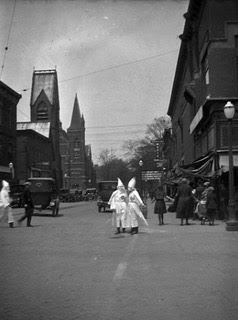
Jeff Gill
Missing stories and broken fragments
___
When I discussed the beginning of the public efforts of the Ku Klux Klan in Licking County, one hundred years ago in January, I knew it would provoke some interesting and I hope useful discussions.
Right from the outset, both in my own social media posts and in this column, I've been hearing back from people who have heard these same stories, and seen the same robes and hoods in family closets (the Klan actually called them "helmets" with "detachable visors," but I'll mostly call them hoods and masks).
I'm talking about stories shared within families and tales told secondhand because there's an interesting gap in the official record. If you go to any library or archive, in person or online, you will find that the Newark Advocate is missing for most of 1923, all of 1924 and 1925, and the first months of 1926.
Year after year before back through the turn of the century, and after 1926 pretty much without a gap to the present day, but the pages of the "first draft of history" in our local daily paper are gone.
They were gone when I first went to the old Newark Public Library as I moved here in August of 1989, and I found the same at the State Archives a few months later in 1990. It's as if a methodical effort was made years ago to erase the published record of the period whose centennial we're passing through.
I went immediately to look what I could find on microfilm (waving at everyone in the audience who remembers microfilm readers, and cranking through history squinting at the images projected onto the hooded screens), or perhaps in older bound volumes, because I had done the same in my hometown of Valparaiso, Indiana in researching our Klan history there. In May of 1923 there was a massive Klan event in Valparaiso, a gathering of 50,000 or more which would only be eclipsed by a larger rally on July 4th in Kokomo, which totaled some 100,000 to possibly 200,000, in attendance from multiple states around the Midwest.
But if you read in the 1970s and 1980s as I did about Klan rallies of the 1920s, you also saw that there were not one but two "konklaves," or state assemblies at a place called Buckeye Lake, Ohio: first in that busy year of 1923 following the Kokomo rally, numbering around 75,000, and another in 1925 which exceeded 100,000.
Spoiler alert: after 1926, this "second era" Klan would collapse in a steaming pile of corruption and graft and rape and murder. The political gains of 1923 and 1924 would not save D.C. Stevenson, Grand Dragon of Indiana from his legal troubles, but not before he bought houses in a nice suburb of Indianapolis and on the shores of Buckeye Lake. The man who said in public, "I am the law" about the influence of his secret society and their thousands of supporters would go to prison, but not before releasing information about membership and officers and deals made with elected officials . . . in Indiana.
So we know a great deal through those court records about the Indiana Klan. In Ohio, not so much. The secret records all disappeared elsewhere after Stevenson's conviction. As I learned while expecting to read contemporary accounts from our local paper about the summer of 1923, someone made them all go away at some point.
Well, not all. Because there are other sources, if not local ones. And locally, even one hundred years later, people have their own stories, those of parents and grandparents and others who once donned robes and hoods and saluted a burning cross, right here in Licking County.
Putting those broken fragments together, a more complete picture comes into view. And one which draws together places like Valparaiso, Indiana and Newark, Ohio.
Jeff Gill is a writer, storyteller, and preacher in central Ohio; he's got a few more of these stories to tell, if you're willing to listen. Tell him what pieces you have at hand through knapsack77@gmail.com, or follow @Knapsack on Twitter.
Klan members in Valparaiso downtown on May 19, 1923
Tuesday, January 31, 2023
Notes from my Knapsack 2-9-23
Notes from my Knapsack 2-9-23
Jeff Gill
Engaged in a losing proposition
___
When it comes to weight loss, the best advice always is to take it slowly, not to go after crash diets and drastic measures.
Which makes sense.
So I have some good news and bad news on that front. I've lost 72 pounds, which is a large amount, but over three years. Taking that long is supposed to a good way to lose weight, and perhaps to keep it off.
Losing the 72 pounds over three years should be the good news, but the bad news is I've lost twelve pounds twice a year, six times over.
Right: if you're good at math, which is a great skill to have, you've figured out I weigh about what I did as 2020 dawned.
Given the time period, we can talk about COVID and restrictions and changes in social patterns and doom scrolling and stress eating, but I'll just sum up by saying I'm much better at gaining weight than losing it. Not that I can't lose it: 72 pounds! But it comes back.
I have plenty of excuses and personal justifications for my lack of exercise (at least consistent exercise) and poor nutritional choices (those darn ads for pizza!), but I also know there's lots of company out there. My suspicion is a number of you are already doing the math to figure out, if you use my admittedly odd metric, how much weight you've lost in the last few years. Many of you might well be ahead of me.
Meanwhile, I am working with an elderly relative who keeps losing weight who really shouldn't be. This gets complex and challenging to explain, and I won't (yes, I know about those cans of calorie rich shake-like stuff, and no, they won't drink it), but the irony here is that of the great many friends and fellow travelers through this bourn who are also or have previously cared for very elderly family members all say "let them eat whatever they want!" Oh, and I am. But the nutritional value of "whatever they want" can make the average picky toddler's diet sound healthy.
So I oscillate between a senior who eats truly unhealthy stuff and is losing weight, and trying to be more judicious and healthful in my own pantry, but end up putting weight back on (yes, and eating in my car is not a ticket to good health, but as my doctor says with a grin "you can carry apples in your car as easily as you buy a bag of chips, can't you?").
If I actually stayed 72 pounds less than I am right now, I'd likely have medical worries right there. That's not my actual goal. My real goal is not to sit in a car for ten to twelve hours a week, and that's where lifestyle choices get much more dramatic than choosing between fresh fruit and real imitation processed cheese food.
Jeff Gill is a writer, storyteller, and preacher in central Ohio; he's fit as a fiddle if by that you mean shaped like one. Tell him how you stay healthy in the wintertime at knapsack77@gmail.com, or follow @Knapsack on Twitter.
Jeff Gill
Engaged in a losing proposition
___
When it comes to weight loss, the best advice always is to take it slowly, not to go after crash diets and drastic measures.
Which makes sense.
So I have some good news and bad news on that front. I've lost 72 pounds, which is a large amount, but over three years. Taking that long is supposed to a good way to lose weight, and perhaps to keep it off.
Losing the 72 pounds over three years should be the good news, but the bad news is I've lost twelve pounds twice a year, six times over.
Right: if you're good at math, which is a great skill to have, you've figured out I weigh about what I did as 2020 dawned.
Given the time period, we can talk about COVID and restrictions and changes in social patterns and doom scrolling and stress eating, but I'll just sum up by saying I'm much better at gaining weight than losing it. Not that I can't lose it: 72 pounds! But it comes back.
I have plenty of excuses and personal justifications for my lack of exercise (at least consistent exercise) and poor nutritional choices (those darn ads for pizza!), but I also know there's lots of company out there. My suspicion is a number of you are already doing the math to figure out, if you use my admittedly odd metric, how much weight you've lost in the last few years. Many of you might well be ahead of me.
Meanwhile, I am working with an elderly relative who keeps losing weight who really shouldn't be. This gets complex and challenging to explain, and I won't (yes, I know about those cans of calorie rich shake-like stuff, and no, they won't drink it), but the irony here is that of the great many friends and fellow travelers through this bourn who are also or have previously cared for very elderly family members all say "let them eat whatever they want!" Oh, and I am. But the nutritional value of "whatever they want" can make the average picky toddler's diet sound healthy.
So I oscillate between a senior who eats truly unhealthy stuff and is losing weight, and trying to be more judicious and healthful in my own pantry, but end up putting weight back on (yes, and eating in my car is not a ticket to good health, but as my doctor says with a grin "you can carry apples in your car as easily as you buy a bag of chips, can't you?").
If I actually stayed 72 pounds less than I am right now, I'd likely have medical worries right there. That's not my actual goal. My real goal is not to sit in a car for ten to twelve hours a week, and that's where lifestyle choices get much more dramatic than choosing between fresh fruit and real imitation processed cheese food.
Jeff Gill is a writer, storyteller, and preacher in central Ohio; he's fit as a fiddle if by that you mean shaped like one. Tell him how you stay healthy in the wintertime at knapsack77@gmail.com, or follow @Knapsack on Twitter.
Sunday, January 29, 2023
Faith Works 2-3-23
Faith Works 2-3-23
Jeff Gill
When visitors to church are not welcome
___
Exactly one hundred years ago, this newspaper and other Midwest publications started printing descriptions of church services in Newark and Licking County from the Sundays just before.
On January 21 and 28, in different locations around the area, groups of men in hoods and gowns silently entered after worship had begun, and left behind envelopes filled with money.
The Ku Klux Klan had come to town. This was what's called today the "second era" of the Klan. The first was a guerrilla organization led by Confederate veterans which fought Reconstruction; after the shameful settlement following the Tilden-Hayes election of 1876, Union troops were removed from the Southern states for the most part, and by the end of 1877 segregation and legal discrimination returned to open politics, and the first Klan ended because secrecy was no longer needed. Klan leaders became governors and senators and other officials, exerting their authority out in the open.
The second Klan erupted in the wake of the first major silent film epic, "The Birth of a Nation." 1915 saw a new rise in anxiety over maintaining Jim Crow in the South, and the Midwest was concerned about central and southern Europeans in general, and Catholicism in particular. Imagery out of D.W. Griffith's movie inspired a rebirth of the Klan.
While the second era of the Klan launched in the Atlanta, Georgia area and was quite racist in rhetoric and activity, it was the Midwestern Klan which drove their numbers through the roof, especially after some sales-oriented organizers saw an opportunity in 1921 to turn a simple dues paying model for Klan membership into a form of mutual aid and insurance, and to sell commercially produced gowns and hoods and other regalia at a steep mark-up to new Klansmen, along with a growth model that was very much a multi-level marketing approach. Hate, and modern sales techniques, and soon some Grand Dragons and Imperial Wizards were getting rich, in Atlanta and in Indianapolis.
We know the Ku Klux Klan was active in Licking County at some point in 1922 because on January 18th, 1923 crosses were burnt on high points visible to most of Newark, and in Hanover. They were signals for a mass meeting on the 19th which had around 500 in attendance, all of which points to some serious organization well before the first public cross burnings and church visitations.
As the year went on, events were staged at Sixth Street Park, the county fairgrounds, and other locations around the county with both hooded members and ordinary citizens massed to hear the speakers, who used some of the newfangled "public address system" technology to share their message of hate and exclusion.
What can be confusing if you mostly know the Klan from their post-Civil War, "Gone With the Wind" image, and "Birth of a Nation" simply a call-back to that era, or the third era Klan which emerged during the rise of the Civil Rights movement in the South during the 1950s and 60s, is that the 1920s Klan was biggest in the Midwest, and this second era Klan spat almost all of its bile at the Catholic Church. They presented themselves as protectors of Prohibition, and as opponents to bootleggers, and to the 20s Klan, anyone not in favor of Prohibition was a bootlegger, at least in spirit. They were racist, no doubt, but their public efforts were aimed largely at priests and parishes, arguing "Americanism" could not co-exist with Catholicism.
From 1923 to 1927, the Klan ran our county, politically and culturally, and much of the Midwest. Then it collapsed, and good people as well as guilty parties tried to pretend it never happened. I think we still need to confront and confess and deal with the wounds of that era; you'll learn more about the Klan's impact on churches and the community through this year.
Jeff Gill is a writer, storyteller, and preacher in central Ohio; he's been studying the Klan's Indiana & Ohio history for many years. Tell him about how you've seen the past as a place for present healing at knapsack77@gmail.com, or follow @Knapsack on Twitter.
Jeff Gill
When visitors to church are not welcome
___
Exactly one hundred years ago, this newspaper and other Midwest publications started printing descriptions of church services in Newark and Licking County from the Sundays just before.
On January 21 and 28, in different locations around the area, groups of men in hoods and gowns silently entered after worship had begun, and left behind envelopes filled with money.
The Ku Klux Klan had come to town. This was what's called today the "second era" of the Klan. The first was a guerrilla organization led by Confederate veterans which fought Reconstruction; after the shameful settlement following the Tilden-Hayes election of 1876, Union troops were removed from the Southern states for the most part, and by the end of 1877 segregation and legal discrimination returned to open politics, and the first Klan ended because secrecy was no longer needed. Klan leaders became governors and senators and other officials, exerting their authority out in the open.
The second Klan erupted in the wake of the first major silent film epic, "The Birth of a Nation." 1915 saw a new rise in anxiety over maintaining Jim Crow in the South, and the Midwest was concerned about central and southern Europeans in general, and Catholicism in particular. Imagery out of D.W. Griffith's movie inspired a rebirth of the Klan.
While the second era of the Klan launched in the Atlanta, Georgia area and was quite racist in rhetoric and activity, it was the Midwestern Klan which drove their numbers through the roof, especially after some sales-oriented organizers saw an opportunity in 1921 to turn a simple dues paying model for Klan membership into a form of mutual aid and insurance, and to sell commercially produced gowns and hoods and other regalia at a steep mark-up to new Klansmen, along with a growth model that was very much a multi-level marketing approach. Hate, and modern sales techniques, and soon some Grand Dragons and Imperial Wizards were getting rich, in Atlanta and in Indianapolis.
We know the Ku Klux Klan was active in Licking County at some point in 1922 because on January 18th, 1923 crosses were burnt on high points visible to most of Newark, and in Hanover. They were signals for a mass meeting on the 19th which had around 500 in attendance, all of which points to some serious organization well before the first public cross burnings and church visitations.
As the year went on, events were staged at Sixth Street Park, the county fairgrounds, and other locations around the county with both hooded members and ordinary citizens massed to hear the speakers, who used some of the newfangled "public address system" technology to share their message of hate and exclusion.
What can be confusing if you mostly know the Klan from their post-Civil War, "Gone With the Wind" image, and "Birth of a Nation" simply a call-back to that era, or the third era Klan which emerged during the rise of the Civil Rights movement in the South during the 1950s and 60s, is that the 1920s Klan was biggest in the Midwest, and this second era Klan spat almost all of its bile at the Catholic Church. They presented themselves as protectors of Prohibition, and as opponents to bootleggers, and to the 20s Klan, anyone not in favor of Prohibition was a bootlegger, at least in spirit. They were racist, no doubt, but their public efforts were aimed largely at priests and parishes, arguing "Americanism" could not co-exist with Catholicism.
From 1923 to 1927, the Klan ran our county, politically and culturally, and much of the Midwest. Then it collapsed, and good people as well as guilty parties tried to pretend it never happened. I think we still need to confront and confess and deal with the wounds of that era; you'll learn more about the Klan's impact on churches and the community through this year.
Jeff Gill is a writer, storyteller, and preacher in central Ohio; he's been studying the Klan's Indiana & Ohio history for many years. Tell him about how you've seen the past as a place for present healing at knapsack77@gmail.com, or follow @Knapsack on Twitter.
Monday, January 23, 2023
Faith Works 1-27-23
Faith Works 1-27-23
Jeff Gill
It's still cold out there
___
Five years ago at the end of January, a number of churches came together and did a new thing. A wide assortment of people, motivated by a variety of faith perspectives and beliefs about God, humanity, and community, pitched in to create a solution when there wasn't any obvious answer.
Our first community emergency overnight warming center was opened at the end of January, 2018, because it was about to reach ten degrees below zero even without wind chill effects, with heavy wet snow right behind something called a "polar vortex" . . . and speaking for myself, I'd never heard of such a thing before.
We all knew it could get cold in Licking County during the winter, and some nights bitterly so. Some of us knew there were people who are what's called unsheltered homeless, not in an emergency shelter of a traditional sort, who were getting by "sleeping rough," in a variety of doorways and stairwells and creek banks around the downtown area. Then and now, the total numbers are open for question, but anyone involved with people who were dealing with homelessness knew we had at least dozens who were unsheltered, in tents or under tarps or sleeping in cars, with that polar vortex on the way.
And while our formal shelters were doing the best they could, they had children and families already in residence. A few emails and calls confirmed there just was no provision in place for people who were unsheltered. So a few more phone calls and emails and social media blasts later, some churches and groups and individuals said "we're going to do it, and figure it out as we go."
Five years later, we still are. Figuring it out, that is. Such as the question of when we open up an emergency warming shelter. The threat of negative ten or worse mobilized us in 2018 (as I recall, it hit minus thirteen that first night, and windchills were frightful), and we ended up opening between two church locations for six nights that winter. A group of us working on the issue set the benchmark at 10 degrees, then bumped it up to 15 degrees forecast lows as our criteria for planning to be open last year, but we ended up providing 15 nights of shelter, which pushed our capacity to the brink, so we nudged the threshold back to 10 degrees this winter.
What we hadn't dealt with before was having our first season's warming shelter needing to open on Christmas Eve, which is what happened last month. Volunteers, which is what we all are, can be hard to pin down for Dec. 24 or 25, but they came through; church buildings are busy Christmas Eve, but our hosts this year were good innkeepers, let's say. Everything else closed, as we were opening up. But it was going to be cold outside. So we opened up, and for the first time stayed open 65 hours straight, because there was no other answer out there.
Over the last five years, people came together. Churches opened doors; some realized this program may not work at their location, but we appreciate every building that has hosted or even considered it. Volunteers have come and gone; a few keep coming back, and often they end up helping guide the effort.
Listing every church and organization that has shared in this effort would take my whole space and the rest of the page. And this isn't where we're going to recruit or announce training for volunteers: watch Newark Homeless Outreach on social media for more on that, and the Licking County Health Department helps with our outreach along with Pathways.
I just want to remind all those who read this: it's still cold out there. And when it's deadly cold, we have to do something. The emergency warming centers are not much, but they're something. Something, I have to say, that is marvelous, and even occasionally, something miraculous.
Jeff Gill is a writer, storyteller, and preacher in central Ohio; he's proud to have been involved with this effort, and happy to invite others to join. Tell him where you see our community coming together at knapsack77@gmail.com or follow @Knapsack on Twitter.
Jeff Gill
It's still cold out there
___
Five years ago at the end of January, a number of churches came together and did a new thing. A wide assortment of people, motivated by a variety of faith perspectives and beliefs about God, humanity, and community, pitched in to create a solution when there wasn't any obvious answer.
Our first community emergency overnight warming center was opened at the end of January, 2018, because it was about to reach ten degrees below zero even without wind chill effects, with heavy wet snow right behind something called a "polar vortex" . . . and speaking for myself, I'd never heard of such a thing before.
We all knew it could get cold in Licking County during the winter, and some nights bitterly so. Some of us knew there were people who are what's called unsheltered homeless, not in an emergency shelter of a traditional sort, who were getting by "sleeping rough," in a variety of doorways and stairwells and creek banks around the downtown area. Then and now, the total numbers are open for question, but anyone involved with people who were dealing with homelessness knew we had at least dozens who were unsheltered, in tents or under tarps or sleeping in cars, with that polar vortex on the way.
And while our formal shelters were doing the best they could, they had children and families already in residence. A few emails and calls confirmed there just was no provision in place for people who were unsheltered. So a few more phone calls and emails and social media blasts later, some churches and groups and individuals said "we're going to do it, and figure it out as we go."
Five years later, we still are. Figuring it out, that is. Such as the question of when we open up an emergency warming shelter. The threat of negative ten or worse mobilized us in 2018 (as I recall, it hit minus thirteen that first night, and windchills were frightful), and we ended up opening between two church locations for six nights that winter. A group of us working on the issue set the benchmark at 10 degrees, then bumped it up to 15 degrees forecast lows as our criteria for planning to be open last year, but we ended up providing 15 nights of shelter, which pushed our capacity to the brink, so we nudged the threshold back to 10 degrees this winter.
What we hadn't dealt with before was having our first season's warming shelter needing to open on Christmas Eve, which is what happened last month. Volunteers, which is what we all are, can be hard to pin down for Dec. 24 or 25, but they came through; church buildings are busy Christmas Eve, but our hosts this year were good innkeepers, let's say. Everything else closed, as we were opening up. But it was going to be cold outside. So we opened up, and for the first time stayed open 65 hours straight, because there was no other answer out there.
Over the last five years, people came together. Churches opened doors; some realized this program may not work at their location, but we appreciate every building that has hosted or even considered it. Volunteers have come and gone; a few keep coming back, and often they end up helping guide the effort.
Listing every church and organization that has shared in this effort would take my whole space and the rest of the page. And this isn't where we're going to recruit or announce training for volunteers: watch Newark Homeless Outreach on social media for more on that, and the Licking County Health Department helps with our outreach along with Pathways.
I just want to remind all those who read this: it's still cold out there. And when it's deadly cold, we have to do something. The emergency warming centers are not much, but they're something. Something, I have to say, that is marvelous, and even occasionally, something miraculous.
Jeff Gill is a writer, storyteller, and preacher in central Ohio; he's proud to have been involved with this effort, and happy to invite others to join. Tell him where you see our community coming together at knapsack77@gmail.com or follow @Knapsack on Twitter.
Thursday, January 05, 2023
Notes from my Knapsack 1-26-23
Notes from my Knapsack 1-26-23
Jeff Gill
Five years, progress still needed
___
Five years ago as January was nearing its end, something new was heading our way.
A "polar vortex" was forecast to rumble across central Ohio, with lows in the negative two digits. I'd been involved in housing and homelessness responses in Licking County since 1992, and knew from recent work in the community we had at minimum dozens of unsheltered homeless, people who for a variety of reasons were outside of the hatful of emergency shelters we had and blessedly do have in our area.
Whatever the reason, the expected ten below and half a foot of snow was going to put unbearable stress on the lives of people living without shelter, so I did some checking around, by phone and email, for what our emergency response plan was. To boil down a slew of communications, the replies came down to "yeah, we need to think about that, too; maybe next year."
So I called a few leaders of the church I served in 2018, and another person seeing the same grim prospects heading our way did the same. Over the next three nights, a motley array of volunteers and donated materials came into two church basements that opened hearts and doors to sheltering people who had nowhere else to go.
I'll be blunt: when people ask me if it worked, my reply was "no one died." That's really what was at stake. It got to minus thirteen at my location, and not my tongue but my fingertips did, in fact, stick to the metal of the church sign as I was putting up a notice that we were open. I went inside to warm up before I did the other side. It was dangerously cold. We were not trying to save souls or herd people into recovery or even urge folks to sign up for housing programs, though information was made available, and a few individuals asked to pray upstairs.
But we did this simply to ensure that, unlike some other places around Ohio and the Midwest, we didn't let death end a person's story. I heard those nights myriad reasons why people were homeless; some stories made sense and put a chill down my back in a warm basement, and others didn't quite add up, but I heard them out, offered what support and guidance we could. Most of them had a plan, some realistic, others less so, but they all had a dream of not living like this, sooner or later. The point of the warming shelter was to give them a chance to work out those dreams in practical terms, in due time.
That's still why we do it. Later on in 2019 we were blessed with the support of the Licking County Foundation to put together a Warming Center Task Force. It's still volunteers and church basements and bits and pieces of a plan. We set a guideline of opening up if it got colder than 10 degrees overnight, bumped it up to 15 degree overnight lows, and this past year pushed it back to 10 degrees simply because we are NOT trying to stay open all winter.
The emergency warming centers are not a solution for anything, honestly. They exist, when the steering committee decides to open, to save lives. You could make a case for being open whenever it's below freezing at night, but that's a different program and frankly it can't work on an all volunteer basis. Thank you to the many of you reading this who have helped out, in large ways and small.
The work continues, the solutions imperfect, but where there is life, there is hope.
Jeff Gill is a writer, storyteller, and preacher in central Ohio; he's been cold, but not that cold. Tell him how you keep your heart warm at knapsack77@gmail.com, or follow @Knapsack on Twitter.
Jeff Gill
Five years, progress still needed
___
Five years ago as January was nearing its end, something new was heading our way.
A "polar vortex" was forecast to rumble across central Ohio, with lows in the negative two digits. I'd been involved in housing and homelessness responses in Licking County since 1992, and knew from recent work in the community we had at minimum dozens of unsheltered homeless, people who for a variety of reasons were outside of the hatful of emergency shelters we had and blessedly do have in our area.
Whatever the reason, the expected ten below and half a foot of snow was going to put unbearable stress on the lives of people living without shelter, so I did some checking around, by phone and email, for what our emergency response plan was. To boil down a slew of communications, the replies came down to "yeah, we need to think about that, too; maybe next year."
So I called a few leaders of the church I served in 2018, and another person seeing the same grim prospects heading our way did the same. Over the next three nights, a motley array of volunteers and donated materials came into two church basements that opened hearts and doors to sheltering people who had nowhere else to go.
I'll be blunt: when people ask me if it worked, my reply was "no one died." That's really what was at stake. It got to minus thirteen at my location, and not my tongue but my fingertips did, in fact, stick to the metal of the church sign as I was putting up a notice that we were open. I went inside to warm up before I did the other side. It was dangerously cold. We were not trying to save souls or herd people into recovery or even urge folks to sign up for housing programs, though information was made available, and a few individuals asked to pray upstairs.
But we did this simply to ensure that, unlike some other places around Ohio and the Midwest, we didn't let death end a person's story. I heard those nights myriad reasons why people were homeless; some stories made sense and put a chill down my back in a warm basement, and others didn't quite add up, but I heard them out, offered what support and guidance we could. Most of them had a plan, some realistic, others less so, but they all had a dream of not living like this, sooner or later. The point of the warming shelter was to give them a chance to work out those dreams in practical terms, in due time.
That's still why we do it. Later on in 2019 we were blessed with the support of the Licking County Foundation to put together a Warming Center Task Force. It's still volunteers and church basements and bits and pieces of a plan. We set a guideline of opening up if it got colder than 10 degrees overnight, bumped it up to 15 degree overnight lows, and this past year pushed it back to 10 degrees simply because we are NOT trying to stay open all winter.
The emergency warming centers are not a solution for anything, honestly. They exist, when the steering committee decides to open, to save lives. You could make a case for being open whenever it's below freezing at night, but that's a different program and frankly it can't work on an all volunteer basis. Thank you to the many of you reading this who have helped out, in large ways and small.
The work continues, the solutions imperfect, but where there is life, there is hope.
Jeff Gill is a writer, storyteller, and preacher in central Ohio; he's been cold, but not that cold. Tell him how you keep your heart warm at knapsack77@gmail.com, or follow @Knapsack on Twitter.
Tuesday, January 03, 2023
Faith Works 1-20-23
Faith Works 1-20-23
Jeff Gill
Faithful fitness deep in wintertime
___
How's that resolution going?
Yep, rhetorical question. I know, it's not going well, because they rarely do. You haven't read me recommending resolutions for a new year, because I just don't see them as a good tool for self-change. Great for gym memberships, terrible for transformation.
Speaking pastorally, I've got to start out by saying, and as a Christian I'm going to Jesus this up a bit: you really need to do some spiritual surrender to see your life change, and not try harder. Seriously. (Or srsly, if I were texting you this.)
It all starts with God, and about God. It's a God thing, I'm saying. So much personal improvement runs onto the rocks of "me"; not so much in terms of selfishness, but in framing the issue as something you can and should and must do. I must put myself on the path to change, I must do the work, I must be able to . . .
Look, I have a gospel message for you. God loves you. Exactly as you are. Period.
Yeah, I hear the chorus: but God hates sin, God doesn't love brokenness, we are called and chosen to . . . fine, all true, but let's start where Jesus started. Not where most personal trainers start. You are a beloved child of the Most High right where you are, whatever your weight or resting heart rate is. God loves you, and has a plan and a purpose for you. Rest in THAT, please, and get rooted in that. Now. To start with. As you are.
Got it? God loves you, and yes, loves you so much that you might just find God working to move you somewhere different than where you are right now. Where? I may not be the best person to answer that. You and God can, though. You don't talk to God much? Well, that's my one personal trainer, physical fitness mandate to offer. You should spend more time getting in tune with, in listening to God, until you have some faint sweet sense that you are hearing where God wants you to go.
I strongly doubt that will mean running for most of you. But I have a friend who finds God out there on the running track or plodding along the slushy streets even in winter, putting in miles, and communing with the Lord. That's not a commandment for us all, that is his communion.
Again, the point is not that you put more effort or work or will power into trying to do what God wants out of you: God loves you. Know that. And in accepting that knowledge, and living into it, I firmly believe you will find a path opening for you.
That path might go to and through a gym, a program, a coach, a friend or accountability partner; God might guide you around the block, to the park, or just around your living room in high-stepping during the commercials as you watch TV. You may adjust your diet, but I have to admit I don't even like that word. Too much baggage, I say, and I'm a preacher who likes to try to renew words with baggage, like repentance and salvation. But the word diet may just be beyond redemption.
Just eat, eat what you like, and more importantly, eat what blesses you. And I do believe that if you come to an awareness of how God is at work in you already, you'll figure out what to eat to live, and be blessed, and in communion with God's purposes.
Maybe even with some bread and wine.
Jeff Gill is a writer, storyteller, and preacher in central Ohio; he's working on both surrender and acceptance, and praying for health as a consequence, not a reward. Tell him how you stay fit for God's glory at knapsack77@gmail.com, or follow @Knapsack on Twitter.
Jeff Gill
Faithful fitness deep in wintertime
___
How's that resolution going?
Yep, rhetorical question. I know, it's not going well, because they rarely do. You haven't read me recommending resolutions for a new year, because I just don't see them as a good tool for self-change. Great for gym memberships, terrible for transformation.
Speaking pastorally, I've got to start out by saying, and as a Christian I'm going to Jesus this up a bit: you really need to do some spiritual surrender to see your life change, and not try harder. Seriously. (Or srsly, if I were texting you this.)
It all starts with God, and about God. It's a God thing, I'm saying. So much personal improvement runs onto the rocks of "me"; not so much in terms of selfishness, but in framing the issue as something you can and should and must do. I must put myself on the path to change, I must do the work, I must be able to . . .
Look, I have a gospel message for you. God loves you. Exactly as you are. Period.
Yeah, I hear the chorus: but God hates sin, God doesn't love brokenness, we are called and chosen to . . . fine, all true, but let's start where Jesus started. Not where most personal trainers start. You are a beloved child of the Most High right where you are, whatever your weight or resting heart rate is. God loves you, and has a plan and a purpose for you. Rest in THAT, please, and get rooted in that. Now. To start with. As you are.
Got it? God loves you, and yes, loves you so much that you might just find God working to move you somewhere different than where you are right now. Where? I may not be the best person to answer that. You and God can, though. You don't talk to God much? Well, that's my one personal trainer, physical fitness mandate to offer. You should spend more time getting in tune with, in listening to God, until you have some faint sweet sense that you are hearing where God wants you to go.
I strongly doubt that will mean running for most of you. But I have a friend who finds God out there on the running track or plodding along the slushy streets even in winter, putting in miles, and communing with the Lord. That's not a commandment for us all, that is his communion.
Again, the point is not that you put more effort or work or will power into trying to do what God wants out of you: God loves you. Know that. And in accepting that knowledge, and living into it, I firmly believe you will find a path opening for you.
That path might go to and through a gym, a program, a coach, a friend or accountability partner; God might guide you around the block, to the park, or just around your living room in high-stepping during the commercials as you watch TV. You may adjust your diet, but I have to admit I don't even like that word. Too much baggage, I say, and I'm a preacher who likes to try to renew words with baggage, like repentance and salvation. But the word diet may just be beyond redemption.
Just eat, eat what you like, and more importantly, eat what blesses you. And I do believe that if you come to an awareness of how God is at work in you already, you'll figure out what to eat to live, and be blessed, and in communion with God's purposes.
Maybe even with some bread and wine.
Jeff Gill is a writer, storyteller, and preacher in central Ohio; he's working on both surrender and acceptance, and praying for health as a consequence, not a reward. Tell him how you stay fit for God's glory at knapsack77@gmail.com, or follow @Knapsack on Twitter.
Faith Works 1-13-23
Faith Works 1-13-23
Jeff Gill
Considerations post- and pre-Christmases to come
___
When I was in elementary school, and Walt Disney World was newly opened in Florida, it was a point of amazement and no little envy that one of our classmates announced her family was going to spend Christmas, as in Christmas Eve and Christmas Day itself plus another day or two, at the Magic Kingdom.
It was a mix of fascination with Uncle Walt's creation in those swamps and orange groves, and a touch of horror at the idea of not spending Christmas, well, at home. Home, be it ever so humble, et cetera. Your own house, with your own tree, and your family traditions no matter how peculiar (don't ask, we all have 'em). To spend Christmas walking past Cinderella's Castle and Mister Toad's Wild Ride just seemed borderline unimaginable.
Later on I would start to find out what it is like to Christmas, if I can verb that noun, in a strange place. It's not all bad, you bring your traditions with you to the degree that you can, and you learn about those of others. It can make Christmas feel more special, and helps you think about "the reason for the season," the birth of that child whose life would transform the old familiar broken world.
This past holiday season made me think very sternly about the holidays I have ahead. Practically speaking, while I'm blessed with relatively excellent health and full mobility, it would be foolish not to realize I can't assume at 86 or so I can, well, walk ten miles a day as a tourist, or feel confident about navigating whatever travel logistics are necessary when I'm another couple of decades older.
Which boils down to this: I've got about twenty years left where I could do something away from home. Two-zero, two decades' worth. A very envision-able number. Realistically, there will be family needs which trim that number down, let alone costs and budgets restricting just how wild I can get. But if I want to do a different sort of Christmas, I'd better get cracking.
Epcot can take care of itself, I don't want to spend a Christmas there, but I'm reliably told it can be great fun. But my wife and I have pitched Paris and London back and forth for years, just to go in the first place, let alone during a holiday season. We band-parented our way to Manhattan during Thanksgiving week a few years ago, and that box is checked. But would we want to see the Eiffel Tower decorated for Joyeux Noel, or see Westminster Abbey adorned for Advent?
We've been blessed to visit Santa Fe a number of times, but always in the summer. I've long wondered what it would be like to see the Sangre de Cristos in the winter, and Archbishop Lamy's cathedral at Christmastime. An internet acquaintance with no more Spanish than I have went to a small village in Mexico, and intrigued me deeply with what that experience would be like in some future December. My wife got to visit Finland for work across a first weekend of Advent, and loved it, and would love to take me there to experience more of it.
And I really can't explain it, but I'd love to visit Vienna around Christmas. I can't explain it, haven't heard a great deal about it, but what I have heard has me wanting to go there. Oh, and Mackinac Island, which can be seen as December ends, but it takes some planning.
If I'm even going to do a couple of those, I need to start planning now. What have you long dreamed of experiencing during the holidays?
Jeff Gill is a writer, storyteller, and preacher in central Ohio; he's imagined all sorts of trips he's not likely to take. Tell him what your grand tour looks like at knapsack77@gmail.com, or follow @Knapsack on Twitter.
Jeff Gill
Considerations post- and pre-Christmases to come
___
When I was in elementary school, and Walt Disney World was newly opened in Florida, it was a point of amazement and no little envy that one of our classmates announced her family was going to spend Christmas, as in Christmas Eve and Christmas Day itself plus another day or two, at the Magic Kingdom.
It was a mix of fascination with Uncle Walt's creation in those swamps and orange groves, and a touch of horror at the idea of not spending Christmas, well, at home. Home, be it ever so humble, et cetera. Your own house, with your own tree, and your family traditions no matter how peculiar (don't ask, we all have 'em). To spend Christmas walking past Cinderella's Castle and Mister Toad's Wild Ride just seemed borderline unimaginable.
Later on I would start to find out what it is like to Christmas, if I can verb that noun, in a strange place. It's not all bad, you bring your traditions with you to the degree that you can, and you learn about those of others. It can make Christmas feel more special, and helps you think about "the reason for the season," the birth of that child whose life would transform the old familiar broken world.
This past holiday season made me think very sternly about the holidays I have ahead. Practically speaking, while I'm blessed with relatively excellent health and full mobility, it would be foolish not to realize I can't assume at 86 or so I can, well, walk ten miles a day as a tourist, or feel confident about navigating whatever travel logistics are necessary when I'm another couple of decades older.
Which boils down to this: I've got about twenty years left where I could do something away from home. Two-zero, two decades' worth. A very envision-able number. Realistically, there will be family needs which trim that number down, let alone costs and budgets restricting just how wild I can get. But if I want to do a different sort of Christmas, I'd better get cracking.
Epcot can take care of itself, I don't want to spend a Christmas there, but I'm reliably told it can be great fun. But my wife and I have pitched Paris and London back and forth for years, just to go in the first place, let alone during a holiday season. We band-parented our way to Manhattan during Thanksgiving week a few years ago, and that box is checked. But would we want to see the Eiffel Tower decorated for Joyeux Noel, or see Westminster Abbey adorned for Advent?
We've been blessed to visit Santa Fe a number of times, but always in the summer. I've long wondered what it would be like to see the Sangre de Cristos in the winter, and Archbishop Lamy's cathedral at Christmastime. An internet acquaintance with no more Spanish than I have went to a small village in Mexico, and intrigued me deeply with what that experience would be like in some future December. My wife got to visit Finland for work across a first weekend of Advent, and loved it, and would love to take me there to experience more of it.
And I really can't explain it, but I'd love to visit Vienna around Christmas. I can't explain it, haven't heard a great deal about it, but what I have heard has me wanting to go there. Oh, and Mackinac Island, which can be seen as December ends, but it takes some planning.
If I'm even going to do a couple of those, I need to start planning now. What have you long dreamed of experiencing during the holidays?
Jeff Gill is a writer, storyteller, and preacher in central Ohio; he's imagined all sorts of trips he's not likely to take. Tell him what your grand tour looks like at knapsack77@gmail.com, or follow @Knapsack on Twitter.
Friday, December 30, 2022
Faith Works 1-6-23
Faith Works 1-6-23
Jeff Gill
How far would you travel to know
___
Epiphany, also known as the Twelfth Day of Christmas, is necessarily on January the Sixth.
In the Christian calendar it marks the visit of the Magi, or "wise men from the East" in certain translations, to the presence of the newborn Jesus and his parents, Mary and Joseph.
In parts of Christendom, Epiphany is the day for gifts and celebration; in our neck of the woods, it's when the tree comes down if it hadn't long before. Across the history of Biblical interpretation around the birth of Jesus, from Balaam's prophecy in the Book of Numbers to the statements about camels and gifts in Isaiah, to the nativity tale in Matthew's Gospel, these mages, these wise folk, astronomers or perhaps astrologers, bearing three gifts whether that's how many of them there were or not, are said to have traveled.
They came from the east, the tribes and nations and peoples beyond the conquering arc of Alexander the Great, extending beyond the orbit of the Pax Romana. In this place beyond everything familiar, there were wise people who watched the skies and the stars, and who saw signs leading them first to Jerusalem in Judea, and then on to Bethlehem (or Nazareth, some suggest, but the question is open).
We don't get the details in the Matthean account, but we are told the consequences. The Magi traveled a long distance, which took a long time, across hazardous terrain. They entered a place they didn't know before, they had the boldness needed to approach the court of a distant king, by the name of Herod, and they continued even when they realized they'd backed into some vicious internecine conflict in this land.
Somehow, in some way, the movements of stars and planets and their positions in relation to the circling constellations, all told these intrepid pilgrims there was good news of some sort worth taking the effort to see first hand. Which leads me to a question.
Mark Twain in his "Innocents Abroad" of 1869 said: "To do something, say something, see something, before anybody else — these are the things that confer a pleasure compared with other pleasures are tame and commonplace, other ecstasies cheap and trivial. Lifetimes of ecstasy crowded into a single moment." Is this why the Magi came to the manger?
Contrariwise, Samuel Johnson in the late 1700s told potential tourists about a site in northern Ireland: "[The Giant's Causeway] is worth seeing, but not worth the effort of going to see." Yet the Magi, without knowing for sure what or who it was they would see at the end of their journey, continued on in the face of dangers and distractions and surely just the temptation to turn around and go home, where they had no doubt comfortable beds and knew in their sleep where the alarm clock was, to reach out and turn it off and doze another half hour.
Which makes one lesson of Epiphany, for me, this question: what news would motivate and empower me to make that kind of trip? Is there out there any learning or knowledge or illumination that I need or want enough I'd cross the Tigris AND the Euphrates to reach?
What possible information would keep me atop a camel, across a desert, and in defiance of a king's powerful and vicious will, to gain for myself, to know firsthand and see face to face?
My your Epiphany start you off on a journey of illumination and inspiration in 2023.
Jeff Gill is a writer, storyteller, and preacher in central Ohio; he's made some trips, but usually just to see family. Tell him what's put you on the road to find what you're looking for at knapsack77@gmail.com, or follow @Knapsack on Twitter.
Jeff Gill
How far would you travel to know
___
Epiphany, also known as the Twelfth Day of Christmas, is necessarily on January the Sixth.
In the Christian calendar it marks the visit of the Magi, or "wise men from the East" in certain translations, to the presence of the newborn Jesus and his parents, Mary and Joseph.
In parts of Christendom, Epiphany is the day for gifts and celebration; in our neck of the woods, it's when the tree comes down if it hadn't long before. Across the history of Biblical interpretation around the birth of Jesus, from Balaam's prophecy in the Book of Numbers to the statements about camels and gifts in Isaiah, to the nativity tale in Matthew's Gospel, these mages, these wise folk, astronomers or perhaps astrologers, bearing three gifts whether that's how many of them there were or not, are said to have traveled.
They came from the east, the tribes and nations and peoples beyond the conquering arc of Alexander the Great, extending beyond the orbit of the Pax Romana. In this place beyond everything familiar, there were wise people who watched the skies and the stars, and who saw signs leading them first to Jerusalem in Judea, and then on to Bethlehem (or Nazareth, some suggest, but the question is open).
We don't get the details in the Matthean account, but we are told the consequences. The Magi traveled a long distance, which took a long time, across hazardous terrain. They entered a place they didn't know before, they had the boldness needed to approach the court of a distant king, by the name of Herod, and they continued even when they realized they'd backed into some vicious internecine conflict in this land.
Somehow, in some way, the movements of stars and planets and their positions in relation to the circling constellations, all told these intrepid pilgrims there was good news of some sort worth taking the effort to see first hand. Which leads me to a question.
Mark Twain in his "Innocents Abroad" of 1869 said: "To do something, say something, see something, before anybody else — these are the things that confer a pleasure compared with other pleasures are tame and commonplace, other ecstasies cheap and trivial. Lifetimes of ecstasy crowded into a single moment." Is this why the Magi came to the manger?
Contrariwise, Samuel Johnson in the late 1700s told potential tourists about a site in northern Ireland: "[The Giant's Causeway] is worth seeing, but not worth the effort of going to see." Yet the Magi, without knowing for sure what or who it was they would see at the end of their journey, continued on in the face of dangers and distractions and surely just the temptation to turn around and go home, where they had no doubt comfortable beds and knew in their sleep where the alarm clock was, to reach out and turn it off and doze another half hour.
Which makes one lesson of Epiphany, for me, this question: what news would motivate and empower me to make that kind of trip? Is there out there any learning or knowledge or illumination that I need or want enough I'd cross the Tigris AND the Euphrates to reach?
What possible information would keep me atop a camel, across a desert, and in defiance of a king's powerful and vicious will, to gain for myself, to know firsthand and see face to face?
My your Epiphany start you off on a journey of illumination and inspiration in 2023.
Jeff Gill is a writer, storyteller, and preacher in central Ohio; he's made some trips, but usually just to see family. Tell him what's put you on the road to find what you're looking for at knapsack77@gmail.com, or follow @Knapsack on Twitter.
Notes from my Knapsack 1-5-23
Notes from my Knapsack 1-5-23
Jeff Gill
Taking responsibility, sharing accountability
___
Welcome to a new year, 2023!
Or as Pete Townshend might have said, meet the new year, same as the old year. But I suspect we will get fooled again, now and then.
I do expect new events and changes in circumstances during the coming twelve months, simply because if the last twelve or the dozen before that are any indication, a year is long enough for stuff to happen.
But most of the stuff will be fairly predictable.
One of the challenges for a columnist is to ask of oneself, let alone of readers, what change or transformation or shift is possible, let alone necessary.
For myself and in my own views of the community in which I live, I find myself wrestling often with the tension between personal responsibility and community values. I do think it's important, as a general rule, for individuals to take responsibility for their choices, because that's the best way we can learn from them. If you do something dumb, a bad outcome is a great way to internalize the lesson "don't do that again." A common phrase which I think contains some deep wisdom goes "play stupid games, win stupid prizes."
A modest form of this is one adults wrestle with in Scouting. We can work overtime to ensure every youth has all the items they're supposed to bring when they camp out or do an activity out in nature, away from home and stores and security. But at a certain point, you need to learn the lesson of packing your own gear, checking your supplies, ensuring your own comfort. If you skip layers, and it gets cold in the sleeping bag, you learn things that long night, awaiting the chilly dawn.
We adults are there to ensure safety, and I'd never want a youth in my care to be harmed or hurt or frostbitten just to learn a lesson. But there's a certain amount of discomfort we know it's not our job to prevent, in the interests of the young Scouts themselves.
In the adult world, this gets trickier in matters like, say, harm reduction. If you've never heard of it, let me say it boils down — for me, anyhow — to this: people may make decisions I don't agree with, but no one should die to learn a lesson.
Because death, and I ask y'all to bear with me, is the opposite of any lessons whatsoever. You don't learn anything, at least in an earthly sense, by dying. You cease to learn. And your opportunities to learn new lessons, to make different decisions, end.
This can result in some actions and interventions which cause us as a community to wrestle hard with that interplay between personal responsibility and community values. And I get it that providing life saving interventions to people who keep making the same mistakes which lead to hazard and unconsciousness and near-death seems like we would be not leading people to different decisions.
Except I will say again: death is the end of learning, in any earthly sense. I have good friends with different views on substance use and abuse than my own, but we agree on this: people should be able to live long enough to make different choices. Harm reduction may keep people using dangerous and even illegal substances for longer, but that's longer versus ending. Period.
In 2023, I hope and pray we can have some new conversations about harm reduction, and addiction, and recovery, and hope. Because I have grown tired of having some of the same ones for too many years.
Jeff Gill is a writer, storyteller, and preacher in central Ohio; he's sure we can do better but isn't certain we will. Tell him how our community can balance responsibility and respect at knapsack77@gmail.com, or follow @Knapsack on Twitter.
Jeff Gill
Taking responsibility, sharing accountability
___
Welcome to a new year, 2023!
Or as Pete Townshend might have said, meet the new year, same as the old year. But I suspect we will get fooled again, now and then.
I do expect new events and changes in circumstances during the coming twelve months, simply because if the last twelve or the dozen before that are any indication, a year is long enough for stuff to happen.
But most of the stuff will be fairly predictable.
One of the challenges for a columnist is to ask of oneself, let alone of readers, what change or transformation or shift is possible, let alone necessary.
For myself and in my own views of the community in which I live, I find myself wrestling often with the tension between personal responsibility and community values. I do think it's important, as a general rule, for individuals to take responsibility for their choices, because that's the best way we can learn from them. If you do something dumb, a bad outcome is a great way to internalize the lesson "don't do that again." A common phrase which I think contains some deep wisdom goes "play stupid games, win stupid prizes."
A modest form of this is one adults wrestle with in Scouting. We can work overtime to ensure every youth has all the items they're supposed to bring when they camp out or do an activity out in nature, away from home and stores and security. But at a certain point, you need to learn the lesson of packing your own gear, checking your supplies, ensuring your own comfort. If you skip layers, and it gets cold in the sleeping bag, you learn things that long night, awaiting the chilly dawn.
We adults are there to ensure safety, and I'd never want a youth in my care to be harmed or hurt or frostbitten just to learn a lesson. But there's a certain amount of discomfort we know it's not our job to prevent, in the interests of the young Scouts themselves.
In the adult world, this gets trickier in matters like, say, harm reduction. If you've never heard of it, let me say it boils down — for me, anyhow — to this: people may make decisions I don't agree with, but no one should die to learn a lesson.
Because death, and I ask y'all to bear with me, is the opposite of any lessons whatsoever. You don't learn anything, at least in an earthly sense, by dying. You cease to learn. And your opportunities to learn new lessons, to make different decisions, end.
This can result in some actions and interventions which cause us as a community to wrestle hard with that interplay between personal responsibility and community values. And I get it that providing life saving interventions to people who keep making the same mistakes which lead to hazard and unconsciousness and near-death seems like we would be not leading people to different decisions.
Except I will say again: death is the end of learning, in any earthly sense. I have good friends with different views on substance use and abuse than my own, but we agree on this: people should be able to live long enough to make different choices. Harm reduction may keep people using dangerous and even illegal substances for longer, but that's longer versus ending. Period.
In 2023, I hope and pray we can have some new conversations about harm reduction, and addiction, and recovery, and hope. Because I have grown tired of having some of the same ones for too many years.
Jeff Gill is a writer, storyteller, and preacher in central Ohio; he's sure we can do better but isn't certain we will. Tell him how our community can balance responsibility and respect at knapsack77@gmail.com, or follow @Knapsack on Twitter.
Subscribe to:
Comments (Atom)