Wednesday, April 13, 2011

Faith Works 4-16

Faith Works 4-16-11

Jeff Gill


A Week That Changed the World

___


This Friday, in a variety of ways and at a number of locations, the events of some two thousand years ago in a Roman backwater outpost, putting down a possible popular rebellion, will be remembered.


That's remarkable in and of itself, right there.


A handful of revolutionaries and agitators getting their leaders snatched and executed, as any imperial functionary knows, usually disappears back into the woodwork or woods or wood and plaster hovels from whence they came.


A few years later, even their closest associates have forgotten the names of the leaders, the disappeared, those who were cut down. If they are remembered, it's more for trying to figure out what they did wrong so the next attempt at revolution can succeed. The person themselves becomes a lost note played on an uncertain trumpet, whipped away on the wind.


Not in Judea under Pontius Pilate, though. At least at one time.


Pilate is one of the few – OK, only – Roman procurators known to the general public today. He was like any Roman official worth his salt (or "salarium," soldiers in imperial service being paid in the fungible commodity of salt, which could get you a drink or a quiet upstairs room in any corner of the Roman world).


There were quite a few rebel leaders and charismatic figures whose blood was already on Pilate's often-washed hands. The Galilean was by no means his first, probably not even his first slaughtered Galilean. Quick, name one other. No, thought you couldn't.


Processions in Jerusalem were no new news, either; claimants to the wobbly post-Herod Jewish throne often gathered their adherents and marched in with the Passover crowds, hoping to co-opt the tourism excitement for their own cause. Sometimes the Roman legionaries clipped them off in the deeps of the Kidron Valley, occasionally as they passed through the eastern gate, hedged in before and behind, hustled into a tower room of the castellation, not always emerging (or at least emerging chastened, sometimes beaten).


A parade that built on the energy of a Passover pilgrimage might enter the city itself, but the first turn was directly below the walls of the Antonia, the fortification guarding both the Temple courts to the south, and the pilgrim way along its north. Soldiers could apprehend a claimant right at the convenience of their own gates.


For a troublemaker out of the sticks, to get all the way into the Temple porticos, let alone to pitch over the stalls and tables of the financial branch offices, still escaping intact back into the teeming city – that was unusual. But to keep one's hide, let alone one's name alive, you then needed to get out of town. If you stayed in the general reach of both Roman and Sanhedrin authority, your arrest and disposition was simply a matter of time.


What was, and is, the key point is that when the powers that be apprehend and execute you, that's oblivion. Your story ends there, whether shot by dark out in the desert, flown over the ocean in a military transport and pushed out miles from the coast, or assassinated by death squads in broad daylight. These horrible dramas play out regularly around the world here in our present, civilized day, and in dimmer times, longer ago, the death toll was no less savage. The obliteration was no less complete.


Yet this "Good Friday" there will be a contingent gathering at 10:45 am to walk from St. Edward's Catholic Church in Granville up to Denison's Swasey Chapel, a solemn drum and carried cross leading them. St. Paul's Lutheran Church in Newark will host a service from Noon to 3 pm, marking the "Seven Last Words" of a condemned man, commemorated by seven different pastors reflecting on the meaning of that day. In the evening, a 7 pm service at Lakewood High School will bring a number of churches together in remembrance and prayer.


In all those places, and many more, the death on a cross of a man from Nazareth will be remembered, with great clarity and distinctness. Before we consider the radical claims of Easter, it's worth recalling how revolutionary it is that we know who this man is at all, someone whom the vast Roman Empire wanted both dead and forgotten.


This time, they got neither. Just to say the name of the one who died on that cross is a great miracle all by itself. He is not forgotten; you might almost say, in a way, that he lives.


His name is Jesus.


Jeff Gill is a writer, storyteller, and supply preacher around central Ohio; tell him something that shouldn't be forgotten at knapsack77@gmail.com, or follow Knapsack @Twitter.

Wednesday, April 06, 2011

Faith Works 4-9

Faith Works 4-9-11

Jeff Gill


Religious, But Not Very Spiritual

___


Spirituality is a word that won't get you thrown out of too many respectable establishments.


Cultivating a sense of the spiritual is a welcome topic even among the largely secular and unchurched, whether through exercise classes or martial arts or even spending your money to join a "ghost hunt" which is largely sitting around past midnight in a darkened, unfinished room with a digital thermometer and audio recorder.


"I consider myself spiritual, not religious" is a cliché which can be counted on to travel well in many circles, where it won't even be called cliché . . . more like conventional wisdom.


That's how all the cool kids feel, right?


This is the big weekend for the "Church of the Great Outdoors" and the "I Meet God on the Golf Course" denomination thereof, where the High Mass is held at its Vaticanesque enclave of Augusta, Georgia. The Memorial may be a source of civic pride in central Ohio, but ah, The Masters (there should probably be a copyright circle-c there, but the commercialism takes away from the spiritual cachet, don't you think?).


The Masters draws in even agnostics & atheists like me, for the sweet bird song in the background of the broadcast (never mind that CBS piped in augmentation in previous years; they promise they've stopped); the gentle arc of the bridge over some point on the course named for some saint or significant figure in the history of private golf clubs, framed by early spring flowering trees, and the steady, vibrant greens of the stage the drama acts out upon – it's quite a display.


You may not golf, but you get a feeling out of watching it play out; Jan Fink does a marvelous job of giving you a Newark-eye view of being in the middle of the ceremonies and circumstances, and I always eagerly read his tales, having never golfed a round in my life.


Is this an example of "spiritual, not religious"? Likely so, especially when one key imputation of the phrase is "I don't have to go to some gathering of people at set times and days to have a spiritual feeling." That's part of the whole "I can encounter God better at Amen Corner than I do in Sunday services," or "Worship, for me, is being out under the trees…as long as my ball isn't too far under the trees."


To which I always say "don't doubt it for a minute: but do you? Do you pause and thank God for life that day, beauty in that place, a plan for the future beyond the eighteenth hole?"


Some probably do. Most probably mutter curses at heavy dew on their cart seat, let alone louder imprecations when a soaring drive finds a lovely end in that beautiful pond, fringed with picture perfect lily pads. Anyhow.


Speaking purely for myself, I want to admit that, for the most part, I'm someone who is more religious than spiritual. No, that's not a typo. It also feels vaguely like making a public admission of something slightly embarrassing.


I'm religious, not spiritual. The emphasis on spirituality, in my encounters with that priority, ends up placing feeling before thought, and attitudes ahead of action (if action even makes it onto the menu). "Spiritual, not religious" as a stance comes across like a group of people who love to talk about gourmet food, watch programs on how to make it, buy lots of devices and gadgets for cooking at home . . . and who almost exclusively eat meals handed to them through a car window with a handful of change, or in the living room out of tinfoil TV dinner trays.


"Religion" comes from "religare," the Latin for "to bind." Religion is the binding together of community, the drawing together of individuals, the weaving of healing congregations who come together for purposes that cannot be accomplished on one's own. "To bind" not our creativity or to tie down our spirits, but perhaps to stay grounded in what can and must be done, maybe even to "religare" our worst impulses by tying us to models and inspirations which lead us beyond that which would just tie us in knots.


Religion is where we can tie those knots of connection which only really hold well when two (or more) are working together. Many hands, light work, all of that.


There is much about modern life which feels more than a bit unraveled, unraveling ever more, each moment. Some religion, some knotting and tying and re-linking, re-connecting, re-newing, might just be what we need.


I doubt I can get that sitting at home Sunday morning watching The Masters. The Master, though . . .


Jeff Gill is a writer, storyteller, and supply preacher around central Ohio; no, he doesn't golf. He has many other flaws, as well. Try to correct them at knapsack77@gmail.com, or follow Knapsack @Twitter.

Notes From My Knapsack 4-21-11

Twelve Years Old in Granville – Chris, 2011

Granville Sentinel 4-21-11

Jeff Gill

___

[A note from Jeff: I thought this series was done with twelve tales,
from prehistoric days to the view from 1959. As it turns out, there
is, and should be, one more story to round out this experiment in
history and narrative, and both my son and I thank Bernice for her
suggestion. The following is written by my son, Chris, who is (as
many of you have figured out) twelve years old.]

When my dad told me that I had to get a haircut, I was not thrilled.
There is nothing wrong with getting a haircut, it just interrupts my
afternoon.

Once I got there, it really was not so bad. We went to the Village
Barber Shop like we usually do. My dad got his hair cut by Jim, and I
got my hair cut by Susan.

Then we walked past the Granville Post Office where there is the
mural of the founding of Granville. When I look at this picture, I
think about how it would have been like to be twelve years old back
then.

I bet a twelve year old in 1805 would have had to work much harder
and more often, like chopping wood, carrying hay, or maybe even
killing chickens.

We walked to Readers' Garden on the other side of the street and went
in. I went looking for new books around the bookstore, especially the
newest "Wimpy Kid" book.

My dad started talking to Joanne, the owner of the bookstore.
Suddenly, the two of them were introducing me to a lady named
Bernice. She had been reading my dad's stories on "Twelve Years Old
In Granville." Then she turned to me and said that I should write a
story on what it was like to be twelve in 2011.

I thought about what Bernice said as we walked to Subway next to
Elms' Pizza. I felt excited and nervous at the idea of writing one of
these myself. I look to the right, I see the Old Academy Building. I
look ahead, I see the Old Colony cemetery down the hill. I look to
the left, I see Mt. Parnassus. When I think about a long time ago, I
suspect there was much less history to learn back then. There is a
lot more to learn now. It was probably also less fun since more work
was required.

Although, life may have been a little fun back then. Some interesting
things happened, like things that we look at today and say, wow! That
must have been very cool to do back then, when it first started, like
electricity or telephones. And some of the stuff about having farm
animals in your yard, or making food from every step, had to be fun
in their own ways, along with being hard work. At least your parents
already knew how to do all that, and could show you how.

But today, life is very interesting and fun. I cannot wait to be
thirteen.

[With this tale, our "Twelve Years Old" adventure is ended. In the
next column, I'll share with you where you can read a bit more about
our amazing and engaging history here in Granville, Ohio.]

Jeff Gill is a writer, storyteller, and supply preacher around
central Ohio; he didn't write most of this one! Congratulate his son
Chris by way of dad's e-mail, knapsack77@gmail.com.

Thursday, March 31, 2011

Faith Works 4-2

Faith Works 4-2-11

Jeff Gill


Community Celebrations, Rooted in Concerns & Conflict

___


On E. Main Street in Newark, the Salvation Army has long done good work in Christ's name on all our behalf, providing a major chunk of the civic safety net with emergency shelter and a soup kitchen.


Majors Ron & Diana DeMichael are that major bulwark against falling through the cracks for many Licking County residents, and their congregation (remember, they're a church!) and board have done much with our shared support.


This past week I had the chance to be present for a community celebration of sorts, the dedication of a larger, renewed gathering space & kitchen for more regular meals at the Salvation Army soup kitchen. There's much more than soup most days when they are open, and the healthy, nutritious meals numbered over 40,000 last year, and that's not counting the summer feeding program for children that is the extension of the school lunch program when classes are out.


Add those in, and over 80,000 meals came out of the kitchen and warmed hearts and stomachs – last year.


This year is likely to see an increase in need.


So celebration is an almost awkward term, given the basis for what we're celebrating. No one rejoices that there are hungry children and adults, and we're not always happy to think about soup kitchens, but the clean, well-lit, brightly painted common room is enough to lift your heart on a grey day.


Some 7,500 nights of emergency shelter were provided by the Army and their staff and volunteers last year, with many nights when folk had to be turned away. That's changing, too, with the dedication coming up on May 15 and a "Circle of Hope" planned that afternoon. I'll say more about that prayer gathering in a future column, but Kaye Hartman would like to bring together at least 550 people in prayer that afternoon, to join hands all the way around the new, expanded complex (that's how many it would take, at minimum). Mark your calendars for that afternoon next month!


The shelter space is already effectively open, with the night before the soup kitchen dedication having 49 adults and 11 children under their roof. Again, we celebrate the amazing response of Licking County over the last eighteen months to finish this long-dreamt-of plan, but the fact that there is such evident need is cause for sorrow more than celebration.


There's another celebration with a strained overtone coming up tomorrow, and you might want to come and consider the question yourself. We are having a "commemoration" of the 150th anniversary of the beginning of the Civil War all across Licking County, which gave so much blood & treasure to that 1861 conflict.


Commemoration is a good word, because we can't just solemnly observe the anniversary, but celebration feels a bit awkward. We sent nearly 4,000 men, young and old, off to war from Licking County, with hundreds never returning alive, and thousands of wounds carried back home from the conflict, physical and spiritual.


The Civil War shaped our nation, as did the debate over the expansion of slavery before the conflict, and the attempt at Reconstruction which followed. Debates over abolition and slavery had been tearing at the community fabric for decades before the opening of armed conflict, with riots in Granville & Alexandria happening in 1835, 1836, & 1837. Outright disobedience to the laws that came out of Congressional compromises resulted in public furors in 1841 and on into the 1850s with the rise of the Underground Railroad passing through Licking County.


Harrison Chapel Wesleyan Methodist Church was one of many congregations that arose out of conflict within older congregations over anti-slavery arguments. Obadiah Nichols was a class leader, a lay leader who kept the church going in between visits from circuit riding clergy, and a committed abolitionist; I will get to portray him Sunday afternoon at 2:00 pm on the lawn of the Sherwood-Davidson House, on Sixth Street in Newark.


This is the "official" Commemoration Kick-Off for the Civil War 150th events through the year, and you'll get to hear everyone from Abe Lincoln to Johnny Clem give their point of view in this gathering. Licking County Historical Society members are free, and general public folk are asked to contribute $5 to join our little historic re-enactment.


Will we celebrate the Civil War? Not really, but Obadiah would agree we should prayerfully commemorate how our ancestors responded to the need for freedom and justice 150 years ago, just as we, as a community, have responded today through work like the Salvation Army community center.


Jeff Gill is a writer, storyteller, and supply preacher around central Ohio; he hopes you'll come hear him as Obadiah tomorrow! Tell him a story at knapsack77@gmail.com or follow Knapsack @Twitter.

Monday, March 21, 2011

Faith Works 3-26-11

Jeff Gill

"I have surely seen the affliction of my people…and have heard their cry"

___

There are not words to describe what has happened, and tragically is still happening in Japan.

Still happening, not so much because of the nuclear power plant situation, but because in the bitter dregs of a Japanese winter, many of the survivors are hanging on to life in the face of damp cold and lack of water or even food. This, after seeing what will likely total tens of thousands of their friends and neighbors and immediate family members get carried away by a wall of water, if they hadn't been crushed by falling buildings at the outset.

To endure all that, and then feel life slipping away as you wait for help, or even to be a hale and healthy relief worker who has too little to offer the living, and overwhelming numbers of the dead staring coldly back at you . . . it is too much.

Then add the atomic anxiety on top of that.

"Theodicy" is the subset of theology that wrestles with the question "How can a good God let evil occur?" Theodicy takes many forms, but it can readily boil down to "Why, O Lord, why?"

We live on the surface of an uneasy Earth. There is nothing stable or timeless about even snow-capped mountains or endless ocean vistas. Certainty is not actually built into bedrock.

You could wish, I suppose, that we lived on a stable, featureless ball made of simple, sturdy, homogenous material, a ball bearing just soft enough to push tent stakes into, and a neat ribbon of water around the middle. Of course, if it doesn't spin, you don't have day and night; if it doesn't orbit the sun, you don't have stability in your distance from the light & warmth it provides. If the earth doesn't have a molten core and vast plates nudging around on the surface of the crust . . . the biology for dummies version of all this is: if we have a planet with no earthquakes and volcanoes and thunderstorms, we have no life, or at least life like us.

Which is a version of taking on theodicy by saying "You wish the world were different, and if you were the Creator, you'd handle things differently? Check out Job, chapters 38-42. You don't understand all the myriad complexities involved, and why some things must be this way."

The more personal dilemma is that you run up against the enduring question, is freedom worth pain? Especially when it's my freedom at the expense of another's pain? Do there have to be tsunamis for human creatures to have free will?

A very unsatisfactory answer is "yes." Because any other fix we imagine to Creation requires another fix and another and another, and you always end up, going that way, with a preordained puppet theater, eminently safe, but horrible in its own claustrophobic way.

So people of faith look on natural disasters with a mix of empathy, and commitment. Whatever this means, however initiated, we're all sure of one thing: we are called upon at such moments to help. In New Orleans we sent help, and went ourselves by the hundreds of thousands, with many now shifting north to Nashville for rehabs and rebuilds.

Overseas relief efforts are for many religious bodies already at work; this is why general giving is really an ideal way to help, since existing funds went out first to help Japan, and who knows what's next?

Whatever your organized religious tradition, there's a group your fellowship works with where your dollars can back up your prayers. My own tradition of the Christian Church (Disciples of Christ) has the renowned "Week of Compassion" program, which was taken up just before the Japan disaster, but supports an office which responds & co-ordinates all year 'round: www.weekofcompassion.org.

They are also part of an effort known as “One Great Hour of Sharing” which is a special offering given in Presbyterian, UCC, and American Baptist churches, and at www.onegreathourofsharing.org you can find your denominational emphasis & opportunity to give at the “Get Involved” tab. Methodists know they can count on their United Methodist Committee on Relief, or UMCOR, which you can contribute to through www.gbgm-umc.org/umcor.

Catholic efforts are largely co-ordinated through Catholic Relief Services, online at www.crs.org while the Episcopal Relief & Development agency is at www.er-d.org.

If you are familiar with the cooperative efforts of Church World Service, such as the annual CROP Walk, check in at www.churchworldservice.org for their ecumenical efforts. Many evangelical Christian groups are working through Second Harvest Japan, www.2hj.org, and of course www.samaritanspurse.org. The Mennonite and other Anabaptist "peace church" traditions have www.mcc.org for their assistance to get across the Pacific.

What ever your beliefs, act on them, and reach out, and heal, in prayer and practical assistance. "Bear ye one another's burdens," which is what it all comes down to.

Jeff Gill is a writer, storyteller, and supply preacher around central Ohio; tell him a story at knapsack77@gmail.com or follow Knapsack @Twitter.

Friday, March 18, 2011

Knapsack 4-7-11

Twelve Years Old in Granville - 1959

___

Every time he swung around Mount Parnassus and zipped into the valley
over the bridge, Bobby felt just a little bit nervous.

Not so much the speed his Huffy bicycle could reach downhill, but
about the lady in the little brick house at the top of the slope on
the other side.

Mrs. Moody could be, well, moody. Or at least tart-tongued.

He knew that she wrote for the same newspaper that he delivered, and
she would make comments about how they worked for the same boss, but
a paperboy really never ran into anyone other than the circulation
manager, or the delivery truck guy if he was at his corner when the
bundle got dropped off.

His route was on the east side of the village, with another paperboy
on the west side, and a third out Burg Street. Recently, there had
been new houses going up beyond Clear Run, past Mrs. Moody's house,
all the way to Mrs. Sexton's farm with the big mansion behind the
polo field.

"Young man, this area along the road, beyond my house, used to be
called Centerville, did you know that?" Mrs. Moody had lots of
stories about how things used to be. He knew that Mrs. Sexton had
been a Jones, and there were Joneses back to the very first settlers
here, back to when Indians still camped along the streams and creeks.
Bobby found arrowheads and stone axeheads down along Raccoon Creek
and up in the Jones' fields, and she didn't mind as long as he showed
them to her before he took them home.

Mrs. Sexton always said, when he delivered the paper up to her big
house, to just call her "Sallie," which he never could do. He also
never could collect her subscription, at least not as regularly as
most of the rest of his paper route.

Wasn't that odd, that the richest person was the hardest to get money
from? Or maybe she isn't really all that rich anymore, his mother
would say as he counted up at the kitchen table of an evening. Which
seemed odd…weren't rich people always rich?

Anyhow, this was the last loop before heading home, Bobby thought as
he zoomed down into the valley like a jet fighter on a combat
mission. Pull up, cruise past Mrs. Moody, toss the paper up over the
picket fence onto her stoop like a guided missile, and then six more
customers until pedaling up Jones Road to the mansion, last delivery.
Sometimes Mrs. Sexton would wave him into the kitchen off the back,
and pour him a glass of milk, "from my own cows!" she'd always point
out. Then a leisurely ride home, and one more swoop across this
bridge before he was done for the day.

That's how yesterday was, and how tomorrow would probably be. Bobby
wondered if his son might deliver papers on this same route. Wouldn't
that be amazing? Some things changed, like those stories Mrs. Moody
kept telling him about old times, but then there was new stuff, like
hearing about how the Kraft Music Hall might be in color soon, now
that they had Perry Como. Mom and Dad seemed pretty happy about that.

Things would pretty much always be exactly the way they are, thought
Bobby. Except for the parts that will be different.

[As the father, in 2011, of a twelve year old about to turn thirteen,
I'd like to thank the readers of the Sentinel for bearing with me
through these twelve stories of "Twelve Years Old in Granville."]

Notes From My Knapsack 3-24

Notes From My Knapsack 3-24-11

Jeff Gill

Twelve Years Old in Granville – 1905

___

If Billy had ever seen a man cry before, he didn't recall it. And two
crying old men was just the strangest sight.

There in the vestibule of the Presbyterian church, they were just
hugging and weeping and talking across each other, and Billy glanced
about, to see that many other adults had moist eyes as they looked on.

But it was time to go on up the steps into the sanctuary, and the
throngs that had crowded the new sidewalks in front now marched
together towards worship.

This was no ordinary church service; the preacher was a visitor, an
elderly gent (older than the two downstairs) who had grown up here in
the village, while his father had been the parson, both of them
called Rev. Little.

Just as he had feared, they ended up back far enough in the crowd
that by the time they got to the upper level sanctuary, the only open
seats were to the front. Billy had already been warned by his mother
that the guest preacher's father had been an absolute bear about
fidgeting or any noise-making, accidental or not, during worship.
Sitting in the second pew left him thinking that his doom was sealed,
and the nature of that doom occupied his thoughts for much of the
early part of the service.

When Rev. Little stepped to the pulpit, everyone shifted and adjusted
themselves as quietly as they could; Billy was not the only one to
have heard reminders that morning of the senior Rev. Little's eagle
eye. It was likely to be a long sermon, and finding a good position
at the start gave you a fighting chance to make it to the end un-
glared-upon.

To the satisfaction of both young and old, the message was a warm and
affecting one. The minister spoke of his father Jacob, the struggles
to build the church in which they now sat, and further struggles were
alluded to, which some of the adults nodded at gravely.

He did not dwell on that cloud, but went on to recall the fiftieth
anniversary of the village, in 1855, and ceremonies his father
presided over in the earlier building. There was a town meeting of
sorts, and it was adjourned by one Elias Gilman, the oldest surviving
original settler, and it was seconded by the youngest "mature" lad
present, "my brother and now a pastor himself, George Little."

Everyone looked about and saw the silver head nodding, and smiled.
Rev. Charles Little went on to say "the motion they made and seconded
was to adjourn, to a date fifty years hence. And as the final vote
was taken, two boys in the balcony, about the age of . . ." and his
eye swept down into the second row, pointing directly at Billy, to
say "that young man right there. Those two whispered to each other,
as young men sometimes do during divine worship," and a soft chuckle
washed through the church.

"They said to each other, on that motion to come together again,
fifty years hence, that they would be there. And friends, I am glad
to reintroduce to you those two, who have returned to Granville from
the far corners of this land, Henry Carr & G.G. Walker, carrying with
them lightly the burden of another half-century."

At that, the two men from downstairs, weeping yet again, stood arm in
arm in the frontmost pew of the church.

Looking at them, Billy had two thoughts: that it was hard to imagine
they had ever been twelve, but surely they had – and that no one had
ever called him a young man before.

It was a grand day, all around.

Jeff Gill is a writer, storyteller, and supply preacher around
central Ohio; tell him a story at knapsack77@gmail.com.

Monday, March 14, 2011

Faith Works 3-19

Faith Works 3-19-11

Jeff Gill


St. Joseph, Keep Watch Over Us

___


March 19 is the day in liturgical Christian calendars when Mary's husband, Joseph, is remembered. He's also honored on May 1 as "St. Joseph the Worker" which was a late 19th century attempt to steal some of the May Day socialist celebration, but that would be a very different subject.


We know relatively little about Joseph, but in truth we have more detail about him than many Biblical figures. There's description of him in both Matthew and Luke's accounts, and he comes off quite well.


Joseph is clearly respected, of good family – that whole "house and lineage of David" thing – and a worker, in wood.


In fact, later comments about Joseph by way of Jesus (Mt. 13:55) indicate that he was a "tekton," which means he was a bit more than a carpenter. Engineer or architect might be stretching a point, but a "tekton" in the literature of the time referred to a man who took the precious and rare commodity of wood, and used it to build, both directly and also for making the forms around which masonry would be shaped, such as an arch.


Once finished, the wood bracing would be knocked apart (carefully) with a mallet and pried apart, then reused. A tekton had a variety of skills in both wood and stone, and had to visualize the entire structure as it went up, and plan into the future for how, say, a half-dozen sets of forms would be placed and removed to build what might be dozens of arches in the finished building.


Then there's the question of his age. He's not called old, not exactly. The image of Joseph as an older father, whether at the side of Mary in the manger or on the road to Egypt after the visit of the Magi, is because after Jesus' childhood, to about twelve or thirteen, Joseph is clearly dead. We don't hear about his tragic death or the odd accident, it's just taken for granted that when Jesus reappears, narratively, at about 30 years old, Joseph is no more.


Add in the apparent set of step-brothers (this gets into the debate about Joseph, Mary, and if they had children after Jesus, a whole 'nother story), and the weight of scholarship tends to see them as Joseph's children by a first marriage, and there's something about the story of Joseph's dreams, encounters with angels, and ultimate acceptance of Mary, his pregnant betrothed, that feels right about that.


Joseph has some miles and some understanding on him when first we meet, and so there's a first Mrs. J, left unmentioned as were most women of that era, and then a later in life marriage that is a source of some conversation back in Nazareth ("is this not the carpenter's/tekton's son?" is not meant as a simple statement of fact, I'm thinking). The Joseph we start to piece together from our hints and asides, though, is a man who can handle a little talk in the taverns, and shrug it off with grace and dignity.


Since Mark 6:3 calls Jesus a "tekton," we know one more thing for sure about Joseph. He taught his son his trade, as any good father would, then or now. If your craft and skills and tools made a way for you in the world, it was that you handed on, more than coins or gold or even land. Joseph did that for Jesus, his son who was whispered of as "Mary's son," a sly insult which implied that Joseph was not his father.


Tradition rightly calls Joseph the father of Jesus, even if that doesn't tell the whole story. The old Irish cry of "Jesus, Mary, and Joseph!" may put old Joe third, but he's part of the Holy Family. God asked of him a choice, a decision to willingly carry a burden no less than did Mary, and he also said "Yes" to God's purposes.


The road ahead could not have looked clear, and need for things to go this way had to have raised questions in his mind, but Joseph saw God at work enough to say "yes, I'm going to follow this guidance, one step at a time."


For those in Japan, or in the midst of any of the inexplicable trials that wash over us in this life, it may be a good week to reflect on the role of Joseph, his responses in challenging time, and draw strength from his example – as did, most surely, Jesus himself.


Jeff Gill is a writer, storyteller, and supply preacher around central Ohio; tell him about how your work is a source of God's guidance in your life at knapsack77@gmail.com, or follow Knapsack @Twitter.

Monday, March 07, 2011

Faith Works 3-12-11

Jeff Gill


Easter May Keep You Waiting This Year

___


Why does it seem like Lent is starting late this year?
 
Because it is!
 
We will have Easter on the very latest day it can fall, April 25, in 2038 (eat your fruits and vegetables if you plan on showing up!); this year is April 24.
 
Given that the beginning of Lent is "backwards calculated" from Easter, those 40 days of fasting plus the six feasts of Sunday, Ash Wednesday was March 9 this year (March 10 in 2038 for those marking their calendars).
 
Most years, the Ash Wednesday service of an evening as Protestants do it, starts in full darkness; this year (and 2038) it will still be a bit eveningish when you go in.
 
For Catholics, the observance is most often in the early morning, so your cross-shaped mark of ash is visible all day. Hat tip, Catholicism!
 
At any rate, the ongoing question is: why can't Easter be a well-behaved holiday like Christmas or St. Patrick's Day?
 
One reason obviously is that Easter always falls on a Sunday, not a numeric date like Dec. 25 or Mar. 17 that migrates through the week. The Jewish Sabbath of the last day of the week, Saturday, was moved by the early Christian church to recall, each week, that momentous first day of the week when Mary Magdalene & the disciples discovered that Christ was risen, hence Sunday as the day of religious observance.
 
But that first Day of Resurrection was itself an event that happened in relation to the Jewish observance of Passover. The Hebrew liturgical calendar is lunar based, which the nascent Christian bodies didn't need to follow for the most part, and early on, they could accent their weekly celebration of Jesus' return from betrayal & death with the annual full-on remembrance just by watching nearby Jewish communities, and marking Easter the next Sunday after Passover.
 
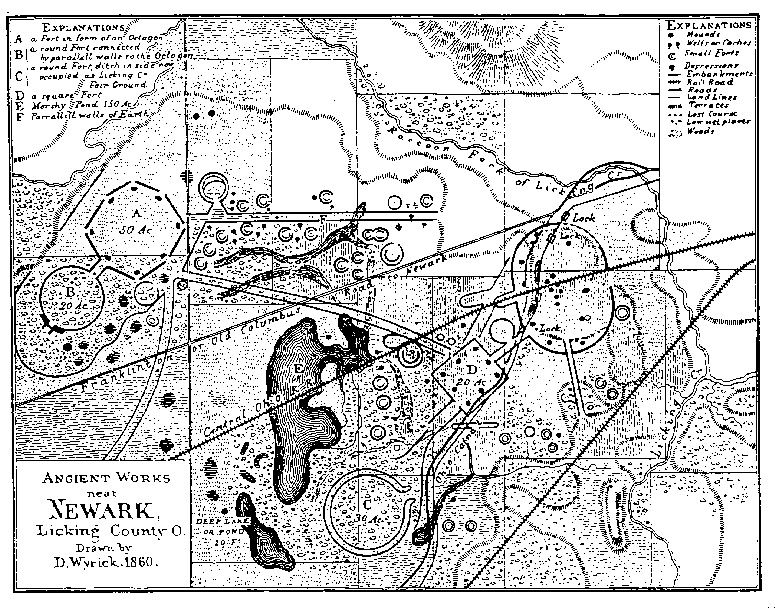
Simple enough, but cheating. That left the Jews to do the hard work & keeping track of the moon, which actually doesn't work well just by eyeball. As we here in the neighborhood of the renowned Newark Earthworks know full well, moonrises and phases are often obscured by clouds, or happen in the middle of the night, and accuracy requires more than just saying "wal, it looks 'bout full to me, don't it?"
 
So you need tables and charts to know, even in a week of overcast, what day your Passover happens. And as Christianity spread across the Mediterranean basin and into northern Europe, there wasn't always a synagogue nearby to keep tabs on. It was time to keep track for themselves.
 
Which they did, but with local variations on how they assembled the charts for tracking lunar months versus the western 12 month calendar. The first council of Nicea had this as a major agenda item (creeds came later as an "action item").
 
Out into the old Roman empire, in the far-flung outposts recently portrayed in the movie "The Eagle," the Celtic Christians had one calendar for calculating Passover, tied in part to old Druidic customs, and the more Roman oriented folk from Canterbury in England followed the Roman mode.
 
At the Synod of Whitby on the eastern coast of northern England, the two sides met, and the Venerable Bede records in his ecclesiastical history that Bishop Wilfrid  (both of them soon to be saints) carried the day, with King Oswy, brother of the late King Oswald of the Northumbrians, voting to side with Rome. On both the Easter lunar tables, and proper monastic haircuts (don't ask).
 
In a nutshell, the date of Easter for Western Christendom then and now works like this: the first Sunday, after the first full moon, after the vernal equinox. As the moon's cycles move versus the fairly stable date of the first day of Spring (Mar. 20 this year), the first Sunday after that next full moon can swing pretty dramatically.
 
So yes, Ash Wednesday last week and Easter next month are late this year. But it isn't too late to pick a spiritual discipline to focus on for these remaining 40-some days until Easter!
 
Jeff Gill is a writer, storyteller, and supply preacher around central Ohio; he enjoys these odd little historical asides far too much. Tell him your favorite historical quirk at knapsack77@gmail.com or follow Knapsack @Twitter.

Friday, March 04, 2011

Notes From My Knapsack 3-10-11

Notes From My Knapsack 3-10-11

Jeff Gill

Twelve Years Old in Granville – 1885

___

If Julia wouldn't loan her the umbrella, then Lucretia wasn't sure
she wanted to go.

Julia might be of an age to go walking along Broadway, with groups of
young women and men, to the Kicking Tree and back (all the way to
Granger, but not around the bend of Mount Parnassus), but she still
ought to share with a younger sister. Lucretia hoped that a whalebone
umbrella might be in the offing for her thirteenth birthday, but it
seemed as if Julia might not have gotten hers until she was nearly
sixteen.

Now Lucretia was following Mother and Father on this lovely fall
afternoon, from their house on Plum with little Osgood in tow, and
Julia staying at home with her snooty friends. It didn't look like
rain at all, but everyone knew that the new fire engine, powered by
steam, was putting on a display at Prospect and Broadway. They were
attempting to shoot a stream of water into the air, pumped from the
new pipes Mr. Bryant had laid out all over the village from a vast
wooden tank up on College Hill. The steam engine, on a handcart, was
supposed to put pressure on the water so that it would be a geyser,
like that place Lucretia had seen in the stereopticon in Mrs. Bolen's
parlor, a picture in three dimensions from somewhere out West, where
water shot from the earth every hour. Imagine!

"Let's keep moving, 'Crete," laughed Father, as she paused to look up
at the new Methodist church on the northeast corner of Main and
Broadway. She had marveled to hear Mr. Montgomery, the well-to-do
farmer out west of the village, tell Father about how every piece of
wainscoting, and the grand arcs of church pews in the sanctuary had
come from just two grand old cherry trees, four feet across, down
along the Raccoon. Now our main intersection in Granville had a
fourth tower for the four corners, just like a big city would have.

They scampered as Mother's and 'Crete's long skirts would let them,
tromping through the mud, and over the small bridge from the drainage
around back of the new "Centenary," as they were calling the
Methodist church now (what with the centennial of American Methodism
falling last year, when they finished the new building). The path
along the north side of Broadway was boarded along almost the whole
length of all the new storefronts, so they made better time as they
heard the murmur of the crowd, and the high, clear voice of Mr.
Bryant above all.

"Look out, look out now!"

The size of the crowd was substantial, filling the intersection and
most of Prospect Street on around the corner, looking back from the
porch of the Mansion House. 'Crete looked up at the three story bulk
of the Kussmaul block anchoring the corner, having kept her eye along
the rooftops, from the Methodist corner right along all the lovely
Italianate two story shops, gazing appreciatively at the variations
of brick patterns and brackets and cornices.

"Father . . ." she said faintly as she nudged him, still looking up.
Then suddenly a ribbon of water snaked down out of the sky, arcing
from behind the buildings, shimmering in the light, falling with a
rippling "splat."

Mother was soaked, and furious, while Osgood was wet and whimpering,
and Father's mustaches sagged with heavy droplets at each end, his
hat crushed over his eyebrows. You could hardly see his angry
expression. Lucretia was dry and untouched.

"I told you Julia should give us her umbrella!"

[Charles Webster Bryant, pharmacist & community leader, organized our
first civic water system, the historical societies for both Granville
& Ohio, and was holding the fire hose nozzle for the first test of
its steam engine. Its power & effectiveness surprised him…and a
number of village residents!]

Wednesday, March 02, 2011

Faith Works 3-05

Faith Works 3-05-11

Jeff Gill


Authority and the Auditory, the Heard and the Heeded

___


"And there were in the same country shepherds abiding in the field, keeping watch over their flock by night. And, lo, the angel of the Lord came upon them, and the glory of the Lord shone round about them: and they were sore afraid."
 
If your first thought on reading those words is "Linus!" I think we'd all understand.
 
From "A Charlie Brown Christmas," the words of Luke 2: 8-14 make up the pivot point of that seasonal favorite (beginning with the introit: "Lights, please.").
 
But the thing is, we HEAR them. In Linus' voice with childlike rhythms, perhaps with a British accent from the radio on Christmas Eve out of Cambridge, with the "Service of Lessons and Carols," and possibly with the resonance of a beloved family member and everyone gathered under the tree.
 
These words, and in this form, carry a weight and authority that goes beyond theology or Biblical literacy, and is essentially the power of what is "heard."
 
Or as Paul says in II Timothy, "Hold fast the form of sound words, which thou hast heard of me, in faith and love which is in Christ Jesus."
 
2011 is the 400th anniversary of the publication of what is known today as the King James Version, or sometimes the Authorized Version (KJV or AV in abbreviation). There are a number of events happening this year around the world, including just down the road this May in Columbus (see http://kingjamesbible.osu.edu).
 
There's obviously a historian's interest in pulling out an old translation of God's Word from the Hebrew and Greek originals, but is there any point for pewsitters and workaday pastors to delve back into the KJV? Just a bit?
 
I would argue, on too many grounds to sum up adequately in a newspaper column, "Yes." Emphatically yes. Not because, as a few still do affirm, the KJV is in some way itself uniquely inspired, or because newer translations are less faithful (although there are many arguments to be had about the relative merits and starting points of each of them).
 
Where I would agree with "KJV only" churches is this: the idea that the KJV is incomprehensible to modern ears is hogwash. Do you have to work a little? Yes.
 
The comparison is sometimes made to Shakespeare, a contemporary of the KJV – and that's a good one, although much of the basis for the translation was William Tyndale's masterful translation, done 80 years before the Bard of Avon! What is useful about that analogy is that a person who just doesn't find words leaping to life on the page, modern or antiquated, will attend a performance of Shakespeare, and say after "so, they must have rewritten most of that, right?"
 
Generally, no. The actor/reader has to do their homework and be aware of the wider context of their speech, but they can then deliver with proper inflection and intonation the words of 1611 in a way that sounds perfectly understandable in 2011.
 
We make much of the sayeths and springeths (and begots), and there are some words like flagon and garner you don't hear on TV these days. And yes, some phrases like "by and by" or "suffer the little children" have flipped in meaning. If you want to read the Old Testament prophets, the KJV team clearly put the A-Team on the poetry of the Psalms and the majesty of the Gospels.
 
Yet the KJV also gives us 'Am I my brother's keeper?'; 'Escaped with the skin of my teeth'; 'Saying peace, peace, where there is no peace'; 'They have sown the wind, and they shall reap the whirlwind'; 'The signs of the times'; 'Fell among thieves'; 'Scales fell from his eyes'; 'Full of good works'; 'A law unto themselves'; 'Wages of sin'; 'The powers that be'; 'All things to all men'; 'Filthy lucre'; 'Let brotherly love continue'; 'The patience of Job'; and of course 'Perfect love casteth out fear' in which I would fain not casteth out the casteth with the bathwater.
 
The Authorized Version was written to be heard, to be spoken with understanding. Reading is important, study has a place, but hearing is central to what the scriptures themselves teach about taking God's Word into your heart.
 
I hope to say a bit more about our old, neglected friend the KJV in this 400th anniversary year, and Tyndale himself, who gave us these words of translation that point, as all effective speech does, beyond themselves: "Behold, I stand at the door and knock."
 
Jeff Gill is a writer, storyteller, and supply preacher around central Ohio; he owns far too many Bibles in myriad translations, but there's always a KJV nearby. Tell him your favorite version at knapsack77@gmail.com or follow Knapsack @Twitter.

Monday, February 21, 2011

Faith Works 2-27

Faith Works 2-27-11

Jeff Gill


Communicating Some Bad News

___


Behold, I come bearing bad news.


At least for some.


In faith community internal relations, a common subject of concern is "communications," as in "we need more communications."


Unfortunately, this is not exactly what you might call a "transparent" statement. In other words, it doesn't mean something clear and direct.


Rarely do you actually find a situation in the church or congregation where the leaders or clergy are not communicating at all. Folks will say "we need more communication," and the response will be, usually quite accurately, "but we've published articles in the newsletter, put notes in the bulletin, announced from the pulpit!"


Here's the bad news. People learn about things best in the way they expect to learn about them.


Huh?


Yeah, I know. It sounds like a non sequitur. Let me try again.


People who usually learn about things from, say, a handout at a board meeting, or from their buddy in the parking lot, will sincerely and honestly not hear or see a word of what was in the newsletter or bulletin or service announcement. Likewise, someone who expects to see the entire week recapped in their bulletin won't likely know or care that you posted on the church website or at the Facebook page any new details about an upcoming event for the community.


There's a growing awareness we have that there are auditory learners, and visual learners, and it's not that the twain never meet, but they pay relatively little attention to each other. Then there's the whole question of what "visual learning" means in relation to text, to print, to . . . stuff like this column.


If you are a regular reader here, odds are you're less focused on worship service video productions to get your information, and if you prefer a live skit or digitally animated visual to drive home the reminder that the deadline for the next "Women of Faith" is coming up fast, you probably don't read long paragraphs of text unless it's to mine out of the vein a fact nugget you realized you needed (you're scanning for the price or the phone number, not "reading" the whole thing).


It's easy enough for me to insert here a rant about living in a "post-literate" culture, where people may well be able to read, but they just don't read except to extract data. I feel that frustration as a pastor and teacher often enough, but I go back before the internet and even before cable TV enough to be skeptical that this is entirely a new problem.


The UMC theologian Tex Sample was writing about this challenge for the church in the early 1980s, and today, the complication is that the profusion of tweets and status updates can fool people into thinking that reading is back in vogue.


Not exactly.


The kind of rapid scanning and skimming that was once the province of PhD candidates with twelve books to "read" by Monday is now a broadly applied skill set known to fourth graders, and reading for impression and nuance and narrative content – oh, my. You are verging on what it means to teach Biblical Hebrew or Koine Greek to your parishoners when you're trying to promote that sort of reading experience.


But that's not the bad news I had in mind. (Whaaaaaaa? There's worse?)


The reality is that, since "people learn about things best in the way they expect to learn about them," we are now leading and ministering, lay and ordained, in a world where we have to communicate in multiple modes. That's right, more work to do the same job. Ask any of your fellow worshipers who work at a fast-food drive-up window about this.


We still need a bulletin, albeit formatted a bit differently; we still need newsletters to some degree, for certain segments of our fellowships; we'd best keep the e-mail updates and blasts, even as e-mail is becoming for today what hand-written letters became twenty years ago; and yes, even a fairly small church should have a Facebook page and Twitter feed, and you should use it.


Once upon a time, kids, there was a world, very near our own, when you just announced before the service, and posted a scrap of parchment inscribed with a goose quill on the outside porch notice board, that the box social would be on Palm Sunday between services. Then you got on your horse and went out calling on families that were usually home.


Isn't that a lovely story, once upon a time?


Jeff Gill is a writer, storyteller, and supply preacher around central Ohio; yes, he's on Facebook and all that stuff. Email him at knapsack77@gmail.com or follow Knapsack @Twitter.

Knapsack 2-24

Notes From My Knapsack 2-24-11

Jeff Gill

Twelve Years Old in Granville – 1871

___

Bluebell knew that some thought her name was a bit odd, but it was
the only one she'd ever had, so it sounded right to her.

Her father was a doctor up past Mary Ann Furnace along Rocky Fork
Creek, down to Hanover and back, riding along the trails through open
valleys and into rocky gorges towards the Knox County line. Mother
died so long ago she could hardly remember her face, and recently
Father had sent her to board at the "Lower Sem," which is what people
hereabouts called the Granville Female College. That distinguished it
from the "Upper Sem," or the Young Ladies Institute, where Dr.
Shepardson led a fine institution, but Dr. Kerr was much beloved by
all of his students as a teacher and leader.

Bluebell would not quite be old enough for the Lower Sem ordinarily,
but she was old beyond her years, after becoming mother hen to so
many younger girls in the wilds of Rocky Fork – part of why her
father wanted to give her back a bit of her childhood in the best way
he knew how. She stayed in the boarding house across the street, next
to the old post-road inn on Broadway, looking out her window at night
to the four story building on the north side of the street, where so
many marvels of the wider world were brought before her.

On weekends, she went to the other side of town to stay with cousins
who had a lovely house and a spare room, but she rather enjoyed the
boarding house during the week. The older girls of thirteen and
fourteen and more looked out for her, taught her how to sew up small
rents in her skirts and other fine little skills she had never
mastered; in return, she told them about how best to tickle a fish
out of a hollow in the creekbank into your hands, and that an osage
orange would keep spiders out of the wardrobe they shared.

Today, a special treat for all the young ladies was the visit of Miss
Hartwell. Bluebell thought how marvelous it was that she was exactly
twice her own age, twenty-four years old, mature yet still so young.
Not yet married, but having graduated from this very school, she had
gone on to teach, in Granville as she had in Jersey Township, and now
in Danville, Illinois, but back to visit family in Hebron, Luray, and
here in Granville.

She was an honored guest of the Lower Sem not as a successful
teacher, though she was, but as a published author. Not just in the
Newark Advocate or North American, but in national publications like
Frank Leslie's Illustrated, "Golden Hours," "Hearth and Home," and
Lippincott's had shown an interest in her work. She had even been
paid for work, Miss Hartwell told them with a smile, before it was
completed!

As a schoolgirl, Bluebell could hardly imagine that.

During the reception after Miss Hartwell's address to the young
ladies, Bluebell had pressed forward to shake the author's hand,
hoping some of that success might, in a way, rub off onto her. She
found herself invited to a chair, where her story was gently drawn
out by the guest, asking for an account of how one so young came to
be there. It was clear that Miss Hartwell understood much of
Bluebell's story without even asking, but she asked about the oddest
details…and even drew out a small notebook, in which, with a pencil,
she noted a number of things as they spoke.

[Mary Hartwell Catherwood married in 1877, and published a book that
became a nationwide best-seller in 1882, titled "Rocky Fork," tracing
the mundane adventures of a young girl named Bluebell, from her
valley home to a town west of Newark named Sharon that is
unmistakably Granville.]

Wednesday, February 16, 2011

Faith Works 2-19

Faith Works 2-19-11

Jeff Gill


The Law of Unintended Consequences

___


In dealing with human persons, when you try to make them do a certain thing, even a good or better choice (maybe even especially then), they have a tendency to shoot off in an unexpected direction.


Under the umbrella of policy and politics, that phenomenon is known as "the law of unintended consequences." Trying to get people to do what you want them to do doesn't always work out the way you think.


One reason for this is that the decision makers and rule creators often are already doing the thing they want to see others do, and so assume that a small disincentive is all it takes to nudge people their way . . . since obviously, everyone would want to live the way they do, and those who don't are simply misinformed or wrongly influenced by some external factor.


What results isn't what's expected because human creatures are much more complicated than that. In faith circles generally and Christianity in particular, we call it sin, but we don't always try to empathize, to think from within the decisions and behaviors, often for fear that this will appear to be "giving in" to sin or excusing it. Call it "sympathy for the devil," as Mr. Jagger did, and church people tend to shy away.


But here's what happens when you don't try to share your good news, in a specific area, without trying to imagine what people are actually thinking from the inside. Not long ago, Ohio passed with great righteousness, a "DUI license plate" law which gives some folks yellow vehicle tags with red lettering  (nice touch, the scarlet letters). The idea was: if you see other people having to wear this mark of shame on the roads, others will then be less likely to drive drunk.


I've read conflicting studies on the outcome so far of that law, but the unintended consequence has been that, in certain circles, the plates have become a badge of honor. Some in law enforcement quietly worry that getting the yellow plates has become a goal for some.


Ditto the perfectly reasonable consequence for an assortment of offenses of withdrawing driver's licenses. It makes sense, and I really don't want to argue against it, but traffic cops tell me in some areas, when you pull over vehicles, as many as two out of three have some kind of issue with their license (none, canceled, suspended) or registration . . . or an outstanding warrant.


That's not two of three of all drivers on the road, but when around two-thirds of those you pull over are in that situation, you have to wonder in general. So how's that "suspended license" thing working out?


Which brings me to a pair of stories this week, unrelated in essence, but closely tied in how I read the law of unintended consequences applying. One was a suggestion that we "drug test" recipients of public assistance. Gosh, on one level, that sounds so reasonable. I can hear lots of good, upstanding citizens thinking, at home with their coffee on a Saturday morning, "Why not?"


The other is the move by a county school district to effectively ban sweets and sugary treats in the classroom. Food allergy issues were raised, but they're actually a very small element in the outline and impact of this plan. The point is to help kids make better choices about food, allow parents to control their kids' caloric and nutritional intake, and promote healthy eating.


One is proposed, the other about to be implemented, and both, I believe, assume that a nudge will cause most people to shift behaviors in a better direction. Both, I believe, are seriously misguided and are likely to cause . . . unintended consequences. I think both plans show a clear lack of consideration of why people make the choices they do, and how to motivate people to want to make better choices.


In faith community discussions, mission-minded activity should always start with trying to understand the population you're trying to reach, on their terms. Only then can you truly enter their world and offer clearly the message you feel called to carry.


Why do people struggling economically choose to spend precious resources on drugs (or alcohol, or cigarettes, both legal but costly choices)? Why do parents send sugary snacks to school for their children and their classmates? Hint on the latter: it's not for the sugar, it's usually the simplest and easiest and most popular choice. On the former: let's think about it, shall we? Before we nod approvingly at a policy option that could create more problems than it solves.


Jeff Gill is a writer, storyteller, and supply preacher around central Ohio; yes, he sent cupcakes to school for his son's birthday in years past - lock him up now. Tell him your nutritional sins at knapsack77@gmail.com or follow Knapsack @Twitter.

Thursday, February 10, 2011

Faith Works 2-12

Faith Works 2-12-11

Jeff Gill


We Live In a Haunted Landscape

___


We live in a haunted landscape, that much is certainly true.


Near where my family lives, I often hear the weeping of pioneer mother Lilly Jones, who will not live to see her three children, including a newborn, grow to adulthood as life fades from her body.


Just yards from where I work on weekdays, her second (of three) gravesites calls to my mind her four brothers and a cousin, standing not far from the rough-hewn square platted out for a courthouse in a county not yet formed.


And I feel the warmth of her smile quite regularly, as I pass her third and last burial location, gazing down on the passing cars near (where her father and mother are buried as well), marveling at the ease with which I slip into a grocery store filled with wonders from around the world.


It may just be me, but I can sense her presence.


There is that Courthouse Square, with watching faces of stone telling grimly serious jokes about our county's past, lips barely moving but the wit apparent to all who have ears to hear.


I can spot shadowy figures, known from old black and white photos, shading into the doorways of today with ethnic restaurants and modern businesses in full color, but their long dead hopes and dreams putting the chiaroscuro into the street scenes.


And yes, I've walked with others who marked a path from a century ago, a journey of terror and sorrow, and then got to gently trace the heartlines back to a birthplace, and a last resting place for one who died on a downtown Newark corner. Should his shade still be here, or there? He walked alongside of me in both places.


We live in a landscape haunted by names we know, and also by the works of a people whose name for themselves we cannot recover, whose individuality largely comes down over thousands of years to one object, found in the last century – today, the Wray figurine has a human face below the hood of bearskin which looks at me often, and whispers . . . something. He knows what the earthworks are for, and he's willing to tell.


I'm still trying to make it out, just what he's saying.


And of course there are steeples and buildings, churches still used for worship and some repurposed, in which pastors preached and deacons served and a living Word called across the ages. Some names we know – Father Lamy, Rev. McCarty, Dr. Fiers – many more we know not, but their imprint is far beyond cornerstones and congregational histories.


In the pews, faithful worshipers are hearing, in the words of the Christian New Testament, "a great cloud of witnesses," our parents and grandparents and great-grandparents, for some of us spiritually only, but no less our ancestors. There are hymns that, wherever I hear them sung, whomever I'm worshiping with, I can hear my grandmother's high clear soprano singing out over the top of the melody.


No, really – I hear her, quite distinctly, gone these thirty years and more.


Then we come to the table, the altar, the Lord's Supper, the communion, the Eucharist. "This do in remembrance of me," said someone who died, and yet lives. We see him not, then suddenly, "in the breaking of the bread," he is visible, present, alive.


We live in a haunted landscape, absolutely.


Ghosts?


I'll leave that subject to the marketing department. There's money to be made and thrills to be evoked on call, as scheduled, for individuals and tours by arrangement (bring your own equipment for recording or photography).


But that's not the kind of haunted I'm talking about, or the spirit that can truly bind a community together. There's a spirit of connection, of common purpose & history, of communication, that has nothing to do with digital temperature readouts or resistance meters -- but it's real and vital and necessary, and perhaps most importantly, it's the results that can be measured, not the experience itself.


It is, however, very real. Maybe even more real than . . . what we call reality.


Jeff Gill is a writer, storyteller, and supply preacher around central Ohio; tell him your local ghost story (careful, he's a skeptic, but you wouldn't know it) at knapsack77@gmail.com or follow Knapsack @Twitter.

Sunday, February 06, 2011

Knapsack 2-10-11

Twelve Years Old in Granville -- Granville Sentinel 2-10-11

Jeff Gill

[This is eighth in a series of twelve stories based on historic fact,
or known small details, about life in this area from the point of
view of a twelve year old.]

Some 2000 Years Ago

She had watched as closely as she could, but it was still a puzzle.

Her mother had set up the loom under the tree where the well-worn
branch showed, in two polished patches of bark, that they were not
the first of their people to set up their weaving here.

They had spent the last few weeks with the fibers, dried after their
removal from the proper plants which were themselves pulled out of
the marshy ground. In large circles, sitting cross-legged on the
hard packed clay surrounding the fire hearths, they had hand rolled
the fibers of thistle and milkweed stems into longer cordage.

The smaller, younger girls had rolled pieces together between their
palms like a daub of riverbank clay turned into a worm, but now
compressing and straining until the tubes became strands – then they
passed those bits on to the older women, who with nary a smile would
roll them between their work hardened hands and along their thighs,
and in no time see those strands become strings.

When the strings were spun into long fiber (by some amazing work done
by women with longer fingernails, dangling spindle weights, and
skills the younger girls despaired of ever matching), it was then
passed around the circle to the beginning again, where the littlest
young women rolled it up onto clay cylinders until a fat ball of
cordage was the result.

Some of that cordage had been woven into a multi-strand rope that
made up the sides of the loom that now hung down from the tree
branch, and other stretches of it had been taken to the fire camp,
where larger pots sat ready with water and nut shells or berries. The
girls of her age had been sent down yesterday to the creekbed, where
they gathered up fist-sized rocks that were hard and dense, not the
stone which easily scraped down into sand, and those stones were now
in the big fire.

Older women with longer arms (and some of whom already had scorched
eyebrows) took pairs of green sticks with small forks on the end, and
lifted the rocks to where they could gently place them in the pots.
After a short time of cooking the dyes with the water, the rolls of
fiber would be placed into them, coming out sometimes with colors you
couldn't always predict. She had just learned yesterday that it was
bright yellow-green hickory nut coats that made the best black dye.

Now the challenge was to master the rhythm of the snake stick,
flashing it back and forth between the vertical strands, tapping down
with the lightning stick to firm up the horizontals from above.

Her mother was making a beautiful pattern, one that echoed the story
of their clan, colors contrasting and marching back and forth among
the more stolid background, like the tale of the people across the
face of the earth, like the weaving of the sun and moon across the
sky and through the year.

She was just working with a solid color, trying to make a sturdy
piece of rough cloth that could cover a baby (maybe even hers in a
few years, absurd though that might seem), or just a panel for a
shirt or pair of trousers.

It looked so easy as her mother worked, and she kept saying "It was
hard for me at first, dear" as she worked her weaving up from her lap
into the air above her head.

The weave was loose, and the ends of sections of fiber hung at odd
intervals, but slowly, row by row, the small loom filled out in the
shadow of the larger one. She would get better.

[There is little fiber found in the ground from the period of Native
American life in Ohio called "Hopewell," but from impressions left in
clay surfaces, and a precious few scraps preserved by contact with
copper, we know their weaving technology was quite skilled, to the
extent of making fine fabrics.]